Bottom
line: Christ spoke Aramaic and nicknamed Simon "Kepha," ("Cephas")
which means "Rock." Most of the New Testament was written in Greek (or
translated into Greek, as is possible in the case of Matthew's Book),
and Kepha was translated as "Petros" or "Petra" (depending on stylistic
needs of the context), which both mean "Rock." In our English Bibles,
"Petros" and "Petra" get translated into "Peter." 1 Peter IS "the Rock," the
earthly head of
Christ's Church as Christ Himself states in Matthew 16. This would be
as if you and I, speaking English and discussing someone named Mary,
were quoted by an Italian who wrote her name as "Maria," which a
Frenchman translated as "Marie".
Many Protestants try to get around Matthew 16:15-19 by pointing to 1
Corinthians 10:3-5 "And did all drink the same spiritual drink: for
they drank of that spiritual Rock that followed them: and that Rock was
Christ." But this is something no Catholic would disagree with! Yes,
the SPIRITUAL Rock, Christ, the High Priest and Head of the Church,
authorized Peter to be the earthly Rock, His Vicar, of the Church --
the father of the New Covenant, just as God the Father made Abraham the
earthly father of the Old Covenant (Isaiah 51:1-2) while remaining the
ultimate, SPIRITUAL Father of that Covenant.
Some try to get around these verses in other imaginative ways, saying
that Christ was talking only about Himself or only about Peter's
faith, as below:
|
Matthew
16:15-19
|
Translations
|
|
He saith unto
them, But whom say ye that I am? And Simon Peter answered and said,
Thou art the Christ, the Son of the living God.
|
Simon makes a
profession of faith
|
|
And Jesus
answered and said unto him, Blessed art thou, Simon bar-Jona: for flesh
and blood hath not revealed it unto thee, but my Father which is in
heaven.
|
Jesus calls
Simon blessed and Simon "bar-Jonah," which means "son of the Dove" (the
Holy Spirit)
|
|
And I say also
unto thee,
|
Jesus is
talking to Simon
|
|
That thou
art Peter (kepha, translated into Koine Greek as "petros" meaning
"rock" and into English as "Peter"),
|
He is still
talking to Simon and now renames him "Kepha," or "Rock." He said "thou
art Rock," not "I am Rock" or "your faith is rock"
|
|
and upon this
rock I will build my church; and the gates of Hell shall not
prevail against it.
|
According to
some Protestants, after just calling Simon blessed and renaming
him "Rock," Jesus is suddenly talking about another "rock" (Peter's
faith, or Jesus Himself)
|
|
And I will give
unto thee the keys of the kingdom of heaven: and whatsoever thou
shalt bind on earth shall be bound in heaven: and whatsoever thou
shalt loose on earth shall be loosed in heaven.
|
Now they say He
just as suddenly is talking to/about Peter again -- as He gives him the
keys to Heaven!
|
But
reading the verse honestly, especially in context and without
anti-Roman prejudice, shows the above sort of rendering to be -- well,
quite absurd. It's almost as though they would have it read, "Simon,
you are blessed! Know what I'm going to do, you old son of the Holy
Spirit you? I'm going to call you Kepha, which means "rock," which the
Koine Greek translators of what I am saying will write as "petros,"
which 1,500 years from now people called "Protestants" will insist
means "little pebble." The Protestants will have it right: calling you
a little pebble is what I indeed mean 'cause that's all you are -- a
tiny, insignificant stone. Kind of Me to point that out after your
profession of faith, eh? And, hey, forget about My having just called
you blessed and how an insult simply doesn't fit the context of what
I've been saying. It's the schizophrenia acting up again. Speaking of
which, and by the way, while you're here, take the keys to Heaven,
please; I don't really mean anything by this gesture at all, I just
thought it'd be a nice thing to do." Silliness!
Now
obviously Christ re-named Simon "Peter" in response to Simon's
confession of faith in Christ the Rock, the Foundation Stone,
so the Protestant assertion that "the rock" was "Peter's faith" has
some merit in a circuitous way (and you will read early Church Fathers
speaking of the rock of Peter's confession), and of course, Cephas the
rock derives his authority from and must never contradict the spiritual
Rock Who
is Christ (I Corinthians 10:4); but in addition to the exegesis above,
it simply can't be
ignored that Peter was re-named Kepha (Rock!) and exercised authority
among the apostles: he was always named first when the apostles were
listed (Matthew 10:1-4, Mark 3:16-19, Luke 6:14-16, Acts 1:13) --
sometimes it was only "Peter and those who were with him" (Luke 9:32);
he was the apostles' spokesman (Matthew 18:21, Mark 8:29, Luke 12:41,
John 6:69, Acts 4:1-13, Acts 2:37-41, Acts 5:15); he exhorted the other
bishops (1 Peter 5:1); he was there at the most important moments
(Matthew 14:28-32, Matthew 17:24, Mark 10:28); he was the first to
proclaim Christ's divinity (Matthew 16:16); he was the first to preach
the Gospel after Pentecost (Acts 2:14-40), thus starting the whole
"Church era"; he worked the first healing in the Church age (Acts
3:6-7); he had the revelation that Gentiles were to be baptized and
accepted as Christians (Acts 10:46-48); he alone was told by Christ
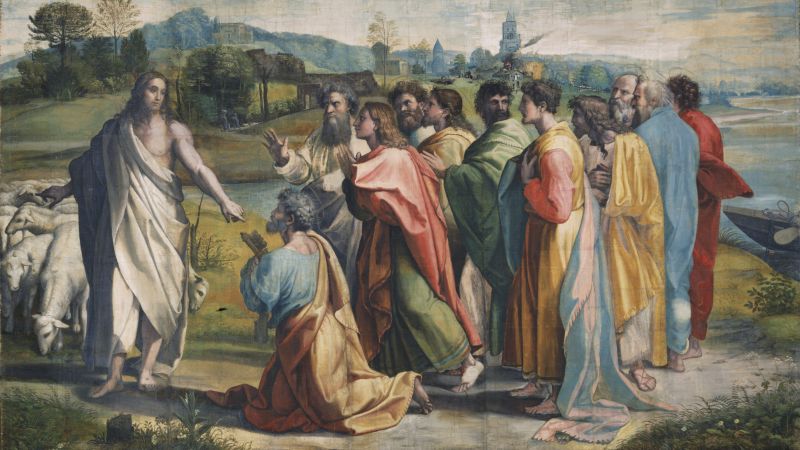
after His resurrection to "Feed My lambs; feed My sheep" (John
21:15-17) and strengthen his brethren (Luke 22:31-32).
But where is the word "pope" in the Bible? Well, where is the word
"father,"because that's what "Pope" means ("pope" means "papa") . But
you won't find the English word "pope" there any more than you'd find
the word "Trinity." The reality, though, is there, in Peter, from the
very beginning. The ecclesiastical offices of Bishops (episkopos),
elders (presbyteros, from which is derived the word "priest"), and
deacons (diakonos) were already in place in the New Testament (Acts
20:28, Philippians 1:1, Acts 1:20, 20:28, Philippians 1:1, 1 Timothy
3:1-2, Titus 1:7, 1 Peter 2:25, Acts 15:2-6, 21:18, Hebrews 11:2, 1
Peter 5:1, 1 Timothy 5:17). The Pope, as Bishop of Rome, is simply the
successor of Peter, who was the first Bishop of Rome and head of the
earthly Church.
Eusebius of Caesaria (A.D. 265-340) tells us in his "Church
History"
who succeeded him:
Ch. 2
"After the martyrdom of Paul and of Peter, Linus was the first to
obtain the episcopate of the church at Rome. Paul mentions him, when
writing to Timothy from Rome, in the salutation at the end of the
epistle".
Ch. 13
"After [Emperor] Vespasian had reigned ten years Titus, his son,
succeeded him. In the second year of his reign, Linus, who had been
bishop of the church of Rome for twelve years [Note: it was actually 9
years], delivered his office to Anencletus. But Titus was succeeded by
his brother Domitian after he had reigned two years and the same number
of months."
Ch. 15
"In the twelfth year of the same reign Clement succeeded Anencletus
after the latter had been bishop of the church of Rome for twelve
years. The apostle in his Epistle to the Philippians informs us that
this Clement was his fellow-worker. His words are as follows: 'With
Clement and the rest of my fellow-laborers whose names are in the book
of life.'"
And
so forth (read what that 4th Pope, Clement, wrote about apostolic succession here). Does
your faith community have a lineage like the one below?
St. Peter (32-67)
St. Linus (67-76)
St. Anacletus (76-88)
St. Clement I (88-97)
St. Evaristus (97-105)
St. Alexander I (105-115)
St. Sixtus I (115-125)
St. Telesphorus (125-136)
St. Hyginus (136-140)
St. Pius I (140-155)
St. Anicetus (155-166)
St. Soter (166-175)
St. Eleutherius (175-189)
St. Victor I (189-199)
St. Zephyrinus (199-217)
St. Callistus I (217-22)
St. Urban I (222-30)
St. Pontain (230-35)
St. Anterus (235-36)
St. Fabian (236-50)
St. Cornelius (251-53)
St. Lucius I (253-54)
St. Stephen I (254-257)
St. Sixtus II (257-258)
St. Dionysius (260-268)
St. Felix I (269-274)
St. Eutychian (275-283)
St. Caius (283-296)
St. Marcellinus (296-304)
St. Marcellus I (308-309)
St. Eusebius (309 or 310)
St. Miltiades (311-14)
St. Sylvester I (314-35)
St. Marcus (336)
St. Julius I (337-52)
Liberius (352-66)
St. Damasus I (366-83)
St. Siricius (384-99)
St. Anastasius I (399-401)
St. Innocent I (401-17)
St. Zosimus (417-18)
St. Boniface I (418-22)
St. Celestine I (422-32)
St. Sixtus III (432-40)
St. Leo I (the Great) (440-61)
St. Hilarius (461-68)
St. Simplicius (468-83)
St. Felix III (II) (483-92)
St. Gelasius I (492-96)
Anastasius II (496-98)
St. Symmachus (498-514)
St. Hormisdas (514-23)
St. John I (523-26)
St. Felix IV (III) (526-30)
Boniface II (530-32)
John II (533-35)
St. Agapetus I (535-36)
St. Silverius (536-37)
Vigilius (537-55)
Pelagius I (556-61)
John III (561-74)
Benedict I (575-79)
Pelagius II (579-90)
St. Gregory I (590-604)
Sabinian (604-606)
Boniface III (607)
St. Boniface IV (608-15)
St. Deusdedit (615-18)
Boniface V (619-25)
Honorius I (625-38)
Severinus (640)
John IV (640-42)
Theodore I (642-49)
St. Martin I (649-55)
St. Eugene I (655-57)
St. Vitalian (657-72)
Adeodatus (II) (672-76)
Donus (676-78)
St. Agatho (678-81)
St. Leo II (682-83)
St. Benedict II (684-85)
John V (685-86)
Conon (686-87)
St. Sergius I (687-701)
John VI (701-05)
John VII (705-07)
Sisinnius (708)
Constantine (708-15)
St. Gregory II (715-31) |
St. Gregory III (731-41)
St. Zachary (741-52)
Stephen II (752) 3
Stephen III (752-57)
St. Paul I (757-67)
Stephen IV (767-72)
Adrian I (772-95)
St. Leo III (795-816)
Stephen V (816-17)
St. Paschal I (817-24)
Eugene II (824-27)
Valentine (827)
Gregory IV (827-44)
Sergius II (844-47)
St. Leo IV (847-55)
Benedict III (855-58)
St. Nicholas I (858-67)
Adrian II (867-72)
John VIII (872-82)
Marinus I (882-84)
St. Adrian III (884-85)
Stephen VI (885-91)
Formosus (891-96)
Boniface VI (896)
Stephen VII (896-97)
Romanus (897)
Theodore II (897)
John IX (898-900)
Benedict IV (900-03)
Leo V (903)
Sergius
III (904-11)
Anastasius III (911-13)
Lando (913-14)
John X (914-28)
Leo VI (928)
Stephen VIII (929-31)
John XI (931-35)
Leo VII (936-39)
Stephen IX (939-42)
Marinus II (942-46)
Agapetus II (946-55)
John XII (955-63)
Leo VIII (963-64)
Benedict V (964)
John
XIII (965-72)
Benedict VI (973-74)
Benedict VII (974-83)
John XIV (983-84)
John XV (985-96)
Gregory V (996-99)
Sylvester II (999-1003)
John XVII (1003)
John XVIII (1003-09)
Sergius IV (1009-12)
Benedict VIII (1012-24)
John XIX (1024-32)
Benedict IX (1032-45)
Sylvester III (1045)
Benedict IX (1045)
Gregory VI (1045-46)
Clement II (1046-47)
Benedict IX (1047-48)
Damasus II (1048)
St. Leo IX (1049-54)
Victor II (1055-57)
Stephen X (1057-58)
Nicholas II (1058-61)
Alexander II (1061-73)
St. Gregory VII (1073-85)
Blessed Victor III (1086-87)
Blessed Urban II (1088-99)
Paschal II (1099-1118)
Gelasius II (1118-19)
Callistus II (1119-24)
Honorius II (1124-30)
Innocent II (1130-43)
Celestine II (1143-44)
Lucius II (1144-45)
Bl. Eugene III (1145-53)
Anastasius IV (1153-54)
Adrian IV (1154-59)
Alexander III (1159-81)
Lucius III (1181-85)
Urban III (1185-87)
Gregory VIII (1187)
Clement III (1187-91)
Celestine III (1191-98)
Innocent III (1198-1216)
Honorius III (1216-27) |
Gregory IX (1227-41)
Celestine
IV (1241)
Innocent
IV (1243-54)
Alexander IV (1254-61)
Urban IV (1261-64)
Clement IV (1265-68)
Blessed Gregory X (1271-76)
Blessed Innocent V (1276)
Adrian V (1276)
John XXI (1276-77)
Nicholas III (1277-80)
Martin IV (1281-85)
Honorius IV (1285-87)
Nicholas IV (1288-92)
St. Celestine V (1294)
Boniface VIII (1294-1303)
Bl. Benedict XI (1303-04)
Clement V (1305-14)
John XXII (1316-34)
Benedict XII (1334-42)
Clement VI (1342-52)
Innocent VI (1352-62)
Blessed Urban V (1362-70)
Gregory XI (1370-78)
Urban VI (1378-89)
Boniface IX (1389-1404)
Innocent VII (1406-06)
Gregory XII (1406-15)
Martin V (1417-31)
Eugene IV (1431-47)
Nicholas V (1447-55)
Callistus III (1455-58)
Pius
II (1458-64)
Paul II (1464-71)
Sixtus IV (1471-84)
Innocent VIII (1484-92)
Alexander VI (1492-1503)
Pius III (1503)
Julius II (1503-13)
Leo X (1513-21)
Adrian VI (1522-23)
Clement VII (1523-34)
Paul III (1534-49)
Julius III (1550-55)
Marcellus II (1555)
Paul IV (1555-59)
Pius IV (1559-65)
St. Pius V (1566-72)
Gregory XIII (1572-85)
Sixtus V (1585-90)
Urban VII (1590)
Gregory XIV (1590-91)
Innocent IX (1591)
Clement VIII (1592-1605)
Leo XI (1605)
Paul V (1605-21)
Gregory XV (1621-23)
Urban VIII (1623-44)
Innocent X (1644-55)
Alexander VII (1655-67)
Clement IX (1667-69)
Clement X (1670-76)
Bl. Innocent XI (1676-89)
Alexander VIII (1689-91)
Innocent XII (1691-1700)
Clement XI (1700-21)
Innocent XIII (1721-24)
Benedict XIII (1724-30)
Clement XII (1730-40)
Benedict XIV (1740-58)
Clement XIII (1758-69)
Clement XIV (1769-74)
Pius VI (1775-99)
Pius VII (1800-23)
Leo XII (1823-29)
Pius VIII (1829-30)
Gregory XVI (1831-46)
Blessed Pius IX (1846-78)
Leo XIII (1878-1903)
St. Pius X (1903-14)
Benedict XV (1914-22)
Pius XI (1922-39)
Pius XII (1939-58)
Blessed John XXIII (1958-63)
Paul VI (1963-78)
John Paul I (1978)
John Paul II (1978—2005)
Benedict XVI (2005-2013)
Francis (2013 - 2025)
Leo XIV (2025- )
|
St.
Peter was martyred in Rome in A.D. 67 by crucifixion, asking to be
crucified upside-down 2
because
he felt unworthy to be crucified in the same way as our Lord. His body
was buried on Vatican Hill where he was martyred, at the present site
of St. Peter's
Basilica. His tomb is there, marked by 2nd century graffitti, his bones
having been wrapped in purple cloth held together by gold thread. The
main graffito reads in Greek: "PETER IS HERE." You can read about his
(and Paul's) martyrdom in Rome in Book II,
Chapter 25 of "Church History" written
by the above-mentioned Eusebius of Caesaria and in "The Tomb of St. Peter" by
Margherita Guarducci (pdf).
The
evidence of post-New Testament Church history is just as convincing.
Read what the early Eastern Church
fathers wrote about Peter and his successors.
Update: August 19, 2022: From the article "Archaeologists at the Sea of
Galilee Say They May Have Found the Real-Life Birthplace of St. Peter,
First Pope of the Christian Church: Scholars have discovered an
inscription that may mark the Church of the Apostles, said to be at St.
Peter's birthplace in Bethsaida":
Archaeologists
in Israel have discovered an ancient inscription dedicating a church to
St. Peter—and there’s evidence that the place of worship may have been
built on the site of the apostle’s birthplace.
Peter
and two other apostles, Sts. Andrew and Philip, were born in Bethsaida,
according to the Gospel of John. Archaeologists and Biblical scholars
have long sought to find the ancient village, narrowing it down to
three potential sites.
The
El-Araj Expedition, led by the Kinneret Institute for Galilean
Archeology and New York’s Nyack College, has been conducting
excavations at one of the sites, on the northern shore of the Sea of
Galilee, since 2016. It’s found evidence of first-century Roman
occupation of El-Araj, such as a bathhouse.
The
latest discovery at the dig is a floral pattern mosaic at a church
first found in 2019. It bears an inscription calling for the
intercession of the “chief and commander of the heavenly apostles”—aka
Peter.4
A single first century find that demonstrates the rightness of acceptng
the Communion of Saints and that Peter was the first Pope.
Think about it.
And, finally, don't pretend that John 14:6 -- " Jesus saith unto him, I
am the way, the truth, and the life: no man cometh unto the Father, but
by me." -- somehow means that the Church doesn't need a Pope. No matter
what faith community you belong to, you have a leader. Your local
community has a leader, a pastor, a main preacher-man, etc. And if it's
a part of a larger faith community, it likely has a President, a
presiding "Bishop," a King, or someone else who heads things up, makes
final decisions, and leads. And of course you would, because it only makes sense. And it makes
sense that Christ would also ordain someone to lead His Church, and
that is what He did with Peter and those who succeed him.
Footnotes
1 One Protestant argument revolves around
the
idea that there are two words for "Rock" in the Greek language: petra
and petros, and that the former refers to a big
boulder while the latter refers to a small pebble. They claim that
because the Greek rendering of Matthew's Gospel uses the word "petros,"
that Jesus was playing down Peter's significance. Petros and petra
meant exactly the same thing at the time Matthew was translated into or
written in Greek, as Greek literature attests (lithos is the
word for "little stone"). Petros was chosen because it's a
masculine noun and Peter was a man. If you had High School French,
here's an analogy for you: even if petros and petra
had different meanings in the Koine Greek spoken at the time of Christ
(which isn't so), the use of the masculine form, petros, by the
Greek translator of Matthew would have made sense anyway. Say you were
wanting to refer to a man metaphorically as "a portal" and were wanting
to give him a nickname that reflected that. In French, you could call
him "la porte," a feminine noun meaning door, or "le portail,"
a masculine noun meaning gate. It'd make sense to use the masculine
noun even though "gate" is a smaller thing than "door." At any rate,
"big rock" or "little rock," rock is rock and Christ said THOU art
"Rock" -- and Jesus was not speaking Greek, but Aramaic and used the
word "Kepha"; this is why Simon Peter is most often called "Cephas."
That
Peter was originally named Kepha is clear when we see that that is
the name used to refer to him in Corinthians and Galatians (see, for
example, I Corinthians 1:11-13, 1 Corinthians 3:21-23, 1 Corinthians
9:4-6, 1 Corinthians 15:4-6, Galatians 2:8-10, depending on Bible
versions. Go to the Bible
Gateway and search for "Cephas").
2
The inverted Latin Cross is known as "St. Peter's Cross." Sadly, some
Satanists have co-opted it for their demonic rituals, have stolen it
for their twisted use in the same way that the rainbow -- a sign of
God's promise to Noah -- was stolen by the "gay pride" movement. Also
sad is that some ignorant Protestants see the Pope standing in front of
a Peter's Cross and then accuse the Holy Father of Satanism.
3
Because Stephen II was elected but never consecrated (he died 3 days
after his election), he is often not counted in official lists of
Popes. The Vatican's official list does not include him, listing the
names of 265 Pontiffs
4 Source:
https://news.artnet.com/art-world/archaeologists-discovered-birthplace-st-peter-2159490
Retrieved August 19, 2022
Relevant Scripture
Isaiah
22:20-25
And it shall come to pass in that day, that I will call my servant
Eliakim the son of Hilkiah: And I will clothe him with thy robe, and
strengthen him with thy girdle, and I will commit thy government into
his hand: and he shall be a father to the inhabitants of Jerusalem, and
to the house of Judah. And the KEY OF THE HOUSE OF DAVID will I lay
upon his shoulder; so he shall open, and none shall shut; and he shall
shut, and none shall open. And I will fasten him as a nail in a sure
place; and he shall be for a glorious throne to his father's house. And
they shall hang upon him all the glory of his father's house, the
offspring and the issue, all vessels of small quantity, from the
vessels of cups, even to all the vessels of flagons. In that day, saith
the LORD of hosts, shall the nail that is fastened in the sure place be
removed, and be cut down, and fall; and the burden that was upon it
shall be cut off: for the LORD hath spoken it. [Note: Eliacim was the
steward of the House of David, a "type" -- a foreshadowing -- of
Christ's Kingdom. Eliacim, therefore, is a foreshadowing of Christ's
steward -- and to this steward was given the Keys. In Matthew 16, Jesus
gave those Keys to Peter.]
Isaiah 51:1-2
Listen to Me, you who follow after righteousness, You who seek the
LORD: Look to THE ROCK [Abraham] from which you were hewn, And to the
hole of the pit from which you were dug. Look to Abraham your father,
And to Sarah who bore you; For I called him alone, And blessed him and
increased him.
Matthew 16:18-19
He saith unto them, But whom say ye that I am? And Simon Peter answered
and said, Thou art the Christ, the Son of the living God. And Jesus
answered and said unto him, Blessed art thou, Simon Bar-Jona: for flesh
and blood hath not revealed it unto thee, but my Father which is in
heaven. And I say also unto thee, That THOU art Peter, and upon this
ROCK [Kepha, Cephas] I will build my church; and the gates of Hell
shall not prevail against it. And I will give unto THEE the KEYS OF THE
KINDGOM of heaven: and whatsoever THOU shalt bind on earth shall be
bound in heaven: and whatsoever THOU shalt loose on earth shall be
loosed in heaven.
John 1:42
And he brought him to Jesus. And when Jesus beheld him, he said, Thou
art Simon the son of Jona: THOU shalt be called Cephas...
John 21:15-19
So when they had eaten breakfast, Jesus said to Simon Peter, "Simon,
son of Jonah, do you love Me more than these?" He said to Him, "Yes,
Lord; You know that I love You." He said to him, "Feed My lambs." He
said to him again a second time, "Simon, son of Jonah, do you love Me?"
He said to Him, "Yes, Lord; You know that I love You." He said to him,
"Tend My sheep." He said to him the third time, "Simon, son of Jonah,
do you love Me?" Peter was grieved because He said to him the third
time, "Do you love Me?" And he said to Him, "Lord, You know all things;
You know that I love You." Jesus said to him, "Feed My sheep. Most
assuredly, I say to you, when you were younger, you girded yourself and
walked where you wished; but when you are old, you will stretch out
your hands, and another will gird you and carry you where you do not
wish." This He spoke, signifying by what death he would glorify God.
And when He had spoken this, He said to him, "Follow Me."
Further Reading
 Books on this topic Books on this topic
|