``Where
the Bishop is, there let the multitude of believers be;
even as where Jesus is, there is the Catholic Church'' Ignatius of
Antioch, 1st c. A.D
Feast of St. Ignatius of Loyola
On October 23,
1491 -- almost a year to the day before Columbus "sailed the
ocean blue" -- a boy named Iñigo López de Loyola was born the youngest
of 13 children to parents of minor nobility in
the castle of Loyola,1 in the Basque part of Spain. He
was a romantic from the beginning, losing himself in stories of
chivalry, and dreaming of little else but military glory. When he
became a man, he devoted himself to the military arts, acquiring fame,
gambling, getting the attention of women, dancing, and dressing well.
In other words, he was a masculine-minded, very wordly peacock.
To achieve his goals, he first became a page, and then, at the age of
17, joined the army. When the people of nearby Pamplona2
called on the
French to help them fight off the Spaniards,
he thought he had his chance at military honors. Most
everyone
else in his company
wanted to give up against the French, but he urged his commander to
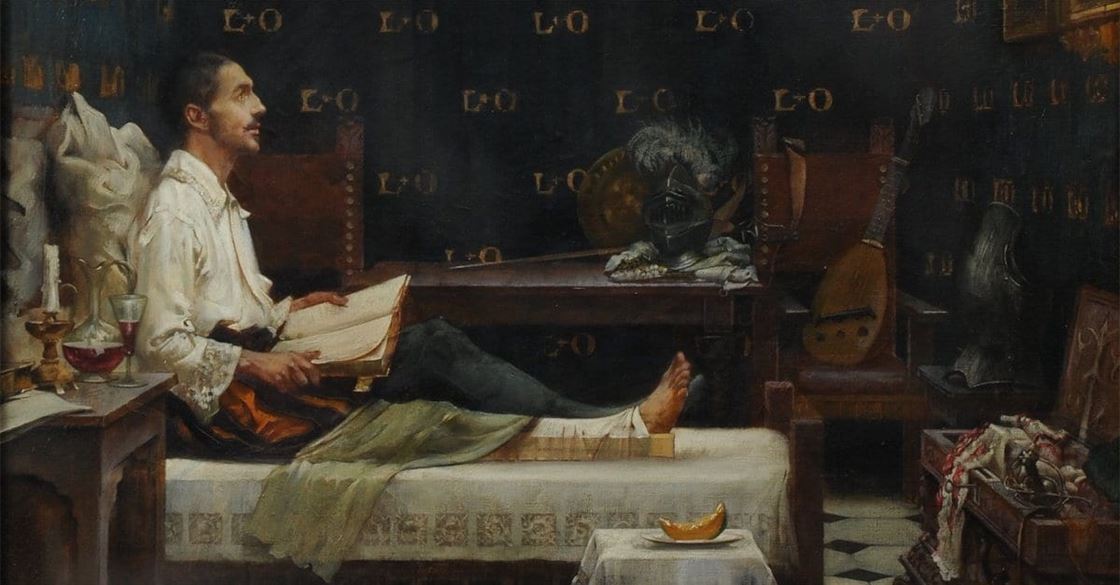
keep up the fight. So on they pressed -- until a cannonball shattered
one of his legs and injured the other. Though he'd fallen and the
battle was lost, the French
were impressed by him, and treated his wounds for a few weeks, after
which he was carried on a litter to Loyola. Doctors back home
saw that his leg hadn't been set properly and had to be re-broken and
re-set. This was done, but his health was failing and he was expected
to die. He rallied, though, and, peacock that he was, even asked the
doctors to perform
further surgery to prevent his leg from looking deformed. This was
done, but he had a long process of mending to go through. Stuck in bed,
he asked for books to be brought to him -- epic romances, of course.
But instead of tales of chivalry, he was brought a book called "Flowers
of the Saints," and De Vita Christi by
Ludolph of
Saxony. The latter book would have a profound effect on Inigo,
affecting the later creation of his great work, his "Spiritual
Exercises."
But it took a bit of time. He'd lie there in bed, indulging in his
favorite romantic fantasies -- then engage in spiritual reading. His
mind would go back and forth between the wordly and the eternal. From
his autobiography (written in the third person):
He pictured to
himself what he should do in honor of an illustrious lady, how he
should journey to the city where she was, in what words he would
address her, and what bright and pleasant sayings he would make use of,
what manner of warlike exploits he should perform to please her. He was
so carried away by this thought that he did not even perceive how far
beyond his power it was to do what he proposed, for she was a lady
exceedingly illustrious and of the highest nobility.
In the meantime, the divine mercy was at work substituting
for these thoughts others suggested by his recent readings. While
perusing the life of Our Lord and the saints, he began to reflect,
saying to himself: "What if I should do what St. Francis did?" "What if
I should act like St. Dominic?" He pondered over these things in his
mind and kept continually proposing to himself serious and difficult
things. He seemed to feel a certain readiness for doing them, with no
other reason except this thought: "St. Dominic did this; I, too, will
do it." "St. Francis did this; therefore, I will do it." These heroic
resolutions remained for a time and then other vain and worldly
thoughts followed. This succession of thoughts occupied him for a long
while, those about God alternating with those about the world. But in
these thoughts there was a difference. When he thought of worldly
things it gave him great pleasure, but afterward he found himself dry
and sad. But when he thought of journeying to Jerusalem, and of living
only on herbs, and practicing austerities, he found pleasure not only
while thinking of them, but also when he had ceased.
The difference he did not notice or value until one day the
eyes of his soul were opened and he began to inquire the reason of the
difference. He learned by experience that one train of thought left him
sad, the other joyful. This was his first reasoning on spiritual
matters. Afterward, when he began the Spiritual Exercises, he was
enlightened, and understood what he afterward taught his children about
the discernment of spirits. When gradually he recognized the different
spirits by which he was moved, one, the spirit of God, the other, the
devil, and when he had gained no little spiritual light from the
reading of pious books, he began to think more seriously of his past
life, and how much penance he should do to expiate his sins.
He resolved to make a pilgrimage to Jerusalem, and began to mortify his
flesh by fasting and scourging. He had a vision of the Blessed Virgin
holding her Infant, and it caused such a sense of repentance in him
that the changes to his personality
were evident to all.
Once he was healed and able to walk -- albeit with a limp, which he had
for the rest of his life -- he
collected some money that was owed to him and started
preparations for his Jerusalem pilgrimage, making his way first to
Montserrat, near Catalonia, but
stopping first to buy some sackcloth to make a garment from. He'd
resolved to do what knights always did on the evenings before they were
knighted: spend that entire night kneeling in vigil at church. He
reached the Benedictine church of Our Lady of Montserrat, placed his
military gear before the Black Madonna there, gave his fine clothes
away to a beggar, and then knelt before the altar until the next
morning. It was the eve of Lady Day.
On Lady Day itself, he left for nearby Manresa. Here he spent about a
year, living at various times in a hospital, a Dominican monastery, and
a cave, where he came up with the rough beginnings of what would become
his "Spiritual Exercises." He made friends of a number of people known
for their piety,
including an old holy woman, and this period of his life was mostly
marked by intense prayer -- many long hours at a time -- and spiritual
"fine-tuning." For ex., he acquired a case of scruples, which he dealt
with in all the wrong ways. He'd confess, but still be tormented by his
sins. To be rid of this problem, he took to fasting -- for so long that
his confessor made him stop. The scruples would wane -- then come
back with a vengeance. When he became so troubled that he thought of
giving up, God finally granted him the grace of realizing that these
scruples were from the Evil One. This episode helped him to learn more
about discerning spirits.
In Manresa, too, he was also granted mystical visions or
insights that helped bring him to spiritual maturity. It was on the
banks of El Cardener River there that he had an experience he describes
like this (again, in the third person):
He sat down for
a little while with his face to the river -- Cardoner -- which was
running deep. While he was seated there, the eyes of his understanding
began to be opened; though he did not see any vision, he understood and
knew many things, both spiritual things and matters of faith and
learning, and this was with so great an enlightenment that everything
seemed new to him. It was as if he were a new man with a new intellect.
After leaving Manresa, he went to Barcelona for around 20 days, and
then took a ship to Italy, landing in Gaeta, and making his way to Rome
on Palm Sunday. From there, he begged
his way to Padova (Padua) and Venice, sleeping in St Mark's Square. He
met a rich Spaniard who introduced him to the Doge of Venice, who gave
him passage on a government ship headed to Cyprus. Once in the Middle
East, he travelled to Salinae, Jaffa (then known as Joppa), and,
finally, Jerusalem. Providence protected him on the way back to Venice:
there were three ships going to Italy, one a big Venetian vessel, one
belonging to Turks, and a very small ship. Iñigo chose the
last -- and made it to Apulia, Italy safely while the other two
capsized.
During his pilgrimage, he resolved to go to Barcelona to study the
Faith in a deep way. On his way back to his homeland, some Spanish
soldiers he ran into advised him to
bypass certain war-torn areas of what is now Italy, but he ignored
their advice and was
arrested as a spy there. He tried to get out of the situation by
literally
acting like an idiot -- pausing after each word he spoke as if he
didn't have the mental capacity to be fluent in thought. And it worked.
He made his way back to Barcelona by ship (enduring almost being
captured by
the great Genovese Admiral Andrea Doria en route), and with the help of
a rich, pious woman, set about studying at the Estudis Generals, a grammar school
that no longer exists. After studying there for 2 years, he went to Alcalá de Henares (known
historically as Complutum) in Madrid to study philosophy and Latin.
Here, at a time Protestantism was rising and stealing souls, he would
come up against the Inquisition for, in essence, preaching without
having the appropriate qualifications. Imprisoned for a number of
weeks, he was ultimately exonerated.
Then he and some companions went about 100 miles northwest to Salamanca
to finish studies in philosophy. Within two weeks of arriving, he was
in trouble again, for the same reasons, this time with the Dominicans
at the Convent of San Esteban. They invited him and his friend,
Calisto, to dinner and told them they would be questioned. Supper done,
the Dominicans took them into the chapel and questioned them separately
about their preaching and beliefs. Not fully satifisfied, the
Dominicans arrested them, imprisoning them for a few weeks -- chaining
them together by the feet to a pillar -- until they were finally
exonerated. They were warned, though, to not preach about certain
advanced theological or spiritual matters until they'd completed their
studies.
So off he went, by donkey, to Paris to complete those studies, first at
the Collège de Montaigu (which no longer exists but which was at the
site of the modern Bibliothèque Sainte-Geneviève), then at the Collège
de Sainte-Barbe (now the Bibliothèque Sainte-Barbe) and, finally, at
the Sorbonne.
During his time in Paris, he began to call himself Ignatius -- the
Latin form of Iñigo which
would be much easier to pronounce and remember for all the French and
Italians he would come to deal with. He also fell into
poverty after he was ripped-off: he entrusted his money to a Spanish
friend who went on to spend it on himself. Ignatius then moved to live
in l'Hôpital Saint-Jacques aux Pèlerins, a source of great hardship
because of its distance from the Sorbonne. He was advised by a fellow
Spaniard to go to Flanders, where lots of wealthy, Catholic Spanish
merchants lived, to raise money. He would make that fund-raising trip
(and one to London) successfully a few times during this period.
He made yet another trip, this time to Rouen: the Spaniard who stole
from him became very ill in that city, and Ignatius wanted to go visit
with him and help him spiritually. He decided to make the trip by
walking barefoot, while fasting and not drinking. On the way, he became
extremely troubled, fearing that he was tempting God. But after a stop
at the
Basilica of Saint-Denys in the village of Argenteuil -- a church which
holds the tunic Christ wore during His Passion -- all anxiety and fear
lifted, and he was filled with consolation. He went on to Rouen,
spiritually advised the man he went to see, and helped him board a ship
back to Spain.
Back in Paris, he started wrapping up his studies. By this time he'd
made a number of great friends, and early in the morning on the Feast
of the Assumption in 1534, he and seven of those friends -- one of
them
being St. Francis Xavier, another being St. Peter Faber, an ordained
priest -- would do something momentous: they went to what is now the
Montmartre section of Paris, but which was then a tiny village on a
hill outside the city. They entered the Martyrium -- the site at which
St. Denis, patron Saint of Paris, was martyred -- and made vows of
poverty, chastity, obedience, and to make a pilgrimage to Jerusalem to
preach to Muslims, if possible or, if it weren't possible, to put
themselves at the disposal of the Pope to do whatever he needed from
them. Then they had Mass. The Society of Jesus -- what we usually call
the "Jesuit Order" -- was born. Well, perhaps not "born"; it wouldn't
be officially approved for another six years. But it was conceived.
The next year, he earned his Masters and left for Spain for health
reasons. He stayed in a poor house there rather than in his family's
castle, and spent time teaching his "Spiritual Exercises" while
recuperating. Then he went to Venice to meet up with his companions
from Paris and prepare to leave for Jerusalem with them. During this
time, he was ordained, but he resolved to not offer Mass for a year,
praying to the Virgin to place him closer and closer to her Son first.
While they waited for the right time to leave for the Holy Land, he and
his compansions taught catechism and
worked in hospitals. But alas! Pilgrimage to Jerusalem was not to be
due to war between
Venice and the Ottomans, so they headed to Rome to put themselves in
the Pope's service. En route, Ignatius stopped at a very small chapel
now known as La Cappella di
Sant’Ignazio alla Storta -- or simply "La Storta." While there
he had a tremendous vision of Christ carrying His Cross, and heard
the words “Ego vobis Romae propitius ero” — “I will be favorable to you
in Rome.” His prayers to Our Lady had been answered!
Once in Rome, the group went about their usual work of catechizing,
preaching, tending to the sick and poor, and offering Ignatius's
"Spiritual Exercises." And Ignatius finally offered his first Mass,
choosing to do so at the Basilica di
Santa Maria Maggiore, in the Chapel of the Nativity on Christmas day.
And, of course, they wrote their rule, pledged their services to
the Pope, and got formal approval for the Society of Jesus on September
27, 1540, with the papal bull Regimini
militantis Ecclesiae. Their motto: "Ad maiorem Dei gloriam" --
For the greater
glory of God. The Pope also gave them a church -- Santa Maria della
Strada, which Ignatius's men rebuilt as the Chiesa del Gesù, the
Jesuits'
mother church. Ignatius and the other Jesuits in Rome lived very, very
close to the site of la Chiesa del Gesù, at the Camerette (or Stanze)
di
Sant’Ignazio. He lived the rest of his life there, dying rather
unenventfully -- possibly of "Roman Fever" (malaria) -- on July 31,
1556..He was canonized -- along with four other Saints (SS. Francis
Xavier, Philip Neri, Teresa of Avila, and Isidore the Farmer) -- on March 12,
1622, by Pope Gregory XV.
On the map below, you can see sites relevant to St. Ignatius's life.
Clicking on these sites will, in most cases, bring up pictures. Zooming
in close on certain areas -- Manresa, Barcelona, Salamanca, Paris, and
Rome (zoom especially close in Rome) --
reveals more clickable sites:
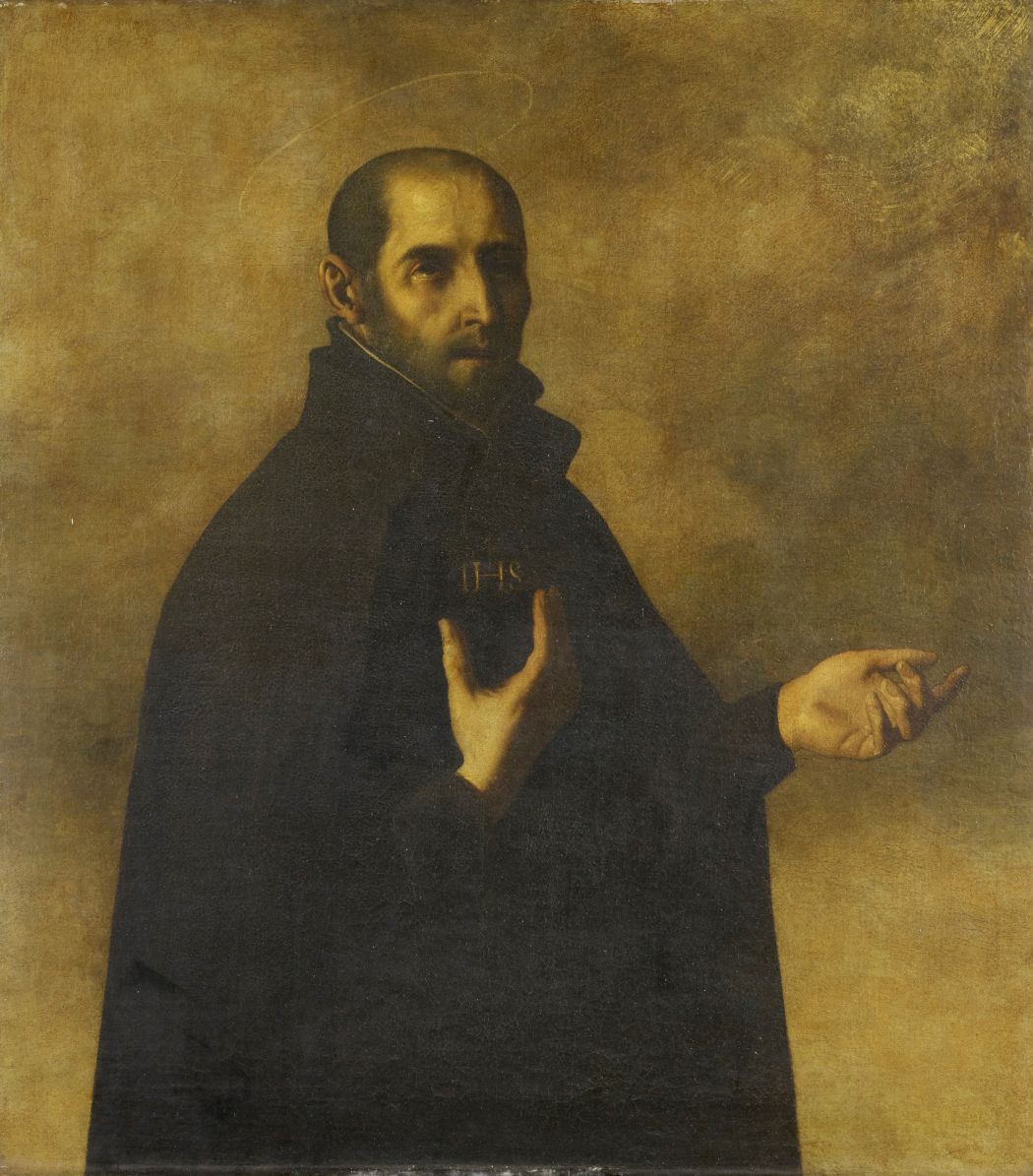
St. Ignatius is the patron saint of soldiers, spiritual retreats,
various cities and dioceses, and, of course, the Jesuits. He can be
recognized in art by his black cassock, the IHS monogram, a Crucifix, a
book, and/or the Jesuit motto "Ad Majorem Dei Gloriam." His relics may
be venerated at the St. Ignatius Chapel in the Chiesa del Santissimo Nome di Gesù
(Chiesa del Gesù) in Rome.
The Society of Jesus went on to do missionary work all over the world,
with St. Francis Xavier bringing the Gospel message to India, Japan,
and other areas of Southeast Asia; men like St. Isaac Jogues and his companions
becoming martyrs in evangelizing the natives of the North American
continent, etc. They founded once great institutions of higher
learning,
such as Georgetown University in Washington, D.C., Fordham University
in New York, Loyola University in Chicago, Saint Louis University in
Missouri, Marquette University in Milwaukee, along with many others and
countless private schools that teach younger students. They've
contributed
greatly to the sciences (especially astronomy), architecture, and
linguistics, and were a crucial part of the counter-Reformation work of
the Church fighting against Protestant heresies.May this once great
order be restored!
Customs
Some may prepare for the day by praying the Novena to St. Ignatius of Loyola
starting on July 22 and ending on the eve of this feast. For the feast
itself, there is the Litany
of St. Ignatius of Loyola, and the following prayer -- a prayer
known as the Suscipe and
written by St. Ignatius himself.
Take, Lord, and
receive all my liberty, my memory, my understanding, and my
entire will, all that I have and possess.
Thou hast given all to me. To Thee, O Lord, I return it.
All is Thine; dispose of it wholly according to Thy will.
Give me Thy love and Thy grace, for this is sufficient for me. Amen.
Suscipe, Domine,
universam meam libertatem.
Accipe memoriam, intellectum, atque voluntatem omnem.
Quidquid habeo vel possideo mihi largitus es; id Tibi totum restituo,
ac Tuae prorsus voluntati trado gubernandum.
Amorem Tui solum cum gratia Tua mihi dones, et dives sum satis, nec
aliud quidquam ultra posco. Amen.
People in Europe might make one of various pilgrimages
to celebrate this feast. In Azpeitia, in the province of Guipúzcoa,
there is the Santuario de Loyola,
a huge Baroque
sanctuary built around "la casa santa" -- the "holy house" in which St.
Ignatius was born. The original house still exists, and the bedroom in
which he was born, the kitchen, and other rooms relevant to his daily
life growing up can all be toured. Attached to this sanctuary is a huge
domed basilica with glorious Churrigueresque ornamentation.
There is also the Camino Ignaciano
-- the Ignatian Way pilgrimage -- which starts at the Santuario in
Loyola, and then goes to Montserrat -- a multi-peaked mountain range
near Barcelona. Montserrat is the site of the
Benedictine abbey, Santa Maria de
Montserrat, which houses the Black
Virgin before which St. Ignatius left his military gear, and is the
place where he gave away
his fine clothes. From there, the pilgrimage goes to
Manresa, where the cave in which St. Ignatius meditated and prayed can
be found. This pilgrimage is around 400 miles long, is made in 27 or so
stages (about 14 miles per day), and takes around 4 weeks to make. You
can learn more about the Camino Ignaciano here:
https://caminoignaciano.org/en/
In Zeanuri, a town in the province of Bizkaia (Vizcaya or Biscay) in
Spain, locals make a
pilgrimage up Mount Gorbela to the hermitage of Nuestra Señora de las Nieves (Our
Lady of the Snows) for an open-air Mass on the Feast of St.
Ignatius.
Young people hike up a day or two earlier and camp before the feast,
the only time camping is allowed on the mountain.
Those fortunate enough to be in Rome today can visit la Chiesa del Gesù, the Jesuits'
mother church. There, they can not only venerate the relics of St.
Ignatius
(and some
-- the right arm -- of St. Francis Xavier) -- but can enjoy a
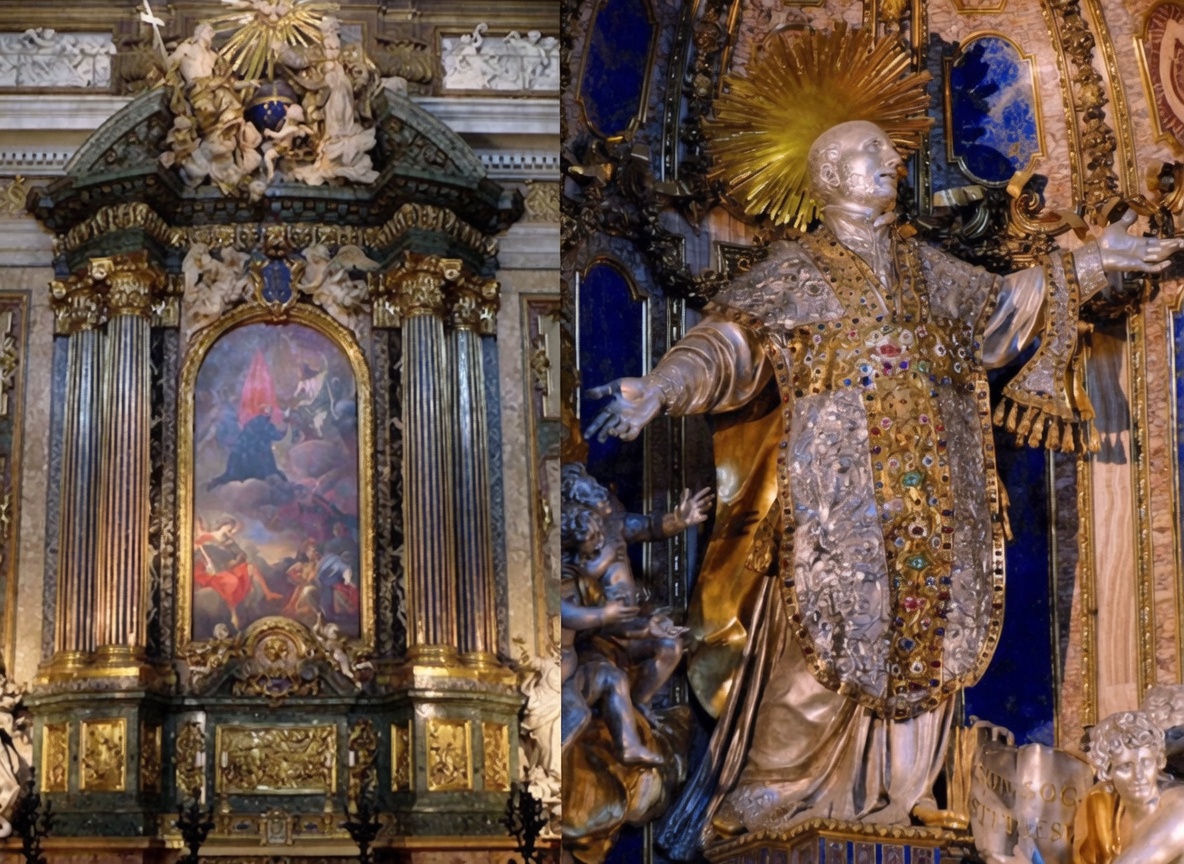
unique, interesting display: la
Macchina Barocca. In the
Chapel of St.
Ignatius is a large painting by Andrea Pozzo depicting
St. Ignatius receiving the monogram IHS from Christ. At 5:30PM each day
(6:00PM in summer), music is played and a voice relates the account of
Ignatius's
conversion, the basic Gospel message, a few selections from Ignatius's
"Spiritual Exercises," and his beloved Anima Christi prayer. As this is
going on, a hidden pulley-and-counterweight mechanism causes the
painting to slowly descend -- only to reveal a great bejewewled silver
and gold statue of St. Ignatius, looking upward with arms outstretched,
standing against a field of deep-blue lapis lazuli, with gilded bronze
putti in attendance. Back in the day, live musicians and a reader would
accompany the machine's display; now, the music and reading are
recorded.
La Macchina
Barocca: the painting -- and what's revealed to be behind it
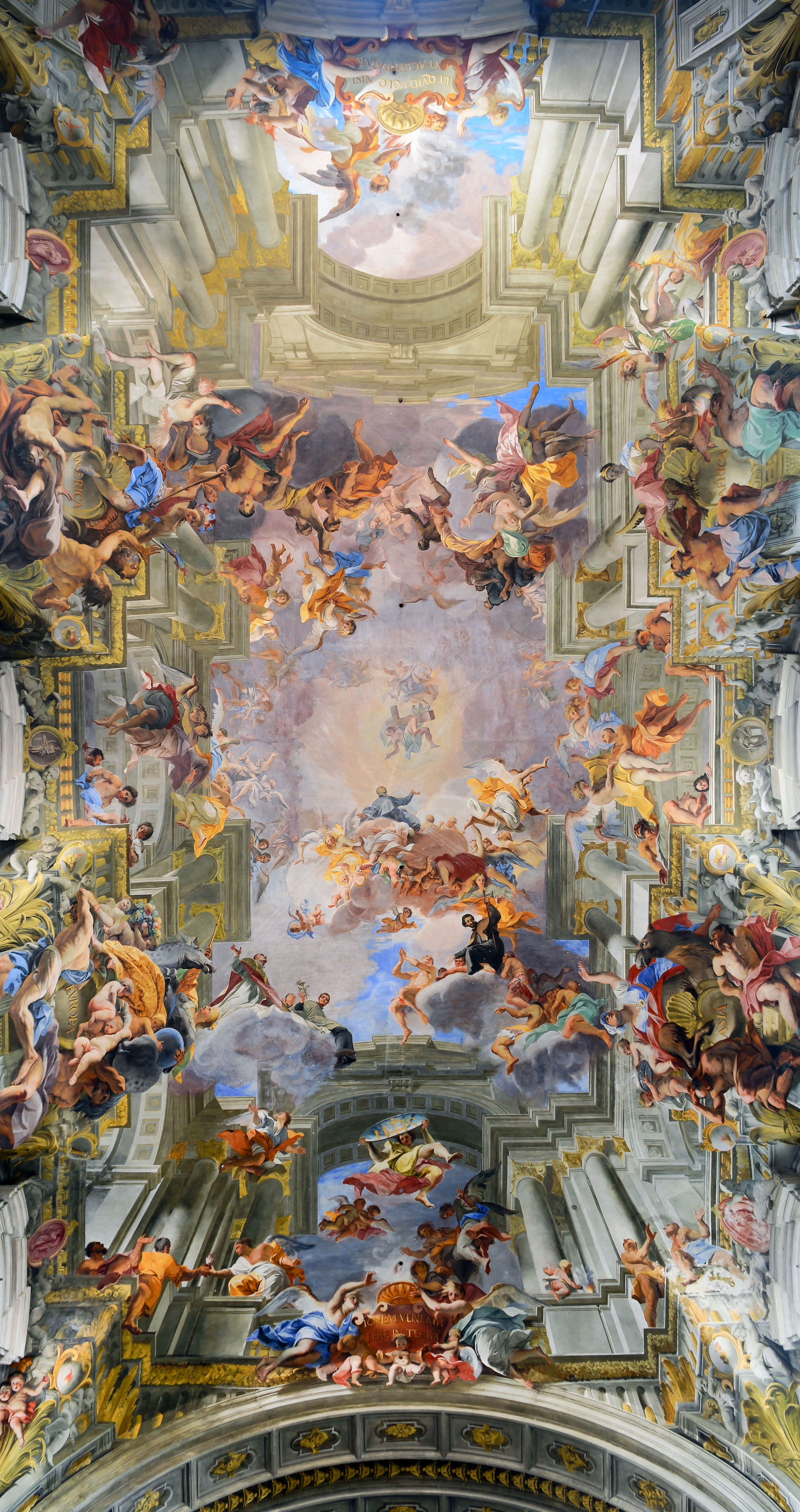
And a visit could be made to the Chiesa di Sant'Ignazio di Loyola in
Campo Marzio about a quarter of a mile -- a 5-minute walk -- away. Not
only does this church house the relics of a number of Saints, including
St. Robert Bellarmine, this is the church with the famous ceiling
fresco, which was also painted by Andrea Pozzo. It uses quadratura
techniques to show St. Ignatius being received into heaven. There is a
brass disk in the floor of the nave to mark the place -- the "Pozzo
spot" -- where the trompe l'oeil effects
work to perfection.
"The Apotheosis
of S. Ignatius" by Andre Pozzo. Click to enlarge.
The people of San Ignacio de Moxos in Bolivia have a very big,
colorful, 4-day long festival called the Ichapekene Piesta (or
Chapequene) that officially lasts from July 30 to August 2, though
celebrations really begin in early May. Among the festivities is the
Machateros, in which men dressed as sun warriors in elaborate feather
headdresses and representing the light of Christianity, dance with
machetes made of wood, battling other dancers wearing animal masks
representing the original owners of the forest and water, symbolically
converting them to Christianity.
No matter where you live, another thing to consider is making an
Ignatian retreat.
The classical Ignatian retreat lasts for 30 days, so might not be
feasible for most, but abbreviated retreats exist as well -- are much
more
common, even. These typically last for 3 or 8 days and are based on St.
Ignatius's "Spiritual Exercises" -- a program of prayer, meditation,
and imaginative contemplation.
As to honoring this feast in the home, one of the most important things
you
can do is to take a lesson from "Spiritual Exercises" and make sure you
and your family members have each adopted, privately, the practice of
making an examen -- or "examination
of conscience" --
before bed each night! 3 When teaching your children how to
do this, you
could use the fingers of their left hands, palms facing them, as
reminders for each of
the five steps (all explained at the page just linked to). 1) Write "Gratitude" on their thumb (tell them to
think "thumbs up!" to God for all His graces); 2) write "Pray to know"
on their index finger (reminding them of the Scarecrow in the Wizard of
Oz pointing to his head while he thinks might help them remember what
the index finger stands for); 3) draw a clock on their middle finger to
symbolize the hours of the day (they can think of their longest finger
as a tall clock tower); 4) write "Sorry" on their ring finger (the
wedding ring finger can be a reminder that we should apologize to those
we love when we offend them);
and 5) write "Do better" on their pinky finger (reminding them of
making a "pinky promise" to try to do better might help them remember).
You could trace left their hand, palm up, on a piece of paper, cut it
out, and label
its fingers in the same way, hanging the cut-outs on the wall next to
their beds to remind them of the five steps of a good examination of
conscience. Or you can use this graphic: Examination of Conscience (pdf)
As to less important traditions, how about a sweet treat named for St.
Ignatius and
made in
the town of St. Ignatius's birth? Try these Ignacios de Azpeitia (start
these
the
night before):
Ignacios de Azpeitia
1 1/2 c. granulated sugar
6 large eggs
Zest of 2 lemons
2 tsp almond extract
2 c. almond flour (finely ground almonds)
2/3 c. + 2 TBSP flour
1 c. sliced almonds (for topping)
Butter or non-stick spray for greasing molds
Cream the butter, sugar, and salt until light and
fluffy. Add eggs one at a time, beating after each addition. Then add
the zest and
extract.
In a separate bowl, whisk together the almond flour and
flour. Gradually add this to the wet mixture and beat until you have a
smooth, thick batter. Cover and
refrigerate overnight.
Preheat oven to 350°F. Generously grease your tart tins,
muffin tins, or other molds that are 2 to 2 1/2" in diameter. Fill each
mold 3/4 full of the batter and sprinkle with sliced almonds, gently
pressing the bottoms of them down into the batter so they'll
stick. Bake for 15–22 minutes, until the tops are golden brown
and the centers are set but still slightly soft. Let them cool in the
molds for 5–10 minutes, then gently remove. Cool completely on a wire
rack.
And while you're eating, you might want to listen to the rousing Fundador
(Founder), written in honor of St. Ignatius:
Fundador sois
Ignacio y General
de la Compañía Real de Jesús,
hueste belicosa y fiel.
¿Qué arrogante caudillo
osará en su furor
eclipsar el gran brillo
de vuestro valor?
Lance, lance a la liza
aveno fiel
a su monstruo Lucifer.
En tus filas se inmola
el celeste escuadrón
por Jesús, quien tremola
tu invicto pendón.
Al contrario infunde
el rayo vengador,
En ti siempre campea
denuedo marcial
y al empíreo recrea
tu fe sin igual.
Pues contigo avanzase
guerreros férvidos,
en valor ínclitos,
con Luzbel bátense,
y alzan sus lábaros
en el combate marcial;
fiel presagio
de paz y de victoria.
¡Compañía de Jesús,
corre a la lid, a la lid!
Del infierno la gente
no apague su ardor
que ilumina la frente
de Ignacio, el valor.
Founder are you,
Ignatius, General
Of the Royal Company of Jesus,
A warlike and faithful host.
What arrogant leader
In his fury would dare
To eclipse the great splendor
Of your valor?
Charge! Charge to the battle!
Faithful warrior,
Against the monster, Lucifer!
In your ranks the heavenly squadron
Offers itself in sacrifice
For Jesus, who unfurls
Your invincible banner.
To the enemy it hurls
The avenging thunderbolt,
In you ever shines
Martial courage
And to heaven it brings delight --
Your faith without equal.
For with you advance
Fervent warriors,
Renowned for valor;
They battle Lucifer,
Raising their standards
In the martial combat,
A sure promise
Of peace and victory.
Company of Jesus,
Run to the fight! To the fight!
Let not the hosts of hell
Quench the fire
That lights the brow
Of Ignatius the valiant!
From "The Liturgical Year" by Dom Prosper
Gueranger
Although the cycle of the time after Pentecost has shown us many times
already the solicitude of the Holy Spirit for the defense of the
Church, yet today the teaching shines forth with a new luster. In the
sixteen century Satan made a formidable attack upon the holy city by
means of a man who, like himself, had fallen from the height of heaven,
a man prevented in early years by the choice graces which lead to
perfection, yet unable in an evil day to resist the spirit of revolt.
As Lucifer aimed at being equal to God, Luther set himself up against
the Vicar of God, on the mountain of the covenant; and soon, falling
from abyss to abyss, he drew after him the third part of the stars of
the firmament of holy Church. How terrible is that mysterious law
whereby the fallen creature, be he man or Angel, is allowed to keep the
same ruling power for evil, which he would otherwise have exercised for
good. But the designs of Eternal Wisdom are never frustrated: against
the misused liberty of the Angel or man, is set up that other merciful
law of substitution, by which St. Michael was the first to benefit.
The development of Ignatius’ vocation to holiness, followed step by
step the defection of Luther. In the Spring of 1521 Luther had just
quit Worms and was defying the world from the Castle of Wartburg, when
Ignatius received at Pampeluna the wound which was the occasion of his
leaving the world and retiring at Manresa. Valiant as his noble
ancestors, he felt within him from his earliest years the warlike ardor
which they had shown on the battlefields of Spain. But the campaign
against the Moors closed at the very time of his birth (1491). Were his
chivalrous instincts to be satisfied with petty political quarrels? The
only true King worthy of his great soul revealed himself to him in the
trial which put a stop to his worldly projects: a new warfare was
opened out to his ambition; another crusade was begun; and in the year
1522, from the mountains of Catalonia to those of Thuringia, was
developed that divine strategy of which the Angels alone knew the
secret.
In this wonderful campaign it seemed that hell was allowed to take the
initiative, while heaven was content to look on, only taking care to
make grace abound the more, where iniquity strove to abound. As in the
previous year Ignatius received his first call three weeks after Luther
had completed his rebellion, so in this year, at three weeks’ distance,
the rival camps of hell and heaven each chose and equipped its leader.
Ten months of diabolical manifestations prepared Satan’s lieutenant, in
the place of his forced retreat, which he called his Patmos; and on the
5th of March the deserter of the altar and of the cloister left
Wartburg.
On the 25th of the same month, the glorious night of the Incarnation,
the brilliant soldier in the armies of the Catholic kingdom, the
descendant of the families of Ognes and Loyola, clad in sackcloth, the
uniform of poverty, to indicate his new projects, watched his arms in
prayer at Montserrat; then hanging up his trusty sword at Mary’s altar,
he went forth to make trial of his future combats by a merciless war
against himself. In opposition to the already proudly floating standard
of the free-thinkers, he displayed upon his own this simple device: To
the greater glory of God! At Paris, where Calvin was secretly
recruiting the future Huguenots, Ignatius, in the name of the God of
armies, organized his vanguard, which he destined to cover the march of
the Christian army, to lead the way, to bear the brunt, to deal the
first blows. On the 15th of August, 1534, five months after the rupture
of England from the Holy See, these first soldiers sealed at Montmartre
the definitive engagement which they were afterwards to solemnly renew
at St. Paul’s outside the Walls. For Rome was to be the rallying place
of the little troop which was soon to incease so wonderfully, and which
was, by its special profession, to be ever in readiness, at the least
sign from the Head of the Church, to exercise its zeal in whatever part
of the world he should think fit, in the defense or propagation of the
faith, or for the progress of souls in doctrine and Christian life.
An illustrious speaker of our own day has said (in a homily delivered
on the feast of the beatification of Bl. Pierre le Fèvre): “What
strikes us at once in the history of the Society of Jesus, is that it
was matured at its very first formation. Whosoever knows the first
founders of the Company knows the whole Company, in its spirit, its
aim, its enterprises, its proceedings, its methods. What a generation
was that which gave it birth! What union of science and activity, of
interior life and military life! One may say they were universal men,
men of a giant race, compared with whom we are but insects: de genere
giganteo, quibus comparati quasi locustæ videbamur.”
All the more touching, then, was the charming simplicity of those first
Fathers of the Society, making their way to Rome on foot, fasting and
weary, but their hearts overflowing with joy, singing with a low voice
the Psalms of David. When it became necessary, on account of the
urgency of the times, for the new institute to abandon the great
traditions of public prayer, it was a sacrifice to several of these
souls; Mary could not give way to Martha without a struggle; for so
many centuries, the solemn celebration of the Divine Office had been
the indispensable duty of every religious family, its primary social
debt, and the principal nourishment of the individual holiness of its
members.
But new times had come, times of decadence and ruin, calling for an
exception as extraordinary as it was grievous to the brave company that
was risking its existence amid ceaseless alarms and continual sallies
upon hostile territory. Ignatius understood this; and to the special
aim imposed upon him, he sacrificed his personal attraction for the
sacred chants; nevertheless, to the end of his life, the least note of
the Psalmody falling on his ears drew tears of ecstasy from his eyes.
After his death, the Church, which had never known any interest to
outbalance the splendor of worship due to her Spouse, wished to return
from a derogation which so deeply wounded the dearest instincts of her
bridal heart; Paul IV revoked it absolutely, but St. Pius V, after
combating it for a long time, was at last obliged to give in. In the
latter ages so full of snares, the time had come for the Church to
organize special armies. But while it became more and more impossible
to expect from these worthy troops, continually taken up with outside
combats, the habits of those who dwelt in security, protected by the
ancient towers of the holy city, at the same time Ignatius repudiated
the strange misconception which would try to reform the Christian
people according to this enforced but abnormal manner of life. The
third of the eighteen rules which he gives as the crowning of the
Spiritual Exercises, to have in us the true sentiments of the orthodox
Church, recommends to the faithful the chants of the Church, the
Psalms, and the different Canonical Hours at their appointed times. And
at the beginning of this book, which is the treasure of the Society of
Jesus, where he mentions the conditions for drawing the greatest fruit
from the Exercises, he ordains in his twentieth annotation that he who
can do so, should choose for the time of his retreat a dwelling from
whence he can easily go to Matins and Vespers as well as to the Holy
Sacrifice. What was our Saint here doing, but advising that the
Exercises should be practiced in the same spirit in which they were
composed in that blessed retreat of Manresa, where the daily attendance
at solemn Mass and the evening Offices had been to him the source of
heavenly delights?
But it is time to listen to the Church’s account of the life of this
great servant of God.
Ignatius, by nation a Spaniard, was born of a noble family at Loyola,
in Cantabria. At first, he attended the court of the Catholic king, and
later on, embraced a military career. Having been wounded at the siege
of Pampeluna, he chanced in his illness to read some pious books, which
kindled in his soul a wonderful eagerness to follow in the footsteps of
Christ and the Saints. He went to Montserrat, and hung up his arms
before the Altar of the Blessed Virgin; he then watched the whole night
in prayer, and thus entered upon his knighthood in the Army of Christ.
Next he retired to Manresa, dressed as he was in sackcloth, for he had
a short time before given his costly garments to a beggar. Here he
stayed for a year, and during that time he lived on bread and water,
given to him in alms; he fasted every day except Sunday, subdued his
flesh with a sharp chain and a hairshirt, slept on the ground, and
scourged himself with iron disciplines. God favored and refreshed him
with such wonderful spiritual lights that afterwards he was wont to
say, that even if the sacred Scriptures did not exist, he would be
ready to die for the faith, on account of those revelations alone which
the Lord had made to him at Manresa. It was at this time that he, a man
without education, composed that admirable book of the Exercises, which
has been approved by the judgment of the Apostolic See, and by the
benefit reaped from it by all.
However, in order to make himself more fit for gaining souls, he
determined to procure the advantages of education, and began by
studying grammar among children. Meanwhile he relaxed nothing of his
zeal for the salvation of others, and it is marvelous what sufferings
and insults he patiently endured in every place, undergoing the hardest
trials, even imprisonment and stripes almost unto death. But he ever
desired to suffer far more for the glory of his Lord. At Paris he was
joined by nine companions from that University, men of different
nations, who had taken their degrees in Art and Theology; and there at
Montmartre he laid the first foundations of the Order, which he was
later on to institute at Rome. He added to the three usual vows a
fourth concerning the Missions, thus binding it closely to the
Apostolic See. Paul III first welcomed and approved the Society, as did
later other Pontiffs and the Council of Trent. Ignatius sent St.
Francis Xavier to preach the Gospel in the Indies, and dispersed others
of his children to spread the Christian faith in other parts of the
world, thus declaring war against paganism, superstition, and heresy.
This war he carried on with such success that it has always been the
universal opinion, confirmed by the word of Pontiffs, that God raised
up Ignatius and the Society founded by him to oppose Luther and the
heretics of his time, as formerly he had raised up other holy men to
oppose other heretics.
He made the restoration of piety among Catholics his first care. He
increased the beauty of the sacred buildings, the giving of
catechetical instructions, the frequentation of sermons and of the
Sacraments. He everywhere opened schools for the education of youth in
piety and letters. He founded at Rome the German College, refuges for
women of evil life, and for young girls who were in danger, houses for
orphans and catechumens of both sexes, and many other pious works. He
devoted himself unweariedly to gaining souls to God. Once he was heard
saying, that if if he were given his choice, he would rather live
uncertain of attaining the Beatific Vision, and in the meanwhile devote
himself to the service of God and the salvation of his neighbor, than
die at once certain of eternal glory. His power over the demons was
wonderful. St. Philip Neri and others saw his countenance shining with
heavenly light. At length in the sixty-fifth year of his age he passed
to the embrace of his Lord, whose greater glory he had ever preached
and ever sought in all things. He was celebrated for miracles and for
his great services to the Church, and Gregory XV enrolled him amongst
the Saints.
This is the victory which overcometh the world, our faith. And thou
didst prove this truth once more to the world, O thou great conqueror
of the age in which the Son of God chose thee to raise up again his
ensign that had been humbled before the standard of Babel. Against the
ever-increasing battalions of the rebels thou didst long stand almost
alone, leaving it to the God of armies to choose his own moment for
engaging thee against Satan’s troops, as he chose his own for
withdrawing thee from human warfare. If the world had then been told of
thy designs, it would have laughed them to scorn; yet now, no one can
deny that it was a decisive moment in the history of the world when,
with as much confidence as the most illustrious general concentrating
his forces, thou gavest the word to thy nine companions to proceed
three and three to the holy City. What great results were obtained in
the fifteen years during which this little troops, recruited by the
Holy Ghost, had thee for its first General! Heresy was trampled out of
Italy, confounded at Trent, checked everywhere, paralyzed in its very
center; immense conquests were made in new worlds, as a compensation
for the losses suffered in our West; Sion herself, renewing the beauty
of her youth, saw her people and her pastors raised up again, and her
sons receiving an education befitting their heavenly destiny; in a
word, all along the line, where he had rashly cried victory, Satan was
now howling, overcome once more by the name of Jesus, which makes every
knee to bow, in heaven, on earth, and in hell! Hadst thou ever, O
Ignatius, gained such glory as this in the armies of earthly kings?
From the throne thou hast won by so many valiant deeds, watch over the
fruits of thy words, and prove thyself always God’s soldier. In the
midst of the contradictions which are never wanting to them, uphold thy
sons in their position of honor and prowess which makes them the
vanguard of the Church. May they be faithful to the spirit of their
glorious Father, “having unceasingly before their eyes: first, God;
next, as the way leading to Him, the form of their institute,
consecrating all their powers to attain this end marked out for them by
God; yet each following the measure of grace he has received from the
Holy Ghost, and particular degree of his vocation:” Lastly, O head of
such a noble lineage, extend thy love to all religious families whose
lot in these times of persecution is so closely allied with that of
thine own sons; bless, especially, the monastic Order whose ancient
branches overshadowed thy first steps in the perfect life, and the
birth of that illustrious Society which will be thy everlasting crown
in heaven. Have pity on France, on Paris, whose University furnished
thee with foundations for the strong, unshaken building raised by thee
to the glory of the Most High. May every Christian learn of thee to
fight for the Lord, and never to betray his standard; may all men,
under thy guidance, return to God, their beginning and their end.
Footnotes:
1 Loyola is a district in the town of
Azpeitia, which is located in the province of Gipuzkoa, in Spain's
Basque country.
2 Pamplona is the home of Sanfermines -- the great
celebration of the Feast of St. Fermin,
with its running of the bulls.
3 Nightly examinations of conscience are
private affairs, not family affairs. While it makes sense to be with
very young children as they are learning the steps -- helping them
learn how to think through the day, identify sins correctly, recall
sins they've committed, repent, and think of ways to do better -- they
should do this on their own when they are able.