|
Wednesday, Friday, and Saturday after Pentecost Sunday are known as
"Whit Embertide," and they come anywhere between mid-May and mid-June,
at the beginning of Summer (June, July, August). The Lessons read
during the Masses connect the Pentecost with the Old Testament Feast of
Firstfruits.
The Gospel readings focus on Our Lord speaking of Himself as the
Heavenly Bread (John 6:44-52), healing the man lowered down through the
roof , telling the Pharisees that it is easier to say "Thy sins are
forgiven" than to say "Arise and walk!" (Luke 5:17-26), and healing
Simon Peter's mother-in-law (Luke 4:38-44).
The Natural Season
Proverbs 6:6-8
"Go to the ant, O sluggard,
and consider her ways, and learn wisdom:
Which, although she hath no guide, nor master, nor captain,
provideth her meat for herself in the summer,
and gathereth her food in the harvest."
Summer is the
time of growth and work, of preparation for the harvest that comes
before Winter. For the Catholic, it is a time of preparation for
harvest on the spiritual level, too, as is reflected in the liturgical
season of Time After Pentecost. Providential it is, then, that June has
a special focus on the Sacred Heart, to Whom we offer our labours and
sufferings through the Morning Offering.
And providential it is that there come in these months the Feasts of
many great Saints who show us how to do our work well, especially the Feast of St. Martha, God's
worker, whose story reminds us to put the spiritual first and to order
our labor.
And in the midst of that work, God gives us great comforts; this
season, like all of the earth's seasons, fills the senses: the symphony
of frogs and crickets against a background of rustling leaves...
fireflies twinkling like stars in the forests... warm winds blowing
through fields of wheat and tall grasses... water lilies floating on
their large, round leaves... skies clear and blue, or cushioned with
great wads of rolling white clouds, shining pale gold on their edges...
water that feels like cool silk against hot skin... the sharp, green
smell of new-mown grass and hay...
... And the colors, the smells, the textures of firstfruits: corn,
tomatoes, and eggplant... strawberries, blueberries, and plums....
wheat, and the hazelnuts that cause one to think of St. Julian of
Norwich's vision:
I saw that He is
to us everything that is good and comfortable for us: He is our
clothing that for love wrappeth us, claspeth us, and all encloseth us
for tender love, that He may never leave us; being to us all-thing that
is good, as to mine understanding.
Also in this He shewed me a little thing, the quantity of an hazel-nut,
in  the palm of my hand; and it was as round as a ball. I
looked thereupon with eye of my understanding, and thought: What may
this be? And it was answered generally thus: It is all that is made. I
marvelled how it might last, for methought it might suddenly have
fallen to naught for littleness. And I was answered in my
understanding: It lasteth, and ever shall last for that God loveth it.
And so all-thing hath the being by the love of God. the palm of my hand; and it was as round as a ball. I
looked thereupon with eye of my understanding, and thought: What may
this be? And it was answered generally thus: It is all that is made. I
marvelled how it might last, for methought it might suddenly have
fallen to naught for littleness. And I was answered in my
understanding: It lasteth, and ever shall last for that God loveth it.
And so all-thing hath the being by the love of God.
All of these
things have being because God, Who is Being itself, loves. Let us love
Him with gratitude and by loving what He
loves! Let us "offer the
firstfruits," as the Lessons tell us, by offering ourselves to Him and
doing what He told us to do: to be good stewards, to care for the poor,
to pray for the dead, and, most
of all, to love the Lord our God with
our whole heart, and with our whole soul, and with all our mind, and
with all our strength; and to love our neighbours as ourselves.
Associations
and Symbols
Summer is
characterized by "dry and hot," and is associated with youth, the
humour of yellow bile, the choleric temperament,
and the
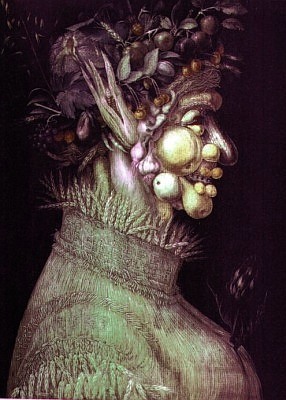
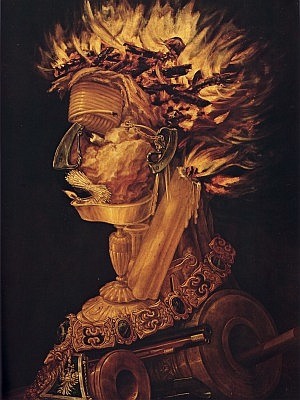
element of fire. Giuseppe Arcimboldo's
fascinating portraits of the season and its associated element lead the
imagination in all directions:
|
|