Genesis 8:22
"All the days of the earth, seedtime and harvest,
cold and heat, summer and winter, night and day, shall not cease."
Advent
Embertide
Wednesday, Friday, and Saturday after Gaudete
Sunday (3rd Sunday of
Advent) are known as "Advent Embertide," and they come near the
beginning of the Season of Winter (December, January, February).
Liturgically, the readings for the days' Masses follow along with the
general themes of Advent, opening up with Wednesday's Introit of Isaias
45: 8 and Psalm 18:2 :
Drop down dew,
ye heavens, from above, and let the clouds rain the Just: let the earth
be opened and bud forth a Savior. The heavens show forth the glory of
God: and the firmament declareth the work of His hands.
Wednesday's and
Saturday's Masses will include one and four Lessons, respectively, with
all of them concerning the words of the Prophet Isaias except for the
last lesson on Saturday, which comes from Daniel and recounts how
Sidrach, Misach, and Abdenago are saved from King Nabuchodonosor's
fiery furnace by an angel. This account, which is followed by a
glorious hymn, is common to all Embertide Saturdays but for Whit
Embertide.
The Gospel readings for the three days concern, respectively, the Annunciation (Luke 1:26-28), Visitation (Luke 1:37-47), and St. John the Baptist's
exhorting us to "prepare the way of the Lord and make straight His
paths" (Luke 3:1-6).
The Natural Season
Psalm 147:12,
16-17
"Praise the Lord, O Jerusalem:
praise thy God, O Sion.
Who giveth snow like wool:
scattereth mists like ashes.
He sendeth his crystal like morsels:
who shall stand before the face of his cold?"
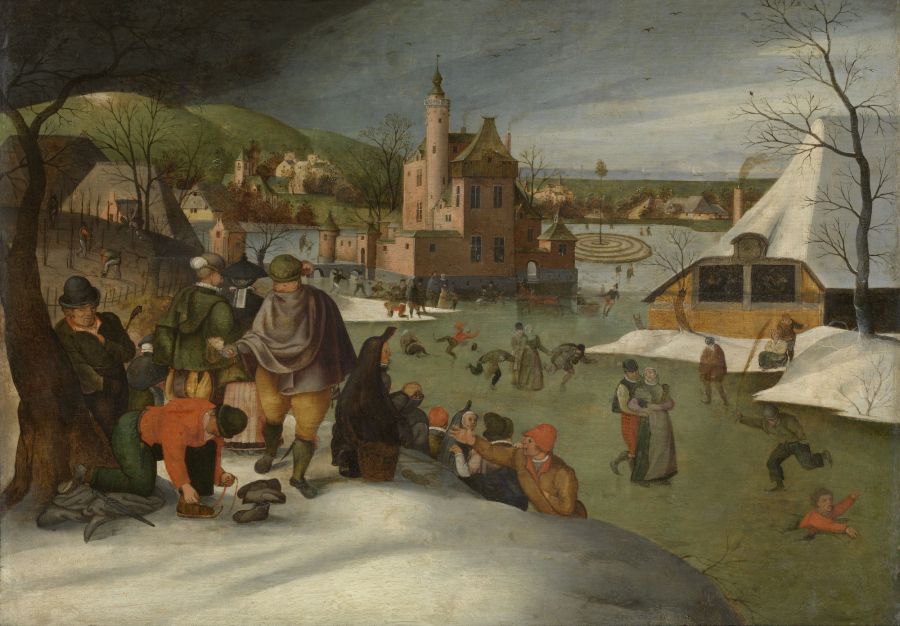
Winter is a time
of reflection, when human activity is stilled and snow blankets the
world with silence. For the Christian, Winter symbolizes Hope: though
the world now appears lifeless and makes us think of our own mortality,
we hope in our resurrection because of the Resurrection of the One
Whose Nativity we await now. How providential that the Christ Child
will be born at the beginning of this icy season, bringing with Him all
the hope of Spring! Also among our Winter feasts are the Epiphany and Candlemas, two of the
loveliest days of the year, the first evoked by water, incense, and
gold; the latter by fire...
Yes, despite the typical, unimaginative view of Winter as a long bout
with misery, the season is among the most beautiful and filled with
charms. The ephemeral beauty of a single snowflake... the pale blue
tint of sky reflected in snow that glitters, and gives way with a
satisfying crunch under foot... skeletal trees entombed in crystal,
white as bones, cold as death, creaking under the weight of their icy
shrouds... the wonderful feeling of being inside, next to a fire, while
the winds whirl outside... the smell of burning wood mingled with
evergreen... warm hands embracing your wind-bitten ones... the
brilliant colors of certain winter birds, so shocking against the ocean
of white... the wonderfully long nights which lend themselves to a
sense of intimacy and quiet! Go outside and look at the clear Winter
skies ruled by Taurus, with the Pleiades on its shoulder and Orion
nearby... Such beauty!
Even if you are not a "winter person," consider that Shakespeare had
the right idea when he wrote in "Love's Labours Lost":
Why should proud
summer boast
Before the birds have any cause to sing?
Why should I joy in an abortive birth?
At Christmas I no more desire a rose
Than wish a snow in May’s new-fangled mirth;
But like of each thing that in season grows.
Associations
and Symbols
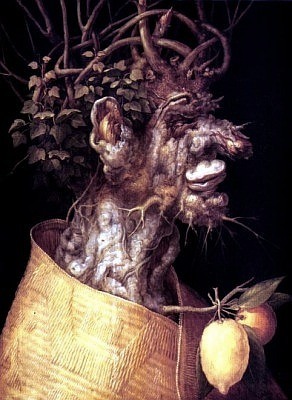
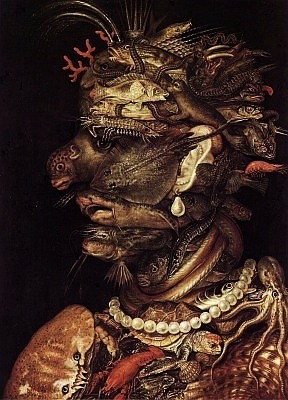
Winter is
characterized by "wet and cold," and is associated with the golden
years of old age, the humour of phlegm, the phlegmatic temperament, and the element of
water. Giuseppe
Arcimboldo's fascinating portraits of the season and its associated
element lead the imagination in all directions:
Get your children to think of what changes atmospherically
and astronomically during the this season. Why is it so cold? How does
the cold affect the earth's air and waters? Remember that lore says
that the weather conditions of each of the three days of an Embertide
foretell the weather of the next three months, so the weather seen on
Wednesday of Advent Embertide predicts the weather of the coming
January, Friday's weather foretells the weather of February, and
Saturday's weather foretells the weather of March. Make a note of the
weather on those three days and see if the old tales are true!
What stars can be seen
during the Winter months? Do your children know the traditional names
for this season's full Moons?:
December
Cold Moon
January
Wolf Moon
February
Snow Moon
If they were in charge of naming the Moons of this season, what would
they call them?
Ask your children to consider how the seasonal changes of Winter affect
the plants and animals. How have the trees changed? What are the
animals doing now? Which are hibernating? Which are gone, having
migrated? What do the animals that aren't hibernating or gone eat now?
Have any stored up food to eat during the cold months? Which have fur
that has grown thicker to protect them? Do any have fur that has
changed color to match the snow?
Ask them to consider how the seasonal changes affect (or traditionally
affected) the activities of man. What can we do now that we couldn't do
at other times of the year? What can't we do? How do modern
conveniences affect the answers to those questions? Ask them how they
would ensure they had shelter, food, and water if they were put into
the middle of the woods right now, with the season as it is. What
plants and animals would be available to eat? How would they keep
themselves dry and warm and protected from the winds?
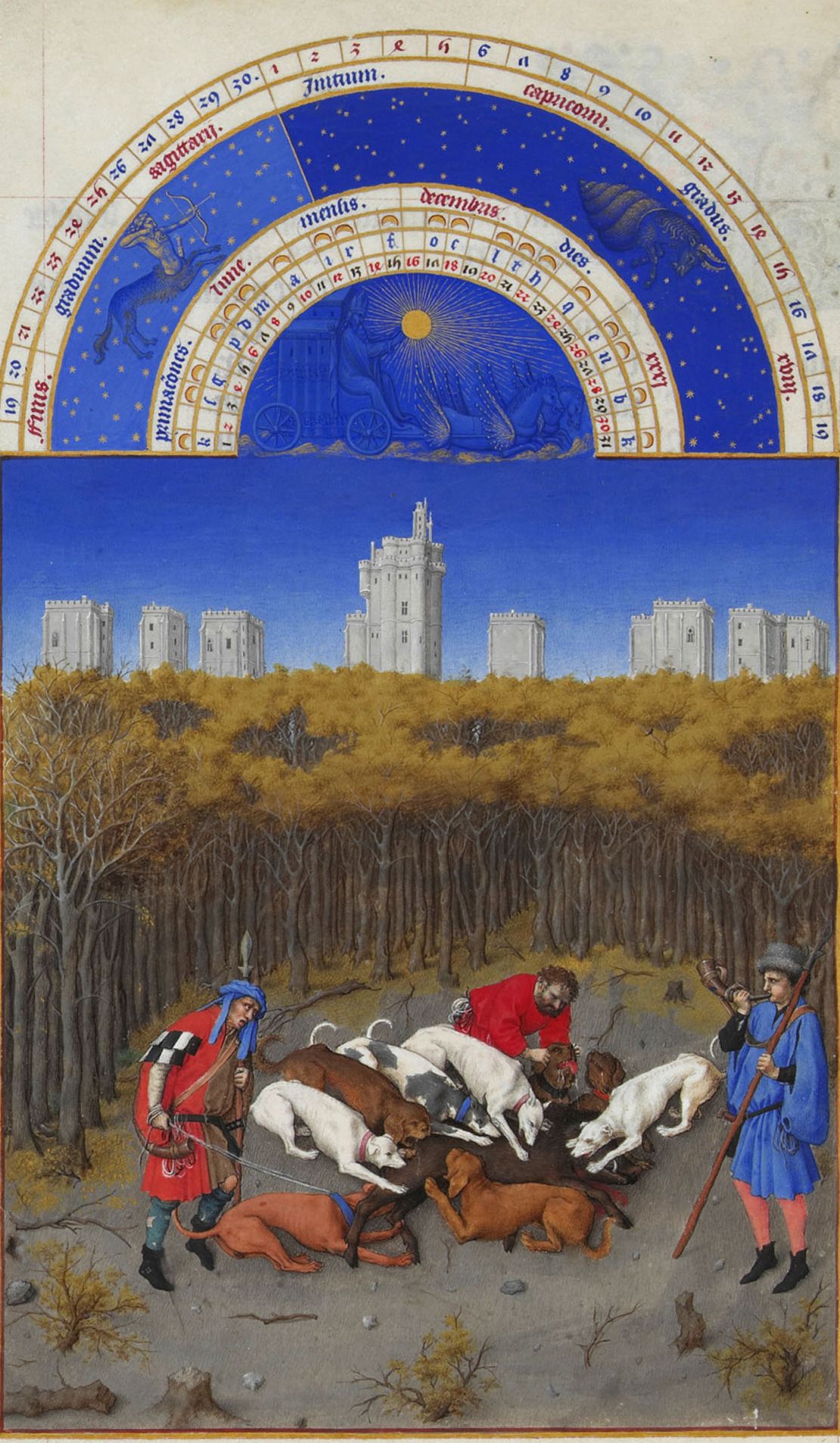
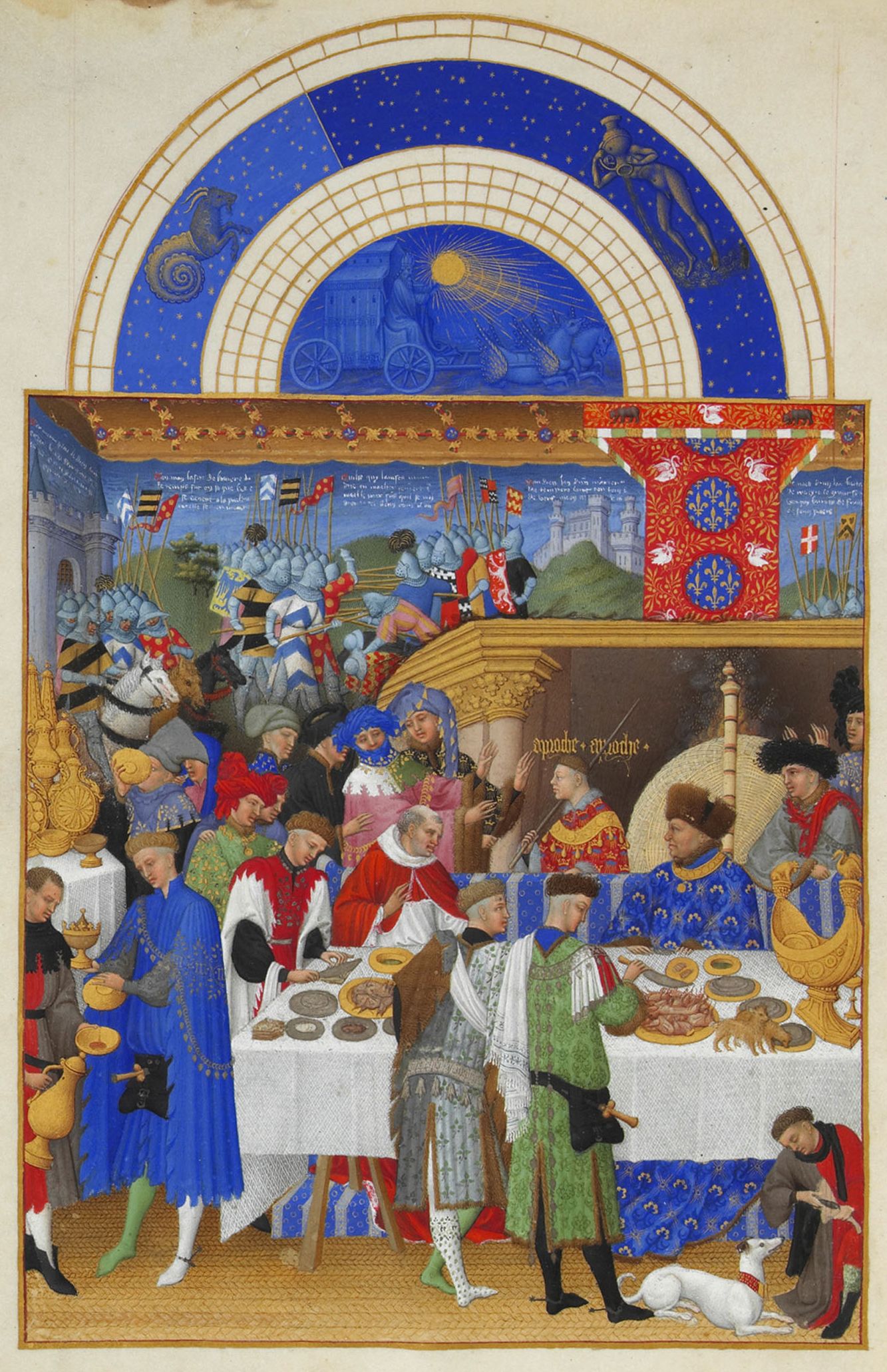
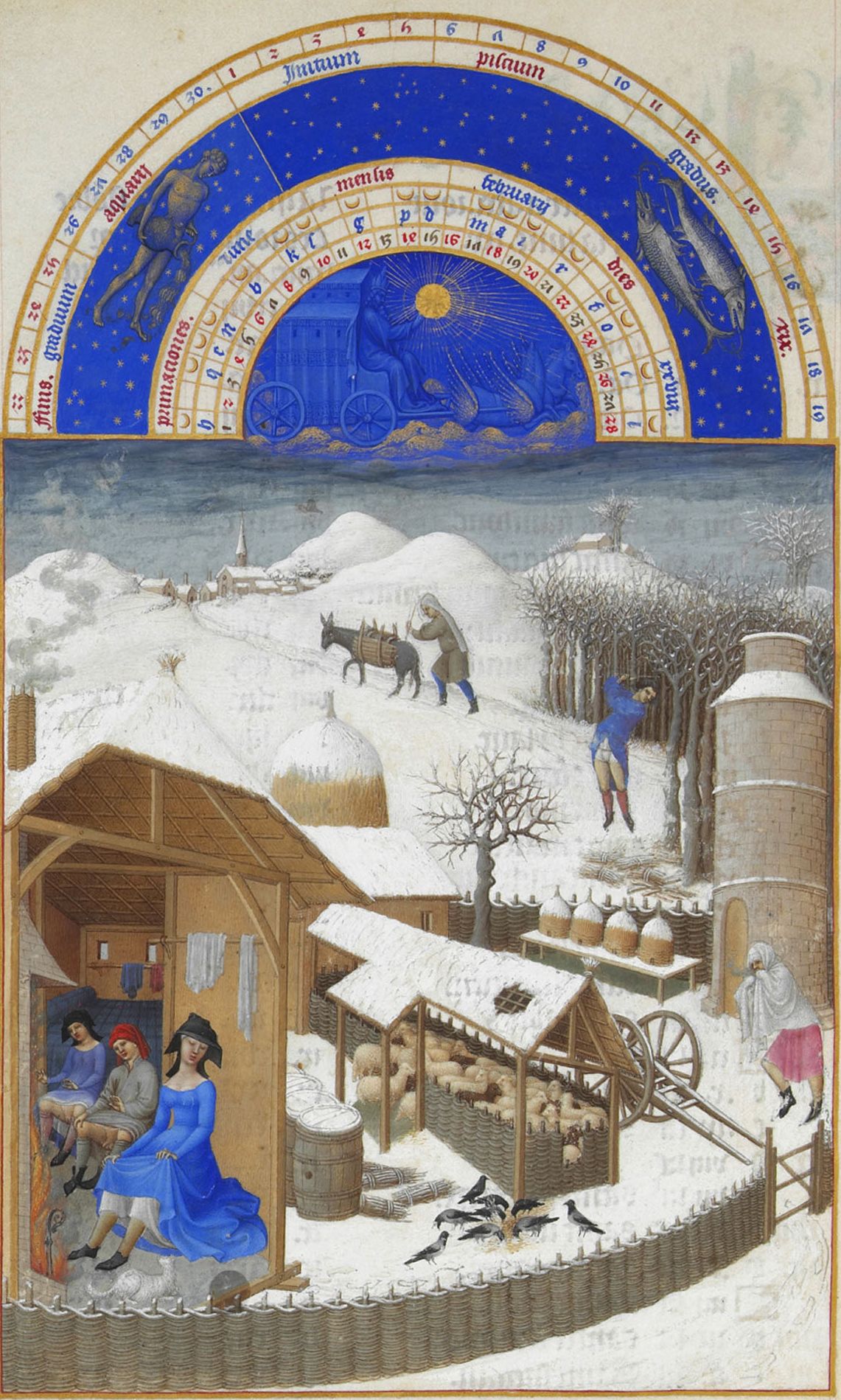
In the Middle Ages, the months are almost always uniformly depicted by
showing the "Labours of Man" throughout the seasons. In stained glass
windows, in illuminated manuscripts, one sees over and over the same
human activities used to portray the months. Below are the months of
December, January and February from the "Très Belles Heures" by the
brothers Jean, Paul, and Hermann Limbourg, the same men who illuminated
the "Très Riches Heures du Duc de Berry". Click on each picture to see
how that month is portrayed in the that latter work:
December
slaughtering the
animals for food
January
feasting on what
has been stored up earlier in the year. The feasting is often depicted
by showing Janus -- the two-faced keeper of doors and gates, the symbol
of beginnings and endings -- at table. Here the concept of past and
future implicit in the old year giving way to the new and usually
depicted by Janus is shown using two men facing in opposite directions.
February
warming oneself
by the fire
In addition to
these things, now is the time to make snow angels, build snowmen and
snowforts and ice sculptures, sled, ski, skate, ice fish, sit around
hearths and tell tales, make crafts indoors, make pine tea and snow ice
cream,1 watch for and feed the
Winter birds, and, most of all, praise God for His artistry and
providence... Get to it! And enjoy Vivaldi's ode to Winter from his
"Four Seasons" concertos as you do:
-- and know that just when you tire of this season, Spring will be here!
Footnotes: 1 How to make snow ice cream, pine
tea, and pine soda. For
the pine recipes, use Eastern White Pine, Western White Pine, Red Pine,
or Sugar Pine needles (Eastern White Pine is said to be the best). Note
that some pines can be toxic, so identify them properly. White pine
needles are loaded with vitamin C, so are good for cold -- but pine
shouldn't be consumed by pregnant women!:
Snow Ice Cream
14 oz. can
sweetened condensed milk
2 teaspoons
vanilla
10 -12 cups or
so of snow
Mix together the
sweetened condensed milk and vanilla in a big bowl. Dump in the snow
and mix.
Pine Tea
Steep for 20
minutes 1/2 cup of pine needles in 3 cups water that's
been brought to a boil (steep, don't boil or you'll destroy the vitamin
C). If desired, sweeten with sugar or honey, and add lemon if you want.
Pine Soda
2 cup pine
needles
2 1/2 cups water
4 TBSP sugar
Rinse the pine
needles a few times in water. Put the needles and sugar
in a tall widemouth jar made of thick glass, pour the water over, close
the jar, and give it a shake to dissolve the sugar. Let sit on a window
sill for
3 to 7 days, checking periodically starting on day 3 to make sure it's
not too bubbly (the jar could explode as the yeast found naturally on
the pine needles
feeds on the sugar!). When it's a bit bubbly (it will be a lot more
carbonated than it looks!), go outside and carefully -- without shaking
-- open the
jar (it may bubble up and spray!). Strain into glasses over ice. Add a
slice of lemon and enjoy.