``Where the
Bishop is, there let the multitude of believers be;
even as where Jesus is, there is the Catholic Church'' Ignatius of
Antioch, 1st c. A.D
Feast of
the Transfiguration
Recall the prophecy of Daniel:
Daniel 7:13-14:
I beheld, therefore, in the vision of the night, and lo, one like the
Son of man came with the clouds of heaven, and he came even to the
ancient of days: and they presented him before him. And he gave him
power, and glory, and a kingdom: and all peoples, tribes, and tongues
shall serve him: his power is an everlasting power that shall not be
taken away: and his kingdom that shall not be destroyed.
Today, forty
days before the Exaltation
of the Holy Cross, we celebrate the realization of that prophecy
when Moses, representing the Law, and Elias (Elijah), representing the
Prophets -- two men who had special visions of God -- appear in glory
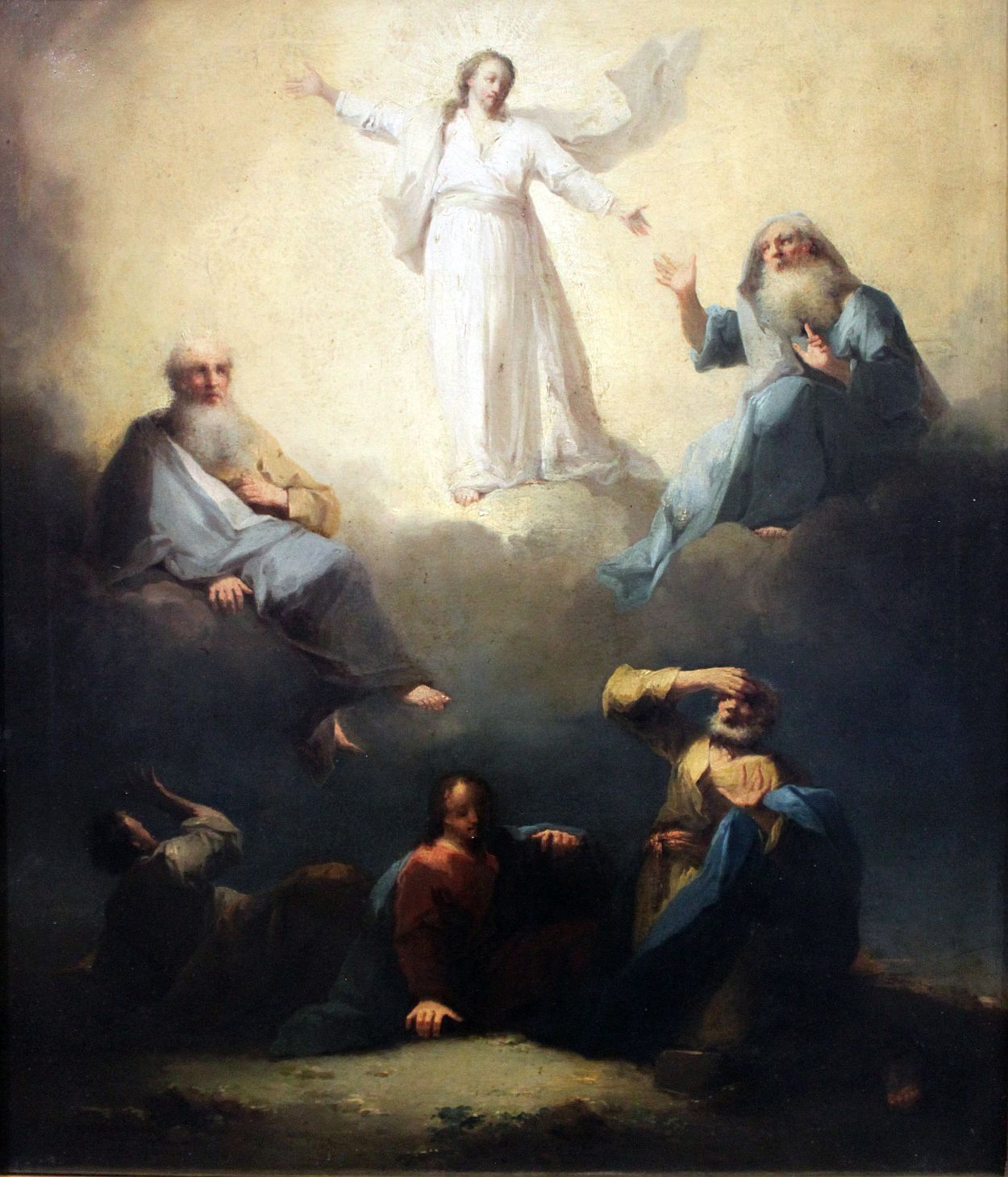
with Jesus
on on Mt. Tabor (Matthew 17, Mark 9, Luke 9). There, SS. Peter, James,
and John see
the Divine Uncreated Light shine forth from Our Lord, Who'd told them
previously that He must die and be resurrected.
Matthew 17:1-8
And after six days Jesus taketh unto him Peter and James, and John his
brother, and bringeth them up into a high mountain apart: And he was
transfigured before them. And his face did shine as the sun: and his
garments became white as snow. And behold there appeared to them Moses
and Elias talking with him.
And Peter answering, said to Jesus: Lord, it is good for us to be here:
if thou wilt, let us make here three tabernacles, one for thee, and one
for Moses, and one for Elias.
And as he was yet speaking, behold a bright cloud overshadowed them.
And lo, a voice out of the cloud, saying: This is my beloved Son, in
whom I am well pleased: hear ye him.
And the disciples hearing, fell upon their face, and were very much
afraid. And Jesus came and touched them: and said to them, Arise, and
fear not. And they lifting up their eyes saw no one but only Jesus. And
as they came down from the mountain, Jesus charged them, saying: Tell
the vision to no man, till the Son of man be risen from the dead.
Christ, as the
Temple Who would be raised up three days after being torn down,
shows that He is, indeed, the One in Whom the glory dwells. As the
Creed
says, "Deum de Deo, Lumen de lumine, Deum verum de Deo vero" (God from
God, Light from Light, true God from true God). Just before this
amazing
event, Christ heard St. Peter's profession of faith and gave him
authority as the first Pope; just after this event, he revealed that He
would go to Jerusalem to suffer and die.
Of significance
to this Feast is what it reveals about true Judaism and its fulfillment
in the Catholic Faith. From the Catholic
Encyclopedia:
False Judaism
had rejected the Messias, and now true Judaism, represented by Moses
and Elias, the Law and the Prophets, recognized and adored Him, while
for the second time God the Father proclaimed Him His only-begotten and
well-loved Son.
St. John
Chrysostom writes more about the appearance of Moses and Elias in his
Homilies on the Gospel of Matthew:
But wherefore
doth He also bring forward Moses and Elias? One might mention many
reasons. And first of all this: because the multitudes said He was,
some Elias, some Jeremias, some one of the old prophets, He brings the
leaders of His choir, that they might see the difference even hereby
between the servants and the Lord; and that Peter was rightly commended
for confessing Him Son of God.
But besides that, one may mention another reason also: that because men
were continually accusing Him of transgressing the law, and accounting
Him to be a blasphemer, as appropriating to Himself a glory which
belonged not to Him, even the Father's, and were saying, "This Man is
not of God, because He keepeth not the Sabbath day;" and again, "For a
good work we stone Thee not, but for blasphemy, and because that Thou,
being a man, makest Thyself God:"that both the charges might be shown
to spring from envy, and He be proved not liable to either; and that
neither is His conduct a transgression of the law, nor His calling
Himself equal to the Father an appropriation of glory not His own; He
brings forward them who had shone out in each of these respects: Moses,
because he gave the law, and the Jews might infer that he would not
have overlooked its being trampled on, as they supposed, nor have shown
respect to the transgressor of it, and the enemy of its founder: Elias
too for his part was jealous for the glory of God, and were any man an
adversary of God, and calling himself God, making himself equal to the
Father, while he was not what he said, and had no right to do so; he
was not the person to stand by, and hearken unto him.
And one may mention another reason also, with those which have been
spoken of. Of what kind then is it? To inform them that He hath power
both of death and life, is ruler both above and beneath. For this cause
He brings forward both him that had died, and him that never yet
suffered this.
But the fifth motive, (for it is a fifth, besides those that have been
mentioned), even the evangelist himself hath revealed. Now what was
this? To show the glory of the Cross, and to console Peter and the
others in their dread of the Passion, and to raise up their minds.
Since having come, they by no means held their peace, but "spake," it
is said, "of the glory which He was to accomplish at Jerusalem;" that
is, of the passion, and the cross; for so they call it always.
St. John
Chrystom, in a continuation of the homily above, explains the deepest
lesson of the Transfiguration: what it foreshadows for our own
glorification at the end of time if He deigns to save us:
But if we will,
we also shall behold Christ, not as they [SS. Peter, James, and John]
then on the mount, but in far greater brightness. For not thus shall He
come hereafter. For whereas then, to spare His disciples, He discovered
so much only of His brightness as they were able to bear; hereafter He
shall come in the very glory of the Father, not with Moses and Elias
only, but with the infinite host of the angels, with the archangels,
with the cherubim, with those infinite tribes, not having a cloud over
His head, but even heaven itself being folded up.
For as it is with the judges; when they judge publicly, the attendants
drawing back the curtains show them to all; even so then likewise all
men shall see Him sitting, and all the human race shall stand by, and
He will make answers to them by Himself; and to some He will say,
"Come, ye blessed of my Father; for I was an hungered, and ye gave me
meat; "to others," Well done, thou good and faithful servant, thou hast
been faithful over a few things, I will set thee over many things.
And again passing an opposite sentence, to some He will answer, "Depart
into the everlasting fire, that is prepared for the devil and his
angels,"and to others, "O thou wicked and slothful servants."And some
He will "cut asunder," and "deliver to the tormentors;" but others He
will command to "be bound hand and foot, and cast into outer darkness?
And after the axe the furnace will follow; and all out of the net, that
is east away, will fall therein.
"Then shall the righteous shine forth as the sun; "or rather more than
the sun. But so much is said, not because their light is to be so much
and no more, but since we know no other star brighter than this, He
chose by the known example to set forth the future brightness of the
saints.
Since on the mount too, when He says, "He did shine as the sun," for
the same cause did He so speak. For that the comparison did not come up
to His light, the apostles showed by falling down. For had the
brightness not been unalloyed, but comparable to the sun; they would
not have fallen, but would easily have borne it.
The righteous therefore will shine as the sun, and more than the sun in
that time; but the sinners shall suffer all extremities. Then will
there be no need of records, proofs, witnesses. For He who judges is
Himself all, both witness, and proof, and judge. For He knows all
things exactly; "For all things are naked and opened unto His eyes."
No man will there appear rich or poor, mighty or weak, wise or unwise,
bond or free; but these masks will be dashed in pieces, and the inquiry
will be into their works only. For if in our courts, when any one is
tried for usurpation, or murder, whatever he may be, whether governor,
or consul, or what you will, all these dignities fleet away, and he
that is convicted suffers the utmost penalty; much more will it be so
there.
Therefore that this may not be so, let us lay aside our filthy
garments, let us put on the armor of light, and the glory of God will
wrap us around.
And speaking of
garments, note how in the Biblical accounts of Christ's showing His
glory during the Transfiguration, even His garments gave off light. God
reveals His glory in created things (see The
Book of Nature), and the more obvious manifestation of this fact
during the Transfiguration points to the renewal of all of creation --
the new Heaven and new earth spoken of in the Apocalypse -- not
just the righteous rational souls, which will
happen at the end of time.
Customs
Good prayers for the day include the introit and collect from the day's
Mass:
Thy lightnings
enlightened the world: the earth shook and trembled. How lovely are Thy
tabernacles, O Lord of hosts! my soul longeth and fainteth for the
courts of the Lord. Glory be to the Father, and to the Son, and to the
Holy Ghost. As it was in the beginning, is now, and ever shall be,
world without end. Amen.
O God, Who in the glorious Transfiguration of Thine only begotten Son
didst confirm the Mysteries of the faith by the witness of the fathers,
and in the voice which came down from the shining cloud, didst
wondrously foreshadow the perfect adoption of sons: vouchsafe in Thy
loving kindness, to make us coheirs with this King of glory, and to
grant that we may be made partakers of that same glory. Through the
same Jesus Christ, Thy Son, our Lord. Who liveth and reigneth with Thee
and the Holy Ghost, one God, world without end. Amen.
This feast has a sort of firstfruits theme -- as do other
early August
feasts like Lammas and the Feast of the Assumption --
and once included the blessing of grapes and wheat (this is still the
case in some Eastern liturgies). So below are a couple of super simple
grape
recipes for you to try. You can use either green or purple grapes for
either, but they should be seedless or, at least, de-seeded:
Roasted Grapes
2 TBSP butter
1 pound seedless grapes, each grape cut in half
3/4 c. walnuts
2 TBSP sugar
1 TBSP honey
squeeze of lemon juice
pinch of pepper
Grease an ovenproof skillet with the butter. Add the halved
grapes, nuts, and sugar to the skillet and roast at 425F for around 25
minutes, stirring periodically. Transfer to a bowl using a slotted
spoon so the juices remain in the pan. Put the pan on top of the stove,
add the honey, and simmer til it gets syrupy. Take off heat and add the
lemon juice and pepper. Pour over the grapes. Eat on top of room
temperature or warmed-up brie on crusty bread (consider slicing and
toasting the bread), and have a Chardonnay or
Sauvignon Blanc to wash it down.
Grape Sorbet
6 cups seedless grapes, frozen overnight in a single layer
4 TBSP sugar or honey
2 tsp lemon zest finely grated
2 tsp lemon juice
Puree in blender or food processor until smooth.
For a trickier recipe -- one that uses not the fruit, but the
leaves of grape vines, Greek Dolmades can't be beat. Here is a version
that uses meat:
Dolmades
40 large fresh grape leaves OR 2 jars of grape leaves
2.75 lbs ground beef
1 1/4 cup long grain basmati rice, uncooked
2 eggs
9 TBSP fresh lemon juice (2-3 lemons)
1 large onion, finely diced
1 bunch dill, stems removed, then finely chopped
1 1/2 TBSP dried mint
1 1/2 teaspoon sea salt
4 TBSP butter
9 c. chicken broth (or 9 cups boiling water + 9 chicken
bouillon cubes)
If using fresh grape leaves, remove stems and blanch them a
few at a time in boiling water for 1-3 minutes, until whenever they go
from a bright green to a more brownish-green color. When they make the
color change, place them in ice water to stop the cooking process. Blot
dry. If using jarred leaves, remove any stems and rinse the leaves.
In a big bowl, mix together the ground beef, 9 TBSP lemon
juice, 2 eggs, mint, dill, onion, salt, and raw rice.
Prepare the dolmades: take a grape leaf and place it shiny
side down/veiny side up. Take a TBSP of the meat mixture and spread it
across the bottom (the stem side) of the leaf, left to right. Fold up
the stem side from the bottom. Then fold the right side of the leaf
over the middle. Then fold the left side over the middle. Then start
rolling up from the bottom, tucking as you go, until you have a "grape
leaf cigar." Repeat til your grape leaves and meat mixture are used up.
Cook the dolmades: Melt the 4 TBSP butter in a pot and pack
the grape leaves tightly in layers. Cover with the broth (or bouillon),
cover the pot, and cook at a low simmer for at least an hour or until
the internal temperature reaches 160°F. Remove the dolmades and reserve
the cooking broth. Serve with avgolemono sauce.
Avgolemono Sauce
1/4 cup cold water
2 1/2 TBSP cornstarch
3 cups dolmades cooking liquid
1 teaspoon sea salt
14 tablespoons of freshly squeezed lemon juice (3-4 lemons)
10 egg yolks, divided
1 egg white
Mix together cold water with cornstarch until it's smooth and
free of clumps.
Take the cooking liquid from the dolmades pot and add any
broth (or water + bouillon) needed to it to get 3 cups of liquid. Bring
this liquid to a simmer.
Meanwhile, beat 2 egg yolks and 1 egg white together til
smooth. Gradually, a bit at a time, beat in the 14 TBSP lemon juice.
Add in 8 egg yolks one at a time, beating as you go. Then add in the
cornstarch mixture and keep beating. Slowly and carefully add in a few
tablespoons of the hot broth and keep beating as you go. Repeat until
the egg mixture has become very hot. Then slowly and carefully pour the
egg mixture into the remaining broth, stirring the broth as you pour.
Add salt and pepper to taste. Serve as a sauce for the dolmades. But
tell everyone that in order to eat, they have to do that Zorba the
Greek
dance. The music you'll need for that:
OK, to be serious again, for music that's relevant to the deep meaning
of the day, this 4th
century hymn by Prudentius -- Quicumque
Christum Quaeritis -- is sung at Vespers and Matins:
Quicumque
Christum quæritis,
oculos in altum tollite:
illic licebit visere
signum perennis gloriæ.
Inlustre quiddam cernimus,
quod nesciat finem pati,
sublime, celsum, interminum,
antiquius caelo et chao.
Hic ille rex est gentium
populique rex Iudaici,
promissus Abrahae patri
eiusque in aevum semini.
Hunc et prophetis testibus
isdemque signatoribus,
testator et sator iubet
adire regnum et cernere:
Gloria Tibi, Domine
Qui natus es de virgine
Cum Patre et Samcto Spiritu,
in sempiterna sæcula.
All ye who would
the Christ descry,
Lift up your eyes to Him on high:
There mortal gaze hath strength to see
The token of His majesty.
A wondrous sign we there behold,
That knows not death nor groweth old,
Sublime, most high, that cannot fade,
That was ere earth and heaven were made.
Here is the King the Gentiles fear,
The Jews’ most mighty King is here
Promised to Abraham of yore,
And to his seed forevermore.
‘Tis He the Prophets’ words foretold,
And by their signs shown forth of old;
The Father’s witness hath ordained
That we should hear with faith unfeigned.
Jesu, to Thee our praise we pay,
To little ones revealed to-day,
With Father and Blest Spirit One
Until the ages’ course is done.
It's a good day to make sure your children and grandchildren
know about Moses (Exodus 1 - Deuteronomy 34) and Elias (III Kings 16 -
IV Kings 2, or I Kings 16 - II Kings 2 in Bibles with Masoretic
numbering). Know, too, about Elias's importance to the Feast of Our Lady of Mt. Carmel. To teach
kids about Moses, you might find Cecil B. DeMille's 1956 epic "The Ten Commandments" helpful.
Finally, here is something to think about: on August 6, 1945 -- the
Feast of the Transfiguration -- Allied Forces dropped a nuclear bomb on
Hiroshima. The blinding, murderous light of that explosion seems like a
ghastly parody of what happened on Mt. Tabor! Tends of thousands of
people were gone -- some literally vaporized -- in a millisecond. But
at almost ground zero stood the a church named for Our Lady of the
Assumption, and in it were four Jesuit priests and ten other clergy and
laymen. Fr. Hubert Schiffer, one of the Jesuits, describes what
happened:
Suddenly, a
terrific explosion filled the air with one bursting thunderstroke. An
invisible force lifted me from the chair, hurled me through the air,
shook me, battered me, whirled me ’round and ’round like a leaf in a
gust of autumn wind.
But none of the priests were killed, none were seriously
harmed, and none became sick from radiation. The church itself
withstood the bomb, one of only a very, very few buildings that
remained in a sea of blocks' worth of flattened offices, stores,
government buildings, and homes. The priests attributed their survival
to their praying the Rosary.
Then, three days later, on August 9, Nagasaki -- the heart of Japanese
Catholicism -- was bombed with the same sort of nuclear weapon, which
hit about 1,500 feet north of the Urakami Cathedral. One of the
few buildings to survive was the Franciscan monastery built by St.
Maximilian Kolbe, who himself was martyred at Auschwitz four years
earlier, after offering to die in the place of another.
See also the
commemoration of the Baptism of Our Lord Jesus
Christ as another event that miraculously reveals Christ as God,
and in which God the Father uses the same words to describe His
Son -- "This is my beloved Son, in Whom I am well pleased" (Matthew
3:17) -- as He used when Christ appeared with SS. Moses and Elias.
Reading
Sermon 51
by Pope St. Leo the Great (d. A.D. 461)
I.
The Gospel
lesson, dearly-beloved, which has reached the inner hearing of our
minds through our bodily ears, calls us to the understanding of a great
mystery, to which we shall by the help of God's grace the better
attain, if we turn our attention to what is narrated just before. The
Saviour of mankind, Jesus Christ, in founding that faith, which recalls
the wicked to righteousness and the dead to life, used to instruct His
disciples by admonitory teaching and by miraculous acts to the end that
He, the Christ, might be believed to be at once the Only-begotten of
God and the Son of Man. For the one without the other was of no avail
to salvation, and it was equally dangerous to have believed the Lord
Jesus Christ to be either only God without manhood, or only man without
Godhead, since both had equally to be confessed, because just as true
manhood existed in His Godhead, so true Godhead existed in His Manhood.
To strengthen, therefore, their most wholesome knowledge of this
belief, the Lord had asked His disciples, among the various opinions of
others, what they themselves believed, or thought about Him: whereat
the Apostle Peter, by the revelation of the most High Father passing
beyond things corporeal and surmounting things human by the eyes of his
mind, saw Him to be Son of the living God, and acknowledged the glory
of the Godhead, because he looked not at the substance of His flesh and
blood alone; and with this lofty faith Christ was so well pleased that
he received the fulness of blessing, and was endued with the holy
firmness of the inviolable Rock on which the Church should be built and
conquer the gates of hell and the laws of death, so that, in loosing or
binding the petitions of any whatsoever, only that should be ratified
in heaven which had been settled by the judgment of Peter.
II.
But this exalted
and highly-praised understanding, dearly-beloved, had also to be
instructed on the mystery of Christ's lower substance, lest the
Apostle's faith, being raised to the glory of confessing the Deity in
Christ, should deem the reception of our weakness unworthy of the
impassible God, and incongruous, and should believe the human nature to
be so glorified in Him as to be incapable of suffering punishment, or
being dissolved in death.
And, therefore, when the Lord said that He must go to Jerusalem, and
suffer many things from the elders and scribes and chief of the
priests, and the third day rise again, the blessed Peter who, being
illumined with light from above, was burning with the heat of his
confession, rejected their mocking insults and the disgrace of the most
cruel death, with, as he thought, a loyal and outspoken contempt, but
was checked by a kindly rebuke from Jesus and animated with the desire
to share His suffering. For the Saviour's exhortation that followed,
instilled and taught this, that they who wished to follow Him should
deny themselves. and count the loss of temporal flyings as light in the
hope of things eternal; because he alone could save his soul that did
not fear to lose it for Christ.
In order, therefore, that the Apostles might entertain this happy,
constant courage with their whole heart, and have no tremblings about
the harshness of taking up the Cross, and that they might not be
ashamed of the punishment of Christ, nor think what He endured
disgraceful for themselves (for the bitterness of suffering was to be
displayed without despite to His; glorious power), Jesus took Peter and
James and his brother John, and ascending a very high' mountain with
them apart, showed them the brightness of His glory; because, although
they had recognised the majesty of God in Him, yet the power of His
body, wherein His Deity was contained, they did not know.
And, therefore, rightly and significantly, had He promised that certain
of the disciples standing by should not taste death till they saw "the
Son of Man coming in His Kingdom," that is, in the kingly brilliance
which, as specially belonging to the nature of His assumed Manhood, He
wished to be conspicuous to these three men. For the unspeakable and
unapproachable vision of the Godhead Itself which is reserved tilt
eternal life for the pure in heart, they could in no wise look upon and
see while still surrounded with mortal flesh. The Lord displays His
glory, therefore, before chosen witnesses, and invests that bodily
shape which He shared with others with such splendour, that His face
was like the sun's brightness and His garments equalled the whiteness
of snow.
III.
And in this
Transfiguration the foremost object was to remove the offence of the
cross from the disciple's heart, and to prevent their faith being
disturbed by the humiliation of His voluntary Passion by revealing to
them the excellence of His hidden dignity. But with no less foresight,
the foundation was laid of the Holy Church's hope, that the whole body
of Christ might realize the character of the change which it would have
to receive, and that the members might promise themselves a share in
that honour which had already shone forth in their Head. About which
the Lord bad Himself said, when He spoke of the majesty of His coming,
"Then shall the righteous shine as the sun in their Father's Kingdom,"
whilst the blessed Apostle Paul bears witness to the self-same thing,
and says: "for I reckon that the sufferings of this thee are not worthy
to be compared with the future glory which shall be revealed in us:"
and again, "for ye are dead, and your life is hid with Christ in God.
For when Christ our life shall appear, then shall ye also appear with
Him in glory."But to confirm the Apostles and assist them to all
knowledge, still further instruction was conveyed by that miracle.
IV.
The significance
of the appearance of Moses and Elias. For Moses and Elias, that is the
Law and the Prophets, appeared talking with the Lord; that in the
presence of those five men might most truly be fulfilled what was said:
"In two or three witnesses stands every word." What more stable, what
more steadfast than this word, in the proclamation of which the trumpet
of the Old and of the New Testament joins, and the documentary evidence
of the ancient witnesses combine with the teaching of the Gospel? For
the pages of both covenants corroborate each other, and He Whom under
the veil of mysteries the types that went before had promised, is
displayed clearly and conspicously by the splendour of the present
glory. Because, as says the blessed John, "the law was given through
Moses: but grace and truth came through Jesus Christ," in Whom is
fulfilled both the promise of prophetic figures and the purpose of the
legal ordinances: for He both teaches the truth of prophecy by His
presence, and renders the commands possible through grace.
V.
The Apostle
Peter, therefore, being excited by the revelation of these mysteries,
despising things mundane and scorning things earthly, was seized with a
sort of frenzied craving for the things eternal, and being filled with
rapture at the whole vision, desired to make his abode with Jesus in
the place where he had been blessed with the manifestation of His
glory. Whence also he says, "Lord, it is good for us to be here: if
thou wilt let us make three tabernacles, one for Thee, one for Moses,
and one for Elias."
But to this proposal the Lord made no answer, signifying that what he
wanted was not indeed; wicked, but contrary to the Divine order: since
the world could not be saved, except; by Christ's death, and by the
Lord's example the faithful were called upon to believe that, although
there ought not to be any doubt about the promises of happiness, yet we
should understand that amidst the trials of this life we must ask for
the power of endurance rather than the glory, because the joyousness of
reigning cannot precede the times of suffering.
VI.
And so "while He
was yet speaking, behold a bright cloud overshadowed them, and behold a
voice out of the cloud, saying, "This is My beloved Son, in whom I am
well pleased; hear ye Him." The Father was indeed present in the Son,
and in the Lord's brightness, which He had tempered to the disciples'
sight, the Father's Essence was not separated from the Only-begotten:
but, in order to emphasize the two-fold personality, as the effulgence
of the Son's body displayed the Son to their sight, so the Father's
voice from out the cloud announced the Father to their hearing. And
when this voice was heard, "the disciples fell upon their faces, and
were sore afraid," trembling at the majesty, not only of the Father,
but also of the Son: for they now had a deeper insight into the
undivided Deity of Both: and in their fear they did not separate the
One from the Other, because they doubted not in their faith. That was a
wide and manifold testimony, therefore, and contained a fuller meaning
than struck the ear. For when the Father said, "This is My beloved Son,
in Whom, etc.," was it not clearly meant, "This is My Son," Whose it is
to be eternally from Me and with Me? because the Begetter is not
anterior to the Begotten, nor the Begotten posterior to the Begetter.
"This is My Son," Who is separated from Me, neither by Godhead, nor by
power, nor by eternity.
"This is My Son," not adopted, but true-born, not created from another
source, but begotten of Me: nor yet made like Me from another nature,
but born equal to Me of My nature.
"This is My Son," "through Whom all things were made, and without Whom
was nothing made" because all things that I do He doth in like manner:
and whatever I perform, He performs with Me inseparably and without
difference: for the Son is in the Father and the Father in the Son, and
Our Unity is never divided: and though I am One Who begot, and He the
Other Whom I begot, yet is it wrong for you to think anything of Him
which is not possible of Me.
"This is My Son," Who sought not by grasping, and seized not in
greediness, that equality with Me which He has, but remaining in the
form of My glory, that He might carry out Our common plan for the
restoration of mankind, He lowered the unchangeable Godhead even to the
form of a slave.
VII.
"Here ye Him,"
therefore, unhesitatingly, in Whom I am throughout well pleased, and by
Whose preaching I am manifested, by Whose humiliation I am glorified;
because He is "the Truth and the Life," He is My "Power and Wisdom."
"Hear ye Him," Whom the mysteries of the Law have foretold, Whom the
mouths of prophets have sung.
"Hear ye Him," Who redeems the world by His blood, Who binds the devil,
and carries off his chattels, Who destroys the bond of sin, and the
compact of the transgression.
Hear ye Him, Who opens the way to heaven, and by the punishment of the
cross prepares for you the steps of ascent to the Kingdom? Why tremble
ye at being redeemed? why fear ye to be healed of your wounds? Let that
happen which Christ wills and I will. Cast away all fleshly fear, and
arm yourselves with faithful constancy; for it is unworthy that ye
should fear in the Saviour's Passion what by His good gift ye shall not
have to fear even at your own end.
VIII.
The Father's
words have a universal application to the whole Church. These things,
dearly-beloved, were said not for their profit only, who heard them
with their own ears, but in these three Apostles the whole Church has
learnt all that their eyes saw and their ears heard.
Let all men's faith then be established, according to the preaching of
the most holy Gospel, and let no one be ashamed of Christ's Cross,
through which the world was redeemed. And let not any one fear to
suffer for righteousness' sake, or doubt of the fulfilment of the
promises, for this reason, that through toil we pass to rest and
through death to life; since all the weakness of our humility was
assumed by Him, in Whom, if we abide in the acknowledgment and love of
Him, we conquer as He conquered, and receive what he promised, because,
whether to the performance of His commands or to the endurance of
adversities, the Father's fore-announcing voice should always be
sounding in our ears, saying, "This is My beloved Son, in Whom I am
well pleased; hear ye Him:" Who liveth and reigneth, with the Father
and the Holy Ghost, for ever and ever. Amen.