|
Wisdom
1:12-14 "Seek not death in the error of your life, neither procure ye
destruction by the works of your hands. For God made not death, neither
hath He pleasure in the destruction of the living. For He created all
things that they might be: and he made the nations of the earth for
health: and there is no poison of destruction in them, nor kingdom of
hell upon the earth."
I Corinthians 15:51-58 "Behold, I tell you a mystery. We shall all
indeed rise again: but we shall not all be changed. In a moment, in the
twinkling of an eye, at the last trumpet: for the trumpet shall sound
and the dead shall rise again incorruptible. And we shall be changed.
For this corruptible must put on incorruption: and this mortal must put
on immortality. And when this mortal hath put on immortality, then
shall come to pass the saying that is written: Death is swallowed up in
victory. O death, where is thy victory? O death, where is thy sting?
Now the sting of death is sin: and the power of sin is the law. But
thanks be to God, who hath given us the victory through our Lord Jesus
Christ. Therefore, my beloved brethren, be ye steadfast and unmoveable:
always abounding in the work of the Lord, knowing that your labour is
not in vain in the Lord."
The first thing to remember about Catholic funerals is the Truth that
the body of the dead one will be resurrected and reunited with the soul
when Jesus comes again at the Last Judgement. In addition, if the
deceased is saved, his body will be glorified. For this reason, the
bodies of our loved ones are treated with the utmost respect. Because
of this, it is against Catholic custom
to cremate the body, this having been
allowed in the past only during times of pestilence, for ex., when
cremation was done for the common good. Now, however, the 1983 Code of
Canon Law (Can. 1176 §3) reads
The Church
earnestly recommends that the pious custom of burial be retained; but
it does not forbid cremation, unless this is chosen for reasons which
are contrary to Christian teaching.
Some reasons
that are contrary to Christian teaching are, for ex.,
those behind the promotion of cremation by those with an anti-Catholic
agenda. From Fr. John Laux's, Catholic Morality (Imprimatur 1932):
On December 8,
1869, the International Congress of Freemasons imposed it as a duty on
all its members to do all in their power to wipe out Catholicity from
the face of the earth. Cremation was proposed as a suitable means to
this end, since it was calculated to gradually undermine the faith of
the people in "the resurrection of the body and life everlasting."
Russell D. Moore
writes, 1
For Christians,
burial is not the disposal of a thing. It is caring for a person. In
burial, we’re reminded that the body is not a shell, a husk tossed
aside by the “real” person, the soul within. To be absent from the body
is to be present with the Lord (2 Cor. 5:6–8; Phil. 1:23), but the body
that remains still belongs to someone, someone we love, someone who
will reclaim it one day.
Our father Abraham did not “dispose” of the “container” previously
occupied by his loved one. Moses tells us that “Abraham buried Sarah
his wife in the cave of the field of Machpelah east of Mamre (that is,
Hebron) in the land of Canaan” (Gen. 23:19, emphasis mine). His burial
of his wife, returning her to the dust from which she came, honored our
foremother, in precise distinction from the shamefulness with which our
God views the leaving of bodies to decompose publicly (Is. 5:25).
The Gospel of John tells us that “Lazarus had already been in the tomb
four days” (John 11:17). The Holy Spirit chose to identify this body as
Lazarus, communicating continuity with the very same person Jesus had
loved before and would love again.
After the crucifixion of Jesus, the Gospels present us with an example
of devotion to Jesus in the way the women—and Joseph of
Arimathea—minister to him, anointing him with spices, specifically
anointing, Mark tells us, him and not just “his remains” (Mark 16:1),
and wrapping him in a shroud. Why is Mary Magdalene so grieved when she
finds the tomb to be empty? It is not that she doubts that a stolen
body can be resurrected by God on the last day. It is instead that she
sees violence done to the body of Jesus as violence done to him,
dishonor done to his body as dishonor to him. When Mary mistakes Jesus
for the gardener, she tells him she is despondent because they “have
taken away my Lord, and I do not know where they have laid him” (John
20:13). This body was, at least in some sense, still her Lord, and it
mattered what someone had done to it. Jesus and the angelic beings
never correct the devoted women. They simply ponder why they seek the
living among the dead.
The point: the
dead human body must be treated with dignity and respect. If one
hastens the body's return to dust by opting
for
cremation (say, for financial reasons, as is increasingly common, or
because
of the threat of
disease), the remains must still be interred; they can't
be scattered or kept at home; they need to be buried in a grave or
entombed in a mausoleum or columbarium.
The second thing to remember is that our relationship with our dead
Christian loved ones isn't dissolved by death; we pray for our dead in
case they are in Purgatory for a while, and ask them to pray for us.
When a loved one physically dies, the first thing a Catholic
should do is call his priest, and then the funeral home if one is used.
Know, though, that chances are good that you can do much of the funeral
-- casket-building, preparing the body for the Vigil (embalming is most
often not necessary or legally required), transportation of the body to
the church and cemetery, burial, etc. -- yourself, avoiding
aesthetically sterile funeral homes altogether, with their no
food/drink/smoking signs, set "visiting hours," banal and non-Catholic
"Wind Beneath My Wings" piped-in music, and strange blend of "Office"
and "Bad Taste Rococo" decor. By handling as much as you can
yourself, you can instead have a truly Catholic and relaxed atmosphere
for the Vigil, ensure that your loved one is treated with the utmost
dignity at all times, and give your loved one the gift of caring for
him after death -- which helps many with their grief, and saves,
literally, thousands of dollars in the process. 2
At any rate, please consider now, while you and your family
members are healthy, the ways you will handle funerals in the future.
They've become such spiritually impoverished, sterile affairs -- and so
incredibly expensive (US$5,000 to $10,000 is supposed to be a "good
deal") -- that the death of a loved one can be spiritually devastating
and bring tremendous financial pressure to the survivors. If a
do-it-yourself funeral appeals to you, learn about them now,
start preparing caskets, learn the laws of your State and what -- if
any -- permits might be required, etc.
If one attends a parish or chapel in which there are no problems
receiving all the Sacraments in the traditional way, arranging a
traditional Requiem Mass shouldn't be a problem. If one attends a
parish where the traditional Mass is offered by a priest not familiar
with the traditional Requiem, the ability to have a
traditional Requiem Mass is, sadly, left up to the whims of the
diocese's Ordinary (Bishop), and quite a few of them might allow the
traditional Mass once in a while, but won't allow a Requiem Mass or
traditional Sacraments. Traditional Catholics must consider their
situation and plan for it as far ahead of time as possible; dying as a
traditional Catholic is often even more difficult than living as one
these days.
By the way, if anyone wants to eulogize the dead, the Vigil or,
especially, the after-burial gathering are the times to do it; eulogies
are not permitted at the traditional Requiem Mass. This seems to enrage
many people because it's a very common thing in Protestant, secular
America, and is, sadly, common at Novus Ordo Masses in some dioceses,
but eulogies in a church can (and do) lead to serious problems. The
very word, "eulogy," means "high praise" -- but what if the deceased
wasn't so wonderful and not so repentant? Should we speak the Truth of
the dead by speaking ill of him, or lie, in a church, for the sake of
politeness and decorum, thereby endangering souls who hear typical
words that intimate the person is most definitely, without a doubt in
Heaven, right now, even though they know that he was a philanderer, a
cheat, or a thief who may not have repented? Eulogizers are often
theologically ignorant, saying things that are simply not consistent
with Catholic doctrine or that that lead one to believe that Purgatory
and Hell do not exist, etc. In addition, eulogies are often quite
personal and quirky, with the deceased having requested in life that
secular, sometimes vulgar, music be played to remember them by, and
such things as that -- things that are best left for the intimacy of a
wake or post-burial gathering, not the liturgy, which is always, by definition,
for the public and an act of the Church. Most of all, how can
we give "high praise" to an unglorified human being when, in a church,
we are in the presence of the Blessed Sacrament? Think about this and
you will see the Church's wisdom.
At any rate, a traditional Catholic funeral consists of three main
parts: the Vigil (sometimes called the "Wake"), the Requiem Mass, and
the Burial and informal after-burial gatherings. Note that the
following pertains to funerals for adults; funerals for baptized
children who've not yet reached the age of reason are quite different
and joyful because they, without a doubt, go straight to Heaven, not
having had the opportunity to commit a mortal sin. In childrens'
funerals, the priest wears white, the Gloria Patri is not replaced with
the Requiem aeternam, the Gloria in excelsis is said, etc. Their Mass
is not a Requiem Mass, but a "Votive Mass of the Angels" (or the Mass
of the day if a votive Mass is not allowed that particular day).
Skip to:
The Vigil (Wake)
The Requiem Mass
The Burial and Informal
After-burial Gatherings
The Vigil (Wake)
The Vigil most
often takes place in a funeral home nowadays, though it could take
place in a home, parish church or chapel, or other place, depending on
the laws of your state and the practices of your parish or chapel. The
Vigil is the time when family gathers around the dead one, first of all
to pray for him, and also to remember his life, and console one
another. If the wake takes place in a funeral home, funeral cards, a
type of holy card, are usually present
(ordered through the funeral home's funeral director), with a Catholic
image on one side and, on the other, a prayer, and the name, birthdate,
and (pray God) Heavenly birthdate, of the dead. If the wake is not held
at a funeral home, one can still order custom-made funeral cards or
make one's own.
The Vigil, which may last from a few hours to two days, has the very
specific purpose of attending to the soul of the dead one. At the
Vigil, therefore, prayer for the dead is central, and you should ask
your priest to lead the mourners in the Rosary
(Glorious Mysteries) for the soul of the departed (if no priest is
available, you can, of course, pray the Rosary yourself as a group).
Note that the following prayer, the "Eternal Rest" prayer, is prayed
for the dead after each decade of the Rosary (where the Fatima Prayer
is usually prayed):
Eternal rest
grant unto him/her (them), O Lord; and let perpetual light shine upon
him/her (them). May he/she (they) rest in peace. Amen.
Latin version: Réquiem ætérnam:
Réquiem ætérnam dona ei (eis) Dómine; et lux perpétua lúceat ei (eis).
Requiéscat (Requiéscant) in pace. Amen.
(The Eternal
Rest Prayer is a good prayer to pray when thoughts of the dead person
come to mind in the years to come; many Catholics also pray this prayer
when passing a cemetery, and also on All Souls Day, and add it to their
Rosaries during the month of November, which is dedicated to the Holy
Souls in Purgatory.)
During the Vigil, the casket is usually open, flanked by candles at both ends (one's Baptismal Candle
should be used, if possible). In some Catholic cultures, mirrors are
covered or turned toward the wall during this time. It is typical for
Catholics to kiss their loved one goodbye, and being relic-minded and very conscious of the holiness
of a Christian's body and its eternal relationship to the Christian's
soul, to keep a lock of hair or some other memento which is later
placed, along with funeral cards and the like, on the family altar. This will help remind
them to pray for their loved one.
Flowers, as symbols of
the beautifully transient, are always present, though some might
request that, aside from a few representative flowers from closest
family members, donations be made to selected charities instead of
additional bouquets being bought. A Crucifix
is, of course, always present, too, and often a Rosary
will be placed in the dead person's hands.
For Visitors
When you enter
the place of the Vigil (you should dress modestly and somberly; black
is traditional), you might find a visitors' sign-in book. Do sign it,
as it is good for the mourners to see many names listed and to know
that their loved one was cared for by many. These books are often used
by the family in sending Thank You cards afterwards, and make this task
much easier in having all the names and addresses in one place.
Then greet the mourners with words of sympathy and of hope in Christ
Risen and Glorified. After this, you will go and kneel on the kneeler
beside the coffin and pray for a few moments (or as long as you need).
The length of time one "should" stay at a Vigil depends on his
closeness to the dead one and the dead one's family. Immediate family
would stay at the Vigil the entire time; casual friends can pay their
respects with even a 10 minute visit and sincere prayers.
Food sent to the home of the mourners during the Vigil (if the Vigil is
held at home), between the Vigil and the Mass, or after the burial,
helping to care for little ones, the handling of chores, and other such
kindnesses are best just done without asking instead of offered. While
saying "if there is anything I can do..." is always sweet, it puts the
mourner in the position of having to ask for a favor. Say those
wonderful words, yes, but also, if you think of something the
mourner might need to have done or that would lighten their spirits, just
do it. In other words, instead of saying, "Do you want me to bring
a cake?" just bring one. Then be unobtrusive -- available, but
unobtrusive. Don't put the mourners in the position of having to
console you. Don't make their mourning about you. Give them space to grieve.
The Requiem Mass
On the day
following the end of the Wake will come the Requiem Mass (non-Catholic
visitors
will find general information on how to
behave at a Catholic Mass here). The body is taken from the place
of the Vigil to the church or chapel as the bell
with the deepest voice -- the "tenor bell" -- tolls, if possible. The
body is taken toward the Altar, to just outside the sanctuary. It is
placed feet toward the Altar if the body is that of a layman, and head
toward the Altar if the body is that of a priest.
Generally speaking, the Requiem Mass is like other Masses but with the
following differences: Incense is not burned at the Introit and Gospel,
the Judica Me, Gloria, the kissing of the Book after
the Gospel Reading, and Kiss of Peace in Solemnn Masses are omitted.
The priest, dressed in a black cope, will
greet the coffin at the door of the Church, sprinkling it with Holy Water, and intoning the De Profundis (Pslam 129) and
the Miserere (Psalm 50).
The Introit asks that eternal rest be given to the departed, and the
Collect asks that God deliver his or her soul. The Epistle will be a
reading of I Thessalonians 4:13-18, in which St. Paul speaks of death.
After the Gradual, a Tract asking absolution from every bond of sin on
the part of the deceased is intoned, followed by the glorious Sequence,
the Dies Irae.
The Gospel will be a reading of John 11:21-27, the story of St.
Martha's profession of faith that her brother, Lazarus, will rise
again. The Offertory prayer asks Jesus Christ, King of Glory, to
deliver the souls of the faithful departed from Hell, and for St.
Michael to lead them into the holy Light. The Secret asks pity on the
soul of the departed. The Communion asks that light eternal shine on
the departed, and the Postcommunion asks that the Sacrifice of the Mass
purify the departed.
Afterwards, the priest, again vested in a black cope, stands at the
foot of the coffin and grants the departed absolution, which is
followed by the Responsory, Libera Me. A Kyrie is then
chanted, followed by the Pater, during which the priest passes
twice around the body, sprinkling it with holy water and incensing it.
This is followed by a prayer asking that the holy angels bear the
departed to paradise. As the body is carried out of church, the
Antiphon In Paradisum is sung ("May the angels lead you into
paradise: may the martyrs receive you at your coming, and lead you into
the holy city, Jerusalem. May the choir of angels receive you, and with
Lazarus, who once was poor, may you have everlasting rest.")
Note: It is customary to give the priest a stole fee for Requiem
Masses, as it is customary to give him a stole fee for weddings and
Baptisms. This isn't obligatory, of course -- no one ever has to pay
for a Sacrament or a liturgical service, and the poor are exempt from
this sort of etiquette -- but a stole fee -- also called a stipend or
honorarium -- is an appreciated financial recognition of the priest's
time and services. Remember that priests make next to nothing; any gift
from his parishioners goes a long way. How much should one give? Some
dioceses suggest amounts for such things as Baptisms, weddings, and
Requiem Masses (and for votive Masses); you can call your diocese or
parish and ask about it. Other dioceses might not have a prescribed
amount, and you can simply ask fellow parishioners what might be a
polite sum to give. As an example, in Indianapolis as of July, 2003,
$50 US is a customary amount for a
funeral Mass (if the priest has to travel to consecrate the grave, his
travel costs and other necessary financial considerations should be
added).
Burial and Informal After-burial Gatherings
After the
Requiem Mass, the coffin is taken to the cemetery. The ground or
mausoleum in which the body will be disposed should be blessed by a
priest if the cemetery is not a proper Catholic cemetery (which is the
ideal) or already blessed. This is done with these words as the grave
and body are sprinkled with holy water and incensed.:
O God, by Your
mercy rest is given to the souls of the faithful, be please to bless
this grave. Appoint Your holy angels to guard it and set free from all
the chains of sin and the soul of him (her) whose body is buried here,
so that with all Thy saints he (she) may rejoice in Thee for ever.
Through Christ our Lord. Amen.
Latin:
Deus, cujus miseratióne ánimæ fidélium requiéscunt, hunc túmulum
benedícere dignáre, eíque Angelum tuum sanctum députa custódem: et
quorum quarúmque córpora hic sepeliúntur, ánimas eórum ab ómnibus
absólve vínculis delictórum; ut in te semper cum Sanctis tuis sine fine
læténtur. Per Christum Dóminum nostrum. Amen..
Now the priest
will intone the Canticle of Luke 1:68-79. This is followed by the
Antiphon John 11:25-26 and by a short Kyrie while the priest prays the
Pater silently and sprinkles the body with holy water. He again asks
that the soul rest in peace, and ends with another prayer for mercy. It
all ends with the following, said as the priest makes the Sign of the
Cross over the body:
Réquiem æternam
dona ei,
Dómine. |
Eternal rest
grant unto him (her), O Lord. |
| Et lux perpétua
lúceat ei. |
And let
perpetual light shine upon him (her). |
| Requiéscat in
pace. |
May he (she)
rest in peace. |
| Amen. |
Amen. |
| Anima ejus, et
ánimæ ómnium fidélium defunctórum, per misericórdiam Dei requiéscant in
pace. |
May his (her)
soul, and the souls of all the faithful departed, through the mercy of
God rest in peace. |
| Amen. |
Amen. |
Traditionally,
at least in Catholic cemeteries, the body of a layman is buried such
that the head faces East, symbolizing their awaiting bodily
resurrection by Christ, Who is called "Orient." Priests are buried in
the opposite direction of the laity, symbolizing their having to
confront the effects of their pastoring on the souls entrusted to them
by God.
After the funeral, it is typical to gather at the house of the one
closest to the departed, to eat, drink, remember, console one another,
and pray (these informal post-burial gatherings are also sometimes
referred to as "wakes." This isn't strictly accurate, but common
usage). This is when bringing food and drink is especially appreciated,
as it is in the days to come when the crowds go home -- but the
survivors, still grieving, are beginning to confront the sad reality of
their temporal loss. In fact, it tends to be the days after the
funeral, when all the distractions of funeral arrangements and greeting
people have vanished, that are most painful. Don't forget the mourners
in the weeks that follow. Bring food by, take care of small chores for
them, call them, let them cry and talk. And don't be afraid to mention
the departed; though everyone is different, most mourners want -- need
-- to talk about their loved one. After prayer,
just providing an ear and encouraging the mourner to offer up his pain are often the best
things you can do. Mention the person's name (or "the baby" in the case
of miscarriage), remember the departed with the mourner, affirm the
suffering the mourner is going through. Never, ever tell someone to
"get over it" or that they've "got to move on," etc. Let them
tell you how they feel; don't attempt to orchestrate, diminish,
or ignore their emotions. The best way to deal with grief is to go
through it -- with faith and the support of people who allow
the mourner to mourn.
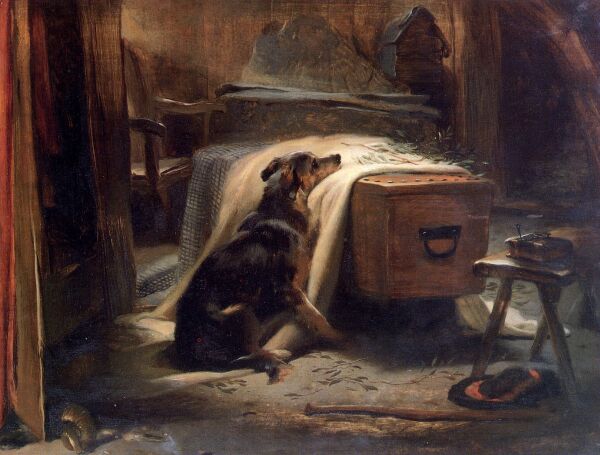 "Old
Shepherd's Chief Mourner," by Edwin Landseer, 1837
"Old
Shepherd's Chief Mourner," by Edwin Landseer, 1837
Who May Not
Have a Christian Burial
Catholic funerals are denied to the unbaptized (note that
catechumens, including infants whose parents planned on having them
baptized, are "baptized" by desire, and that martyrs are "baptized" by
blood); infidels; heretics; suicides (unless they were of unsound mind
or showed signs of repentance); notorious, unrepentant sinners; the
excommunicated; the schismatic; those under ecclesiastical censure;
those who, without remorse, have openly held the sacraments in
contempt; and those who, for
anti-Christian motives, choose to be cremated.
See also Praying for the Dead.
Footnote:
1 Moore, Russell D.,
"Grave Signs," Touchstone Magazine, January/February, 2007
2 See the book Caring for the Dead: Your Final Act of Love, Dewey
Decimal# 393, ISBN# 0942679210 . The link is offsite, will open in new
browser window. I quibble with the title; caring for your loved one's
body isn't the "final" act of love! We pray for our dead for the rest
of our lives!
|
|