``Where
the Bishop is, there let the multitude of believers be;
even as where Jesus is, there is the Catholic Church'' Ignatius of
Antioch, 1st c. A.D
Advent Overview
Theme:
His
Historical and Future Coming
Color:
Violet
Mood:
Somber
anticipation, restrained joy that grows each day until Christmas,
rather like waiting for a new mother to give birth -- joyous,
yet restrained, hesitant, and humbled until the moment of the birth
arrives
Symbols:
Advent
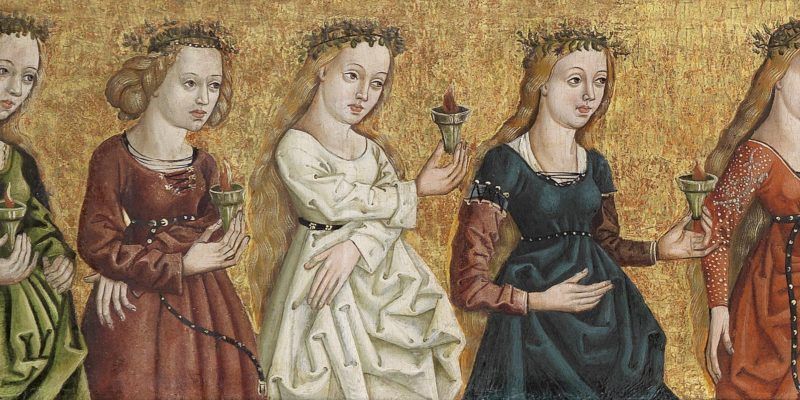
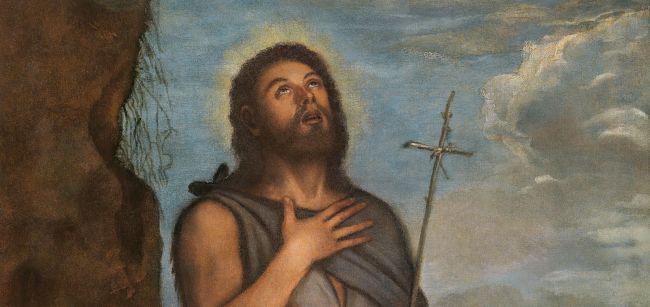
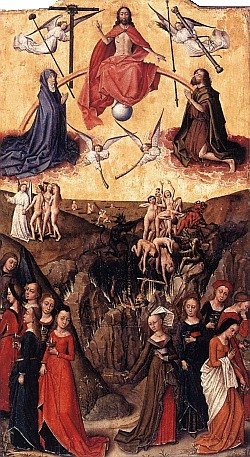
candles, empty crib, St. John the Baptist, the Ten Virgins
Length:
the
4th Sunday before Christmas to 24 December.
The 1st of the 4 Sundays in Advent is known as "Advent Sunday";
the 3rd Sunday is known as "Gaudete Sunday."
Advent -- the start of the Church's new liturigcal year -- begins on
the Sunday closest to -- before or after --
St. Andrew's Day (November 30). The focus of the season is preparation
for the coming of the Lord
-- both
in commemoration of His Nativity and His coming again at the end of
time. Though most Protestants -- and far too many Catholics -- see this
time of year as a part of the "Christmas Season," it isn't; the
Christmas season does not begin until the first Mass at Christmas Eve,
and doesn't end liturgically until the Octave of the Epiphany on
January 14. It goes on in the spiritual sense until Candlemas on
February 2, when all celebrations of Christ's Childhood give way to Septuagesima and Lent.
The mood of this season is a penitential one of somber
spiritual
preparation, like Lent, but one that increases in joy with each day as
Christmas approaches. The gaudy
"Christmas" commercialism that surrounds Advent in the Western world
should
be overcome as much as possible. The singing of Christmas carols (which
comes earlier and earlier each year), the talk of "Christmas" as a
present reality, the decorated trees and the parties -- these things
are "out of season" for Catholics; we should strive to keep the Seasons
of Advent holy and penitential, always remembering, as they say, that
"He is the reason for the Season."
To
sum up the similarities and differences between Advent and Lent as
penitential seasons, there's this, by Fr. Lawrence Smith:
Advent
is the time to make ready for Christ to live with us. Lent is the time
to make us ready to die with Christ. Advent makes Lent possible. Lent
makes salvation possible. Advent is the time when eternity approaches
earth. Lent is the time when time reaches consummation in Christ's
eternal Sacrifice to the Father. Advent leads to Christ's life in time
on earth. Lent leads to Christ's eternal Life in Heaven. The Cross --
through the Mass, penance, and mortification -- is the bridge
connecting Advent and Lent, Christ and His Church, man and God.
Each of the Church's penitential seasons is a dying to the world with
the goal of attaining new life in Christ.
Catholic
apologist Jacob Michael wrote something very interesting about how
secular America sees "Christmas" as beginning after Thanksgiving and
ending on 25 December, and then makes "New Years Resolutions" at the
beginning of the secular year:
...what
Christians do (or should be doing!) during Advent and leading up to
Christmas is a foreshadowing of what they will do during the days of
their lives that lead up to the Second Coming; what non-Christians
refuse to do during Advent, and put off until after Christmas, is
precisely a foreshadowing of what they will experience at the Second
Coming.
We Christians are to prepare for the Coming of Christ before He
actually comes -- and that Coming is symbolized and recalled at
Christmas. Non-Christians miss this season of preparation, and then
scramble for six days after the 25th to make their resolutions. By
then, however, it's too late -- Christmas has come and gone, Our Lord
has already made His visitation to the earth, and He has found them
unprepared. This is precisely what will take place at the Second
Coming, when those who have put off for their entire lives the
necessary preparations will suddenly be scrambling to put their affairs
in order. Unfortunately, by then it will have been too late, and there
will be no time for repentance. The Second Coming will be less
forgiving than the Incarnation. There will be no four-week warning
period before the Second Coming, like we get during Advent. There will
be no six-day period of grace after the Second Coming during which to
make resolutions and self-examination, like the secular world does from
Dec. 26 until Jan. 1.
So
please, restore Advent and don't think "Christmas is here" until it
truly comes. One way to help focus on the theme of preparation is to
read the parables of
The Fig Tree, The Man Going on a Long Journey, The Faithful and Wicked
Stewards, and The Ten Virgins in the 24th and 25th chapters of St.
Matthew's Gospel. Another way to help you do this is to think of the
Saint who embodies the spirit of this Season more than any other: the
great St. John
the Baptist. If you have an icon of him, venerate it
especially now. Make special prayers to him and consider the message of
this "voice of one crying in the desert": "Prepare ye the way of the
Lord, make straight his paths." You will note that the readings of the
second, third, and fourth Sundays of Advent focus on St. John, the
earthly herald of Christ's coming whom St. Ephraem likened to the Star
of Bethlehem, the Heavenly herald of His coming.
St.
Ephraem also wrote these words which recall the Forerunner's message of
preparation:
To
prevent his disciples from asking the time of his coming, Christ said:
About that hour no one knows, neither the angels nor the Son. It is not
for you to know times or moments. He has kept those things hidden so
that we may keep watch, each of us thinking that he will come in our
own day. If he had revealed the time of his coming, his coming would
have lost its savour: it would no longer be an object of yearning for
the nations and the age in which it will be revealed. He promised that
he would come but did not say when he would come, and so all
generations and ages await him eagerly. Though the Lord has established
the signs of his coming, the time of their fulfilment has not been
plainly revealed. These signs have come and gone with a multiplicity of
change; more than that, they are still present. His final coming is
like his first. As holy men and prophets waited for him, thinking that
he would reveal himself in their own day, so today each of the faithful
longs to welcome him in his own day, because Christ has not made plain
the day of his coming.
He has not made it plain for this reason especially, that no one may
think that he whose power and dominion rule all numbers and times is
ruled by fate and time. He described the signs of his coming; how could
what he has himself decided be hidden from him? Therefore, he used
these words to increase respect for the signs of his coming, so that
from that day forward all generations and ages might think that he
would come again in their own day.
Keep watch; when the body is asleep nature takes control of us, and
what is done is not done by our will but by force, by the impulse of
nature. When deep listlessness takes possession of the soul, for
example, faint-heartedness or melancholy, the enemy overpowers it and
makes it do what it does not will. The force of nature, the enemy of
the soul, is in control.
When the Lord commanded us to be vigilant, he meant vigilance in both
parts of man: in the body, against the tendency to sleep; in the soul,
against lethargy and timidity. As Scripture says: Wake up, you just,
and I have risen, and am still with you; and again, Do not lose heart.
Take note of the
liturgy -- both certain Masses and parts of the Divine Office -- in
Advent, especially
on Saturdays and at other times scattered throughout the season. You'll
hear the "Rorate Caeli" frequently, the beautiful cry to God to send
forth the Savior:
Drop down dew,
ye heavens, from above,
and let the clouds rain the just
R. Let the earth
be opened and send forth a Saviour
Rorate caeli
desuper et nubes pluant justum
R. Aperiatur
terra et germinet salvatorem
Marian-focused "Rorate Masses" offered
on Advent Saturdays (and, in some places, on other days throughout
Advent) take place
very, very early in the morning, when it's still dark -- so dark that
people burn candles to light the church, awaiting literal
dawn as we await the "Dayspring, Brightness of the everlasting light,
Sun
of justice, come to give light to them that sit in darkness and in the
shadow of death!"
First Sunday of
Advent: S. Maria Maggiore
Second Sunday of Advent: S. Croce in Gerusalemme
Third Sunday of Advent: S. Pietro in Vaticano
Advent Ember Wednesday: S. Maria Maggiore
Advent Ember Friday: SS. Apostoli
Advent Ember Saturday: S. Pietro in Vaticano
Fourth Sunday of Advent: SS. Apostoli
Temporal Preparations
Advent
is also season of preparation in a more mundane sense. Homes are
cleaned from top to bottom, and Christmas cakes and cookies are often
made by the hundreds for family and to give out to friends and
acquaintances when Christmas finally arrives.
Christmas trees shouldn't be decorated (or at least lit) until Christmas Eve
because Advent itself should remain penitential, but time can be
wonderfully spent making Christmas Tree ornaments throughout the Season
for when Christmas finally arrives. Here is a recipe for Baker's Clay which you can
use to do just that.
Christmas Cards
Since
Victorian times, Catholics send Christmas cards at this time of year,
usually with religious themes and avoiding the secularized language and
images so prevalent today (i.e., "Season's Greetings" as opposed to
"Merry Christmas"; Santa or Rudolph instead of Mother and Child, etc.)
Always, the emphasis should be on Christ! Religious-themed Christmas
cards are getting more and more difficult to find; buying them early
from a Catholic Bookstore is a good idea. At the very least, a Catholic
message could be added by hand to the inside of an otherwise
non-religious card (by the way, "merry" originally meant, and
should mean to Catholics, "blessed and peaceful," not party-like as in
"merry-making." For ex., the carol, "God Rest Ye Merry, Gentlemen" has
a comma after the "merry" and addresses "gentlemen," not "merry
gentlemen." It means "God keep you peaceful and blessed, men!" And on
another note, the angel never said to the shepherds, "Glory to God in
the highest, and on earth peace, good will toward men"
as the King James version reads; he said, "Glory to God in the highest
and on earth, peace to men of good will" -- Luke
2:14 -- a vastly different sentiment that doesn't lead to the false
idea that there can be peace among ill-willed men.)
At any rate, cards should be sent around two weeks before Christmas
(around the Feast of Our Lady of Guadalupe) to ensure they arrive in
time. Cards received are often displayed -- in albums, randomly on
tables, or by fastening them to ribbons which hang on a wall.
And as with the secularized holiday cards, Catholics might avoid
greeting people during this season with "Happy holidays!" and the like.
"Merry Christmas" is the proper greeting -- and if one wants to get
technical about it, Catholics may say "Blessed Advent" up until the
first Mass on Christmas Eve, and "Merry Christmas" thereafter for the
twelve days of Christmas. People might not understand, but this affords
Catholics an opportunity to explain (with a smile).
In the same way that people count down the days of Lent in various
ways, Advent calendars are used to
count down the days of Advent from December 1 to December 25. Another
way to count down the days is to make a paper chain, with 23 to 29
links (depending on when Advent starts) representing the days of
Advent, starting on the first Sunday of Advent. Differently colored
papers can be used for the various links, for ex.Advent Sundays can be
represented by paper colored violet (and rose for Gaudete Sunday); the Marian feasts can
be represented by white paper, the Ember Days
can be represented by a darker-colored purple paper; the Golden Nights
can be represented by gold-colored paper, etc. Various links can be
decorated as well, with symbols of the Saints whose feasts fall during
this season. Then, as each day passes, a link is removed.
One
particular Advent custom that should be mentioned here and which
families might want to consider beginning on Advent Sunday is known as
"Christkindl" (Christ Child). Maria Von Trapp describes it thus:
Once
more the mother appears with the bowl, which she passes around. This
time the pieces of paper contain the names of the members of the family
and are neatly rolled up, because the drawing has to be done in great
secrecy. The person whose name one has drawn is now in one's special
care. From this day until Christmas, one has to do as many little
favors for him or her as one can. One has to provide at least one
surprise every single day — but without ever being found out. This
creates a wonderful atmosphere of joyful suspense, kindness, and
thoughtfulness. Perhaps you will find that somebody has made your bed
or shined your shoes or has informed you, in a disguised handwriting on
a holy card, that "a rosary has been said for you today" or a number of
sacrifices have been offered up. This new relationship is called
"Christkindl" (Christ Child) in the old country, where children believe
that the Christmas tree and the gifts under it are brought down by the
Christ Child himself.
The beautiful thing about this particular custom is that the
relationship is a reciprocal one. The person whose name I have drawn
and who is under my care becomes for me the helpless little Christ
Child in the manger; and as I am performing these many little acts of
love and consideration for someone in the family I am really doing them
for the Infant of Bethlehem, according to the word, "And he that shall
receive one such little child in my name, receiveth me." That is why
this particular person turns into "my Christkindl." At the same time I
am the "Christkindl" also for the one I am caring for because I want to
imitate the Holy Child and render all those little services in the same
spirit as He did in that small house of Nazareth, when as a child He
served His Mother and His foster father with a similar love and
devotion.
Many times throughout these weeks can be heard such exclamations as, "I
have a wonderful Christkindl this year!" or, "Goodness, I forgot to do
something for my Christkindl and it is already suppertime!" It is a
delightful custom, which creates much of the true Christmas spirit and
ought to be spread far and wide.
The
last seven nights of Advent, from the 17th to the 23rd, are known as
"The
Golden Nights," and on
these special days, the sense of Our Lord's Coming becomes more intense
and focused. The O
Antiphons are sung and families can make special devotions
at this time.
From December 16 to
Christmas Eve --
the nine days before
Christmas -- Mexicans and Mexican Americans have a wonderful custom
called "Las Posadas," a nightly procession
that brings to life Joseph
and Mary's search for an inn.
In Colombia, Venezuela, Ecuador, and the North American communities
made of people from those areas, a beautiful, musical novena is
prayed -- the Novena de Aguinaldos --
starting on December 16 and ending on Christmas Eve. Family and friends
gather together for nine consecutive nights to pray, meditate, sing,
and eat as they await the arrival of the Christ Child.
As to reading, in addition to the reading below, you might enjoy
reading St. Bernard
of Clairvaux's Sermons on Advent and Christmas, which you can find in
this site's Catholic
Library.
And as to music, you'll find songs sprinkled throughout the pages here
that cover the feasts of Advent, but I have to present this one, an
allusion to the parable of the ten virgins (Matthew 24-25). It is sung
by the
Hillbilly Thomists, a group of Dominican friars who play bluegrass.
It's perfect for the season:
Chorus:
Keep those lamps trimmed, now
Keep those lamps trimmed
Midnight's comin' in
Won't you keep those lamps trimmed?
You do not know the day
And you do not know the hour
Keep watch, stay awake
You do not know the day
My soul waits for more than sentinels
The Lord, for He comes with mercy
Chorus
Got no time to waste, now
Got no time to waste
Bridegroom's coming soon
Ain't got no time to waste
From the depths I cry
Lord, for He comes with mercy
Chorus x4, sung as
a round
Reading:
"The
Mystery of Advent"
from Dom Gueranger's "Liturgical Year"
If,
now that we have described the characteristic features of Advent which
distinguish it from the rest of the year, we would penetrate into the
profound mystery which occupies the mind of the Church during this
season, we find that the mystery of the Coming, or Advent, of Jesus is
at once simple and threefold. It is simple for it is the one same Son
of God that is coming; it is threefold because He comes at three
different times and in three different ways.
'In the first coming,' says St. Bernard, 'He comes in the flesh and in
weakness; in the second, He comes in spirit and in power; in the third,
He
comes in glory and in majesty; and the second coming is the means
whereby
we pass from the first to the third.'
This, then, is the mystery of Advent. Let us now listen to the
explanation of this threefold visit of Christ, given to us by Peter of
Blois, in his third sermon de Adventu:
'There are
three comings of our Lord; the first in the flesh; the second in the
soul; the third at the judgment. The first was at midnight according to
those
words of the Gospel: At Midnight there was a cry made, Lo, the
Bridegroom cometh! But this first coming is long since past for Christ
has been seen on the earth and has conversed among men. We are now in
the second coming, provided only we are such as that He may thus come
to us; for He has said that if we love Him, He will come unto us and
take
up His abode with us. So that this second coming is full of uncertainty
to us; for who, save the Spirit of God, knows them that are of God?
They that are raised out of themselves by the desire of heavenly
things, know indeed when He comes, but whence He cometh or whither He
goeth they know not. As for the third coming, it is most certain that
it will be, most uncertain when it will be; for nothing is more sure
than death, and nothing less sure than the hour of death. When they
shall say, peace and security, says the apostle, then shall sudden
destruction come upon them, as the pains upon her that is with child,
and they shall not escape. So that the first coming was humble and
hidden, the second is mysterious and full of love, the third will be
majestic and terrible. In His first coming, Christ was judged by men
unjustly; in His second, He renders us just by His grace; His third, He
will judge all things with justice. In His first,
a lamb; in His last, a lion; in the one between the two, the tenderest
of friends.'
The holy Church, therefore, during Advent, awaits in tears and with
ardour the arrival of her Jesus in His first coming. For this, she
borrows the fervid expressions of the prophets, to which she joins her
own supplications. These longings for the Messias expressed by the
Church, are not a mere commemoration of the desires of the ancient
Jewish people; they have a reality and efficacy of their own, an
influence in the great act of God's munificence, whereby He gave us His
own Son. From all eternity, the prayers of the ancient Jewish people
and the prayers of the Christian Church ascended together to the
prescient hearing of God; and it was after receiving and granting
them, that He sent, in the appointed time, that blessed Dew upon the
earth, which made it bud forth the Saviour.
The Church aspires also to the second coming, the consequence of the
first, which consists, as we have just seen, in the visit of the
Bridegroom to the bride. This coming takes place, each year, at the
feast of Christmas, when the new birth of the Son of God delivers the
faithful from that yoke of bondage, under which the enemy would oppress
them. The Church, therefore, during Advent, prays that she may be
visited by Him Who is her Head and her Spouse; visited in her
hierarchy; visited in her members, of whom some are living, and some
are dead, but may come to life again; visited, lastly, in those who are
not in communion with her, and even in the very infidels, that so they
may be converted to the true light, which shines even for them. The
expressions of the liturgy which the Church makes use of to ask for
this loving and invisible coming, are those which she employs when
begging for the coming of Jesus in the flesh; for the two visits are
for the same object. In vain would the Son of God have come, nineteen
hundred years ago, to visit and save mankind, unless He came again for
each one of us and at every moment of our lives, bringing to us and
cherishing within us that supernatural life, of which He and His holy
Spirit are the sole principle.
But this annual visit of the Spouse does not content the Church; she
aspires after a third coming which will complete all things by opening
the gates of eternity. She has caught up the last words of her Spouse,
'Surely I am coming quickly,' and she cries out to Him, 'Ah! Lord
Jesus!
Come!' She is impatient to be loosed from her present temporal state;
she longs for the number of the elect to be filled up, and to see
appear, in the clouds of heaven, the sign of her Deliverer and her
Spouse. Her desires, expressed by her Advent liturgy, go even as far as
this: and here we have the explanation of these words of the beloved
disciple in his prophecy: 'The nuptials of the Lamb are come, and His
wife hath prepared herself.'
But the day of this His last coming to her will be a day of terror. The
Church frequently trembles at the very thought of that awful judgment,
in which all mankind is to be tried. She calls it 'a day of wrath, on
which, as David and the Sibyl have
foretold, the world will be reduced to ashes; a day of weeping and of
fear.' Not that she fears for herself, since she knows that this day
will for ever secure for her the crown, as being the bride of Jesus;
but her maternal heart is troubled at the thought that, on the same
day, so many of her children will be on the left hand of the Judge,
and having no share with the elect, will be bound hand and foot, and
cast into the darkness, where there shall be everlasting weeping and
gnashing of teeth. This is the reason why the Church, in the liturgy of
Advent, so frequently speaks of the coming of Christ as a terrible
coming, and selects from the Scriptures those passages which are most
calculated to awaken a salutary fear in the mind of such of her
children as may be sleeping the sleep of sin.
This, then, is the threefold mystery of Advent. The liturgical forms in
which it is embodied, are of two kinds: the one consists of prayers,
passages from the Bible, and similar formulae, in all of which, words
themselves are employed to convey the sentiments which we have been
explaining; the other consists of external rites peculiar to this holy
time, which, by speaking to the outward senses, complete the
expressiveness of the chants and words.
First of all, there is the number of the days of Advent. Forty was the
number originally adopted by the Church, and it is still maintained in
the Ambrosian liturgy, and in the eastern Church. If, at a later
period, the Church of Rome, and those which follow her liturgy, have
changed the number of days, the same idea is still expressed in the
four weeks which have been substituted for the forty days. The new
birth of our Redeemer takes place after four weeks, as the first
nativity happened after four thousand years, according to the Hebrew
and Vulgate chronology.
As in Lent, so likewise during Advent, marriage is not solemnized, lest
worldly joy should distract Christians from those serious thoughts
wherewith the expected coming of the sovereign Judge ought to inspire
them, or from that dearly cherished hope which the friends of the
Bridegroom have of being soon called to the eternal nuptial-feast.
The people are forcibly reminded of the sadness which fills the heart
of the Church, by the sombre colour of the vestments. Excepting on the
feasts of the Saints, purple is the coulour she uses; the deacon does
not wear the dalmatic, nor the sub-deacon the tunic. Formerly it was
the custom, in some places, to wear black vestments. This mourning of
the Church shows how fully she unites herself with those true
Israelites of old who, clothed in sack-cloth and ashes, waited for the
Messias, and bewailed Sion that she had not her beauty, and Juda, that
the sceptre had been taken from him, till He should come who was to be
sent, the expectation of nations. It also signifies the works of
penance, whereby she prepares for the second coming, full as it is of
sweetness and mystery, which is realized in the souls of men, in
proportion as they appreciate the tender love of that Divine Guest, who
has said: 'My delights are to be with the children of men.' It
expresses, thirdly, the desolation of this bride who yearns after her
Beloved, who is long a-coming. Like the turtle dove, she moans her
loneliness, longing for the voice which will say to her: 'Come from
Libanus, my bride! come and thou shalt be crowned. Thou has wounded my
heart.'
The Church also, during Advent, excepting on the feasts of saints,
suppresses the Angelic canticle, Gloria in excelsis Deo, et
in terra pax hominibus bonae voluntatis; for this glorious
song was sung at Bethlehem over the crib of the divine Babe; the
tongues of the Angels are not loosened yet; the Virgin has not yet
brought forth her Divine Treasure; it is not yet time to sing, it is
not even true to say, 'Glory be to God in the highest, and peace on
earth to men of good will.'
Again, at the end of Mass, the deacon does not dismiss the assembly of
the faithful by the words: Ite missa est. He
substitutes the ordinary greeting: Benedicamus Domino!
as though the Church feared to interrupt the prayers of the people,
which could scarce be too long during these days of expectation.
In the night Office, the holy Church also suspends, on those same days,
the hymn of jubilation, Te Deum laudamus. It is in
deep humility that she awaits the supreme blessing which is to come to
her; and, in the interval, she presumes only to ask, and entreat, and
hope. But let the glorious hour come, when in the midst of darkest
night the Sun of Justice will suddenly rise upon the world: then indeed
she will resume her hymn of thanksgiving, and all over the face of the
earth the silence of midnight will be broken by this shout of
enthusiasm: 'We praise Thee, O God! we acknowledge Thee to be our Lord!
Thou, O Christ, art the King of glory, the everlasting Son of the
Father! Thou being to deliver man didst not disdain the Virgin's womb!'
On the ferial days, the rubrics of Advent prescribe that certain
prayers should be said kneeling, at the end of each canonical Hour, and
that the choir should also kneel during a considerable portion of the
Mass. In this respect, the usages of Advent are precisely the same as
those of Lent.
But there is one feature which distinguishes Advent most markedly from
Lent: the word of gladness, the joyful Alleluia, is not interrupted
during Advent, except once or twice during the ferial Office. It is
sung in the Masses of the four Sundays, and vividly contrasts with the
sombre colour of the vestments. On one of these Sundays, the third, the
prohibition of using the organ is removed, and we are gladdened by its
grand notes, and rose-coloured vestments may be used instead of the
purple. These vestiges of joy, thus blended with the holy mournfulness
of the Church, tell us, in a most expressive way, that though she
unites with the ancient people of God in praying for the coming of the
Messias (thus paying the debt which the
entire human race owes to the justice and mercy of God), she does not
forget that the Emmanuel is already come to her, that He is in her, and
that even before she has opened her lips to ask Him to save her, she
has been already redeemed and pre-destined to an eternal union
with
Him. This is the reason why the Alleluia accompanies even her sighs,
and why she seems to be at once joyous and sad, waiting for the coming
of that holy night which will be brighter to her than the most sunny of
days, and on which her joy will expel all her sorrow.