|
Lent (the word "Lent" comes from the Old English "lencten,"
meaning "springtime) lasts from Ash
Wednesday to the Vespers of Holy
Saturday -- forty days, never minding the six Sundays which don't count
as "Lent"
liturgically. The Latin name for Lent, Quadragesima, means forty and
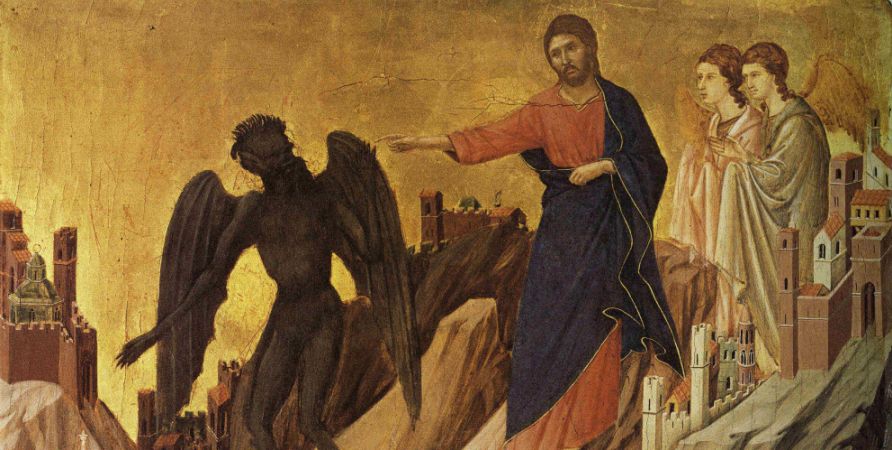
refers to the forty days Christ spent in the desert which is the origin
of the Season.The last two weeks of Lent are known as "Passiontide,"
made up of Passion Week (which begins on Passion
Sunday) and Holy Week (which begins on Palm
Sunday). The last three days of Holy Week
-- Maundy Thursday, Good Friday, and Holy Saturday -- are known as the
"Sacred Triduum." Here for your use is a pdf
file of the scheme of the Lenten season.
The focus of this Season is the Cross and penance, penance, penance as
we imitate Christ's forty days of fasting, like Moses and Elias before
Him, and await the triumph of Easter. We fast (see below), abstain,
mortify the flesh, give alms, and think more of charitable works.
Awakening each morning with the thought, "How might I make amends for
my sins? How can I serve God in a reparative way? How can I serve
others today?" is the attitude to have.
As we meditate on "The Four Last Things"
-- Death, Judgment, Heaven,
and
Hell -- we also practice mortifications by "giving up something" that
would be
a sacrifice to do without. The sacrifice could be anything from
desserts to television to the marital embrace, and it can entail, too,
taking on something unpleasant that we'd normally avoid, for example,
going out of one's way to do another's chores, performing "random acts
of kindness," getting out of bed immediately after waking and not
dallying under the blankets in the morning, taking cold showers instead
of hot
ones, etc. A practice that might help some, especially small
children, to think sacrificially is to make use of "Sacrifice Beads" in the same way that
St. Thérèse of Lisieux did as a child. Note, though, that Sundays --
even the Sundays of Lent -- are not penitential days; they are always
celebratory days of rejoicing. So if you've given up sweets for Lent,
you can indulge some on Sundays, even during this penitential season
(this is why Sundays aren't counted at all as the days "of Lent." If
you go by the calendar, Lent seems to last for 46 days -- if you count
the Sundays. But Catholics don't include those Sundays, so Lent
consists of 40 days).
Ideally, the practices one gives up and takes on during Lent should
center around eliminating a particular vice, or bad habit, one has, and
focus on
cultivating the vice's opposite virtue, or good habit. You can learn
more about vice and virtue, generally, on the Catholic
Moral Thinking page; after reading, try to discern which vice you
most need to eliminate from your life, and which virtue you need to
develop (here, the Becoming Virtuous
pages may be of service to you). Let your Lenten sacrices be those
that best help you eradicate
your most problematic vice by helping you develop the virtue that
defeats it. Provided here is a Lenten Checklist in pdf format to help
you organize your thoughts and Lenten routine: Lenten Checklist.
Don't try to do too
much! Do what you're able to do without becoming frustrated or
overwhelmed. Carry out your sacrifices without complaint and without
making others miserable. And don't make a contest out of your
sacrifices; in fact, it's best to keep them to yourself. Another thing
to not do is to pretend as if giving up your favorite sin is a proper
Lenten sacrifice: sin is something you shouldn't be doing anyway! Yes, most definitely give
up that sin -- but also add the sacrifice of something good, something
allowable, something that is perfectly licit to enjoy in an ordinate
way. And as you go
along, know that offering up
your sufferings for the good of someone you love can help keep you
motivated.
Because of the focus on penance and reparation, it is traditional to
make sure we go to Confession at least once
during this Season to
fulfill the precept of the Church that we go to Confession at least
once a year; this prepares us to follow the precept of receiving the
Eucharist at least once a year during
Eastertide. A beautiful old custom associated with Lenten Confession is
to, before going to see the
priest, bow before each member of your household and to any you've
sinned against, and say, "In the Name of Christ, forgive me if I've
offended you." One responds with "God will forgive you." Done with an
extensive examination of
conscience and a sincere heart, this practice
can be quite healing (also note that confessing sins to a priest is a
Sacrament which remits mortal and venial sins; confessing sins to those
you've offended is a sacramental which, like all sacramentals one
piously takes advantage of, remits venial sins. Both are quite good for
the soul!)
Lent is a particularly good time to otherwise make amends and rebuild
broken relationships. Pray for the ability to truly forgive the
repentant who've wronged you, and consider those whom you've wronged
and whose forgiveness you should seek. Examine your entire life, year
by year, looking for ways you've failed, lied, broken God's laws,
harmed others, etc. Ask for a contrite and humble
heart, and for the fortitude to
make right what you've done wrong.
In addition to mortification and charity, seeing and living Lent as a
forty day spiritual retreat is a good
thing to do. Spiritual reading
should be engaged in, over and above one's regular Lectio Divina. Maria von Trapp
recommended "the Book of Jeremias and the works of Saints, such as The
Ascent of Mount Carmel, by St. John of the Cross; The Introduction to a
Devout Life, by St. Francis de Sales; The Story of a Soul, by St.
Thérèse of Lisieux; The Spiritual Castle, by St. Teresa of Avila; the
Soul of the Apostolate, by Abbot Chautard; the books of Abbot Marmion,
and similar works." You can find all of these books, and many more, in
this site's Catholic Library, and I
provide them here, along with a few other selections:
Prayer for Lent
As to prayer, praying the beautiful Seven
Penitential Psalms (Psalms 6, 31, 37, 50, 101, 129, and 142) is a
traditional practice. It is most traditional to pray all of these each
day of Lent, but if time is an issue, you can pray them all on just the
Fridays of Lent, or, because there are seven of them, and seven Fridays
in Lent, you might want to consider praying one on each Friday. These
Psalms, which include the Psalms "Miserére" and "De Profundis," are
perfect expressions of contrition and prayers for mercy. So apt are
these Psalms at expressing contrition that, as he lay dying in A.D.
430, St. Augustine asked that a monk write them in large letters near
his bed so he could easily read them.
Another great prayer for this season is that of St. Ephraem, Doctor of
the Church (d. 373). This prayer is often prayed with a prostration after each stanza:
O Lord and
Master of my life, take from me the spirit of sloth, despondency, lust
of power, and idle talk;
But grant rather the spirit of chastity, humility, patience, and love
to thy servant.
Yea, O Lord and King, grant me to see my own transgressions, and not to
judge my brother; for blessed art Thou unto the ages of ages.
In the East,
this prayer is prayed liturgically during Lent and is followed by "O
God, cleanse me a sinner" prayed twelve times, with a bow following
each, and one last prostration.
Another prayer to be mindful of is the En
ego, O bone et
dulcissime Iesu (Prayer Before a Crucifix). On all Fridays
during Lent, one may gain a plenary indulgence,
under the usual conditions, by
reciting this prayer before an image of
Christ crucified.
The Litany of Humility, written by
Rafael Cardinal Merry del Val y Zulueta, the Secretary of State to Pope
Saint Pius X (1903-1914), is a good litany for this season, as is the
8th century Litany
of Confession.
Other devotions to focus on particulary during Lent include praying the
Sorrowful Mysteries of the Rosary and making
the Stations of the Cross (on Fridays
especially).
Food in Lent
According to the
1983 Code of Canon Law, the rule for the universal Church
during Lent is to abstain on all Fridays and
to both fast and abstain on Ash Wednesday
and Good Friday.
Some traditional Catholics might voluntarily follow the older pattern
of fasting and abstinence during this time,
which
for the universal Church required:
- Ash
Wednesday, all Fridays, and all Saturdays: fasting and total
abstinence. This means 3 meatless meals -- with the two smaller meals
not equalling in size the main meal of the day -- and no snacking.
- Mondays,
Tuesdays, Wednesdays (except Ash Wednesday), and Thursdays: fasting
and partial abstinence from meat. This means three meals --
with the two smaller meals not equalling in size the main meal of the
day -- and no snacking, but meat can be eaten at the principle meal.
On those days of
fasting and abstinence, fish and meatless soup are traditional (see recipes), as are egg dishes -- pepper
and egg sandwiches for Italian Americans. You'll find lots of parishes
hosting a "Fish Fry" on Fridays at this time of year. Sundays, of
course, are
always free of fasting and abstinence; even in the heart of Lent,
Sundays are about the glorious Resurrection. This pattern of fasting
and abstinence ends after the Vigil Mass of Holy Saturday.
As to special Lenten foods, vegetables, seafoods, salads, pastas, and
beans mark the Season, in addition to the meatless soups. The fasting
of this time once even precluded the eating of eggs and fats, so the
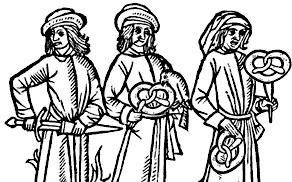
chewy pretzel became the bread and symbol of the times. They'd always
been a Christian food, ever since Roman times, their very shape being
the creation of monks. The three holes represent the Holy Trinity, and
the twists of the dough represent the arms of someone praying. In fact,
the word "pretzel" is a German word deriving ultimately from the Latin
"bracellae," meaning "little arms" (the Vatican has the oldest known
representation of a pretzel, found on a 5th c. manuscript). Below is a
recipe for the large, soft, chewy pretzels that go so well with beer:
Soft Pretzels (makes 12)
1 (.25 ounces) package active dry yeast
2 Tablespoons brown sugar
1 1/8 teaspoons salt
1 1/2 cups warm water (110 degrees F)
3 cups all-purpose flour
1 cup bread flour
2 cups warm water (110 degrees F)
1 Tablespoons baking soda dissolved in 6 qt. water in large pot
egg + water for eggwash
2 Tablespoons butter, melted
2 Tablespoons coarse pretzel salt or kosher salt
In a large mixing bowl, dissolve the yeast, brown sugar and salt in 1
1/2 cups warm water. Stir in flour, and knead dough on a floured
surface until smooth and elastic, about 8 minutes. Place in a greased
bowl, and turn to coat the surface. Cover, and let rise for one hour.
Meanwhile, place parchment on cookie sheets and oil paper.
After dough has risen, cut into 12 pieces. Roll each piece into a 2 to
3 foot, finger-thick rope. With the rope, make a U, cross the ends,
twist, and attach to the center of the bottom of the U. Place on the
parchment-lined sheets and let rise, uncovered, 15 to 20 minutes. While
they are rising, bring the baking soda + water in the pot to a boil.
When the pretzels are risen, boil the pretzels in the water for about 3
minutes, turning once, til puffed a bit. Place on sheets and brush with
eggwash.
Bake at 450 degrees F for 8 to 10 minutes, or until golden brown. Brush
with melted butter, and sprinkle with coarse salt (can use garlic salt
or cinnamon sugar instead).
Hot Cross Buns
are eaten at breakfast on Good Friday,
and there are other special foods eaten on certain days, but you can
read about these on the pages dedicated to those dates.
Note: every single day of
this season has an associated station
church.
Note, too, that some time in Lent is the time to plan any garden you
might want (consider a Mary Garden). If
you're growing plants from seeds and want to start them indoors, the
time to do that is 6 weeks before the last frost date in your area (in
Indiana, that date is around April 20). If you plan on buying plants
instead of seeds,
plant them after that last frost date.
Reading
"The Mystery
of Lent"
from Dom Gueranger's "The Liturgical Year"
We may be sure
that a season so sacred as this of Lent is rich in mysteries. The
Church has made it a time of recollection and penance, in preparation
for the greatest of all her feasts; she would, therefore, bring into it
everything that could excite the faith of her children, and encourage
them to go through the arduous work of atonement for their sins. During
Septuagesima, we had the number "seventy", which reminds us of those
seventy years of captivity in Babylon, after which God's chosen people,
being purified from idolatry, was to return to Jerusalem and celebrate
the Pasch. It is the number "forty" that the Church now brings before
us: a number, as St. Jerome observes, which denotes punishment and
affliction.
Let us remember the forty days and forty nights of the deluge sent by
God in His anger, when He repented that He had made man, and destroyed
the whole human race with the exception of one family. Let us consider
how the Hebrew people, in punishment for their ingratitude, wandered
forty years in the desert, before they were permitted to enter the
promised land. Let us listen to our God commanding the Prophet Ezechiel
to lie forty days on his right side, as a figure of the siege which was
to bring destruction on Jerusalem.
There are two persons in the old Testament who represent the two
manifestations of God: Moses, who typifies the Law; and Elias, who is
the figure of the Prophets. Both of these are permitted to approach
God: the first on Sinai, the second on Horeb; but both of them have to
prepare for the great favour by an expiatory fast of forty days.
With these mysterious facts before us, we can understand why it is that
the Son of God, having become Man for our salvation and wishing to
subject Himself to the pain of fasting, chose the number of forty days.
The institution of Lent is thus brought before us with everything that
can impress the mind with its solemn character, and with its power of
appeasing God and purifying our souls. Let us, therefore, look beyond
the little world which surrounds us, and see how the whole Christian
universe is, at this very time, offering this forty days' penance as a
sacrifice of propitiation to the offended Majesty of God; and let us
hope that, as in the case of the Ninivites, He will mercifully accept
this year's offering of our atonement, and pardon us our sins.
The number of our days of Lent is, then, a holy mystery: let us now
learn, from the liturgy, in what light the Church views her children
during these forty days. She considers them as an immense army,
fighting day and night against their spiritual enemies. We remember
how, on Ash Wednesday, she calls Lent a Christian warfare. In order
that we may have that newness of life, which will make us worthy to
sing once more our "Alleluia", we must conquer our three enemies: the
devil, the flesh, and the world. We are fellow combatants with our
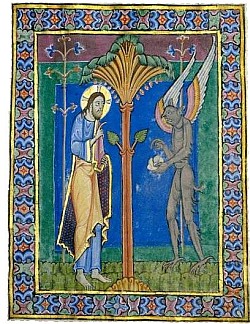
Jesus, for He, too, submits to the triple temptation, suggested to Him
by satan in person. Therefore, we must have on our armour, and watch
unceasingly. And whereas it is of the utmost importance that our hearts
be spirited and brave, the Church gives us a war-song of heaven's own
making, which can fire even cowards with hope of victory and confidence
in God's help: it is the ninetieth Psalm. She inserts the whole of it
in the Mass of the first Sunday of Lent, and every day introduces
several of its verses into the ferial Office.
She there tells us to rely on the protection, wherewith our heavenly
Father covers us, as with a shield; to hope under the shelter of His
wings; to have confidence in Him; for that He will deliver us from the
snare of the hunter, who had robbed us of the holy liberty of the
children of God; to rely upon the succour of the holy angels, who are
our brothers, to whom our Lord hath given charge that they keep us in
all our ways, and who, when Jesus permitted satan to tempt Him, were
the adoring witnesses of His combat, and approached Him, after His
victory, proffering to Him their service and homage. Let us well absorb
these sentiments wherewith the Church would have us to be inspired;
and, during our six weeks' campaign, let us often repeat this admirable
canticle, which so fully describes what the soldiers of Christ should
be and feel in this season of the great spiritual warfare.
But the Church is not satisfied with thus animating us to the contest
with our enemies: she would also have our minds engrossed with thoughts
of deepest import; and for this end she puts before us three great
subjects, which she will gradually enfold to us between this and the
great Easter solemnity. Let us be all attention to these soul-stirring
and instructive lessons.
And firstly, there is the conspiracy of the Jews against our Redeemer.
It will be brought before us in its whole history, from its first
formation to its final consummation on the great Friday, when we shall
behold the Son of God hanging on the wood of the cross. The infamous
workings of the Synagogue will be brought before us so regularly, that
we shall be able to follow the plot in all its details. We shall be
inflamed with love for the august Victim, whose meekness, wisdom, and
dignity bespeak a God. The divine drama, which began in the cave of
Bethlehem, is to close on Calvary, we may assist at it, by meditating
on the passages of the Gospel read to us by the Church during these
days of Lent.
The second of the subjects offered to us, for our instruction, requires
that we should remember how the feast of Easter is to be the day of new
birth for our catechumens, and how, in the early ages of the Church,
Lent was the immediate and solemn preparation given to the candidates
for Baptism. The holy liturgy of the present season retains much of the
instruction she used to give to the catechumens; and as we listen to
her magnificent lessons from both the old and the new Testament,
whereby she completed their "initiation", we ought to think with
gratitude of how we were not required to wait years before being made
children of God, but were mercifully admitted to Baptism even in our
infancy. We shall be led to pray for those new catechumens, who this
very year, in far distant countries, are receiving instructions from
their zealous missioners, and are looking forward, as did the
postulants of the primitive Church, to that grand feast of our
Saviour's victory over death, when they are to be cleansed in the
waters of Baptism and receive from the contact a new
being-regeneration.
Thirdly, we must remember how, formerly, the public penitents, who had
been separated on Ash Wednesday from the assembly of the faithful, were
the object of the Church's maternal solicitude during the whole forty
days of Lent, and were to be admitted to reconciliation on Maundy
Thursday, if their repentance were such as to merit this public
forgiveness. We shall have the admirable course of instructions, which
were originally designed for these penitents, and which the liturgy,
faithful as it ever is to such traditions, still retains for our sake.
As we read these sublime passages of the Scripture, we shall naturally
think upon our own sins, and on what easy terms they were pardoned us;
whereas, had we lived in other times, we should have probably been put
through the ordeal of a public and severe penance. This will excite us
to fervour, for we shall remember that, whatever changes the indulgence
of the Church may lead her to make in her discipline, the justice of
our God is ever the same. We shall find in all this an additional
motive for offering to His divine Majesty the sacrifice of a contrite
heart and we shall go through our penances with that cheerful
eagerness, which the conviction of our deserving much severer ones
always brings with it.
In order to keep up the character of mournfulness and austerity which
is so well suited to Lent, the Church, for many centuries, admitted
very few feasts into this portion of her year, inasmuch as there is
always joy where there is even a spiritual feast. In the fourth
century, we have the Council of Laodicea forbidding, in its fifty-first
canon, the keeping of a feast or commemoration of any saint during
Lent, excepting on the Saturdays or Sundays. The Greek Church rigidly
maintained this point of lenten discipline; nor was it till many
centuries after the Council of Laodicea that she made an exception for
March 25, on which day she now keeps the feast of our Lady's
Annunciation.
The Church of Rome maintained this same discipline, at least in
principle; but she admitted the feast of the Annunciation at a very
early period, and somewhat later, the feast of the apostle St. Mathias,
on February 24. During the last few centuries, she has admitted several
other feasts into that portion of her general calendar which coincides
with Lent; still, she observes a certain restriction, out of respect
for the ancient practice.
The reason why the Church of Rome is less severe on this point of
excluding the saints' feasts during Lent, is that the Christians of the
west have never looked upon the celebration of a feast as incompatible
with fasting; the Greeks, on the contrary, believe that the two are
irreconcilable, and as a consequence of this principle, never observe
Saturday as a fasting-day, because they always keep it as a solemnity,
though they make Holy Saturday an exception, and fast upon it. For the
same reason, they do not fast upon the Annunciation.
This strange idea gave rise, in or about the seventh century, to a
custom which is peculiar to the Greek Church. It is called the "Mass of
the Presanctified", that is to say, consecrated in a previous
Sacrifice. On each Sunday of Lent, the priest consecrates six Hosts,
one of which he receives in that Mass; but the remaining five are
reserved for a simple Communion, which is made on each of the five
following days, without the holy Sacrifice being offered. The Latin
Church practices this rite only once in the year, that is, on Good
Friday, and this in commemoration of a sublime mystery, which we will
explain in its proper place.
This custom of the Greek Church was evidently suggested by the
forty-ninth canon of the Council of Laodicea, which forbids the
offering of bread for the Sacrifice during Lent, excepting on the
Saturdays and Sundays. The Greeks, some centuries later on, concluded
from this canon that the celebration of the holy Sacrifice was
incompatible with fasting; and we learn from the controversy they had,
in the ninth century, with the legate Humbert, that the "Mass of the
Presanctified" (which has no other authority to rest on save a canon of
the famous Council in "Trullo", held in 692) was justified by the
Greeks on this absurd plea, that the Communion of the Body and Blood of
our Lord broke the lenten fast.
The Greeks celebrate this rite in the evening, after Vespers, and the
priest alone communicates, as is done now in the Roman liturgy on Good
Friday. But for many centuries they have made an exception for the
Annunciation; they interrupt the lenten fast on this feast, they
celebrate Mass, and the faithful are allowed to receive holy Communion.
The canon of the Council of Laodicea was probably never received in the
western Church. If the suspension of the holy Sacrifice during Lent was
ever practiced in Rome, it was only on the Thursdays; and even that
custom was abandoned in the eighth century, as we learn from Anastasius
the Librarian, who tells us that Pope St. Gregory II., desiring to
complete the Roman sacramentary, added Masses for the Thursdays of the
first five weeks of Lent. It is difficult to assign the reason of this
interruption of the Mass on Thursdays in the Roman Church, or of the
like custom observed by the Church of Milan on the Fridays of Lent. The
explanations we have found in different authors are not satisfactory.
As far as Milan is concerned, we are inclined to think that, not
satisfied with the mere adoption of the Roman usage of not celebrating
Mass on Good Friday, the Ambrosian Church extended the rite to all the
Fridays of Lent.
After thus briefly alluding to these details, we must close our present
chapter by a few words on the holy rites which are now observed, during
Lent, in our western Churches. We have explained several of these in
our 'Septuagesima.' The suspension of the "Alleluia"; the purple
vestments; the laying aside of the deacon's dalmatic, and the
subdeacon's tunic; the omission of the two joyful canticles "Gloria in
excelsis" and "Te Deum"; the substitution of the mournful "Tract" for
the Alleluia-verse in the Mass; the "Benedicamus Domino" instead of the
"Ite Missa est"; the additional prayer said over the people after the
Postcommunions on ferial days; the celebration of the Vesper Office
before midday, excepting on the Sundays: all these are familiar to our
readers. We have now only to mention, in addition, the genuflections
prescribed for the conclusion of all the Hours of the Divine Office on
ferias, and the rubric which bids the choir to kneel, on those same
days, during the Canon of the Mass.
There were other ceremonies peculiar to the season of Lent, which were
observed in the Churches of the west, but which have now, for many
centuries, fallen into general disuse; we say general, because they are
still partially kept up in some places. Of these rites, the most
imposing was that of putting up a large veil between the choir and the
altar, so that neither clergy nor people could look upon the holy
mysteries celebrated within the sanctuary. This veil-which was called
"the Curtain", and, generally speaking, was of a purple colour-was a
symbol of the penance to which the sinner ought to subject himself, in
order to merit the sight of that divine Majesty, before whose face he
had committed so many outrages. It signified, moreover, the
humiliations endured by our Redeemer, who was a stumbling-block to the
proud Synagogue. But as a veil that is suddenly drawn aside, these
humiliations were to give way, and be changed into the glories of the
Resurrection. Among other places where this rite is still observed, we
may mention the metropolitan church of Paris, "Notre Dame."
It was the custom also, in many churches, to veil the crucifix and the
statues of the saints as soon as Lent began; in order to excite the
faithful to a livelier sense of penance, they were deprived of the
consolation which the sight of these holy images always brings to the
soul. But this custom, which is still retained in some places, was less
general than the more expressive one used in the Roman Church, which we
will explain in our next volume-the veiling of the crucifix and statues
only in Passiontide.
We learn from the ceremonials of the middle ages that, during Lent, and
particularly on the Wednesdays and Fridays, processions used frequently
to be made from one church to another. In monasteries, these
processions were made in the cloister, and barefooted. This custom was
suggested by the practice of Rome, where there is a "Station" for every
day of Lent which, for many centuries, began by a procession to the
stational church.
Lastly, the Church has always been in the habit of adding to her
prayers during the season of Lent. Her discipline was, until recently,
that, on ferias, in cathedral and collegiate churches which were not
exempted by a custom to the contrary, the following additions were made
to the canonical Hours: on Monday, the Office of the Dead; on
Wednesday, the Gradual Psalms; and on Friday, the Penitential Psalms.
In some churches, during the middle ages, the whole Psalter was added
each week of Lent to the usual Office.
|
|