``Where the
Bishop is, there let the multitude of believers be;
even as where Jesus is, there is the Catholic Church'' Ignatius of
Antioch, 1st c. A.D
The Feast of St. Agnes
The young and
beautiful Agnes of Rome became the
object of a rich young man's devotions. His parents -- his father being
the prefect of Rome -- offered her riches if she would make a match
with their son, but Agnes had already decided to consecrate herself to
Jesus. The Golden Legend, written in A.D. 1275 by Jacobus de Voragine,
Archbishop of Genoa, attributes to her these beautiful words:
Go from me thou
fardel of sin, nourishing of evils and morsel of death, and depart, and
know thou that I am prevented and am loved of another Lover, Which hath
given to me many better jewels, Which hath fianced me by His faith, and
is much more noble of lineage than thou art, and of estate. He hath
clad me with precious stones and with jewels of gold, He hath set in my
visage a sign that I receive none other espouse but Him, and hath
showed me over-great treasures which He must give me if I abide with
Him.
I will have none other spouse but Him, I will seek none other. In no
manner may I leave Him, with Him am I firm and fastened in love, which
is more noble, more puissant and fairer than any other, Whose love is
much sweet and gracious, of Whom the chamber is now for to receive me
where the virgins sing merrily. I am now embraced of Him of Whom the
mother is a virgin, and His father knew never woman, to Whom the angels
serve. The sun and the moon marvel them of His beauty, Whose works
never fail, Whose riches never minish, by Whose odour dead men rise
again to life, by Whose touching the sick men be comforted, Whose love
is chastity.
To Him I have given my faith, to Him I have commanded my heart; when I
love Him then am I chaste, and when I touch Him then am I pure and
clean, and when I take Him then am I a virgin. This is the love of my
God.
She was
threatened to be exposed as a Christian, but still refused, whereupon
she was, indeed exposed and ordered to choose between sacrificing to
pagan gods or being thrown into a brothel. She refused to be taken to a
Roman temple to Minerva (Athena), so was stripped naked and thrown into
the brothel, where the men who visited were stricken in their hearts
and couldn't bear to look upon her. All, it is said, but one man -- the
prefect's son. He mocked the more sensitive men, pushed his way into
the brothel, and was struck blind when he tried to look at her. In any
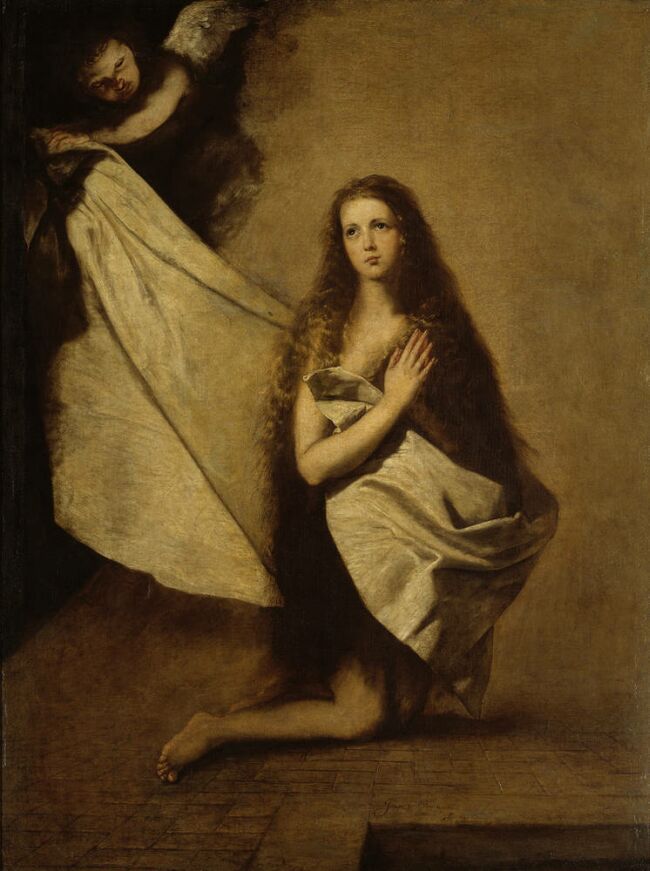
case, she fought to keep her modesty intact, and was helped by her long
hair (legendary accounts
have it that an angel came to bring her a white robe to cover herself).
The Golden Legend says that the prefect heard what happened to his son
and ran to the brothel, accusing Agnes of cruelty and enchantment,
whereupon she raised the young man from the dead. He then wanted to let
Agnes go, but fearing being banished,
put a lieutenant in his place who first tried to kill Agnes by a fire
which didn't harm her, and then ended up killing her with a sword; she
was beheaded at the age of thirteen.
Her remains were laid
in a tomb on the Via Nomentana. Her foster-sister, St. Emerentiana,
went there to pray a few days after Agnes's martyrdom, and she, too,
was killed by pagans -- stoned to death.Eight days after Agnes's death,
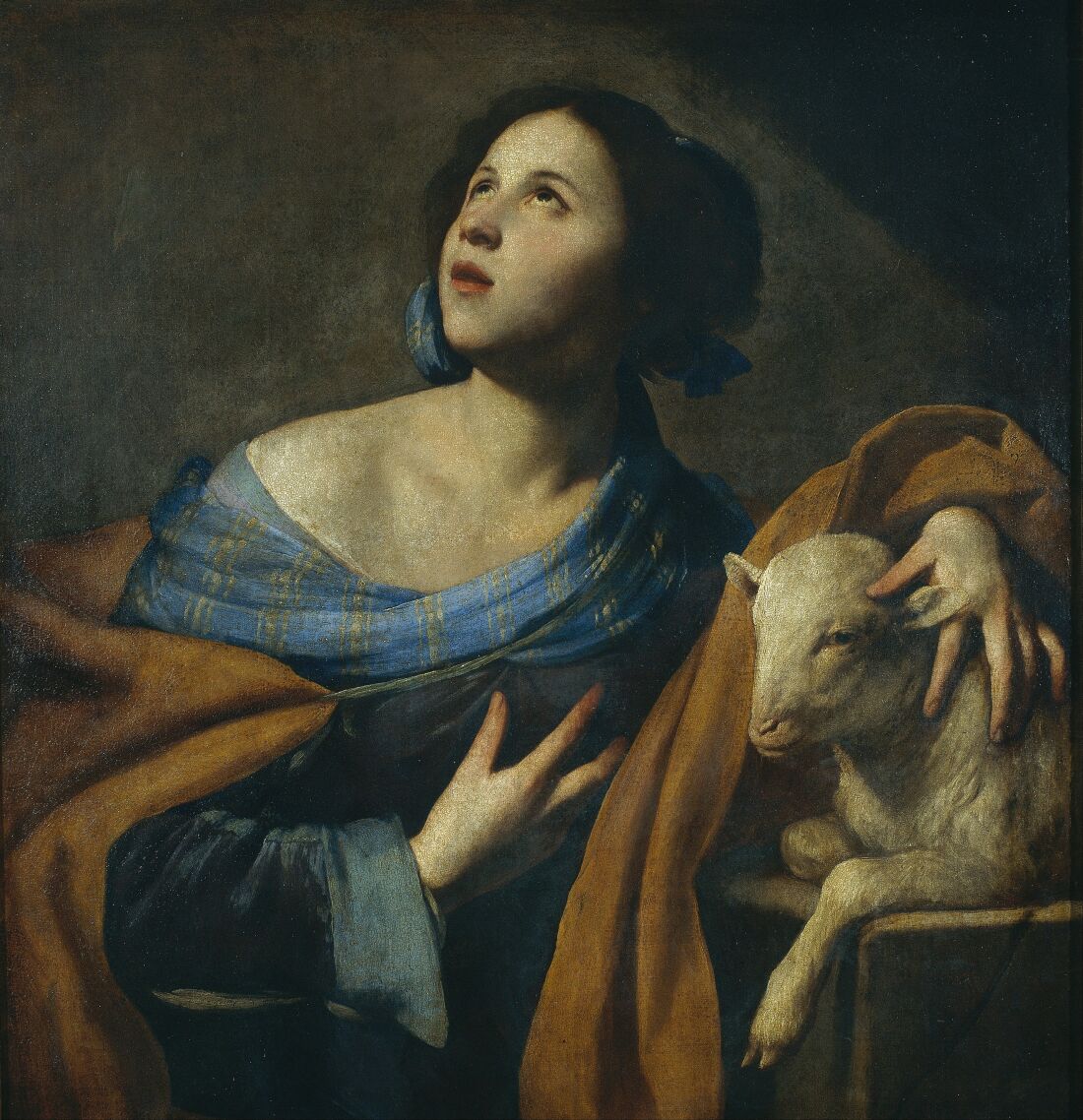
she appeared -- with other virgins and with a lamb at her side -- to
her parents.
When Constantine came into power, he built a basilica in St. Agnes's
honor, at the place of her martyrdom, at the insistence of his
daughter, Constantina, who, upon her death,
was buried next Agnes in a separate mausoleum in A.D. 354. Pope
Honorius -- A.D. 625-638
-- later remodelled the shrine which is known as Sant'Agnese Fuori le Mura (Saint
Agnes Outside the Walls) in Rome. It is said in the Golden
Legend that
when her parents and friends were visiting her tomb one night,
they saw a great
multitude of virgins clad in vestments of gold and silver, and a great
light shone tofore them, and on the right side was a lamb more white
than snow, and saw also St. Agnes among the virgins which said to her
parents: Take heed and see that ye bewail me no more as dead, but be ye
joyful with me, for with all these virgins Jesu Christ hath given me
most brightest habitation and dwelling, and am with him joined in
heaven whom in earth I loved with all my thought.
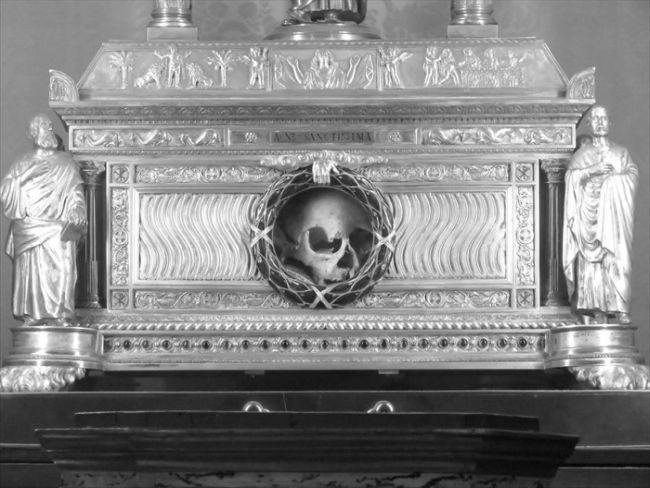
St.
Agnes's reliquary
So important and beloved is St. Agnes that she is named in
the canon of
the Mass and invoked during the Litany of
Saints. She is the patron of girls, chastity, virgins, rape
victims, and engaged couples. In art, she is almost always shown
holding a lamb or the palm of martyrdom.
Customs
Many prepare for this feast by praying the Novena to St. Agnes starting on January
12 and ending on January 20, the eve of Agnes's feast. For her feast
itself, this prayer is traditional:
Sweetest Lord
Jesus Christ, Source of all virtue, Lover of virgins, most powerful
Conqueror of demons, most severe Extirpator of vice, deign to cast Thy
eyes upon my weakness, and through the intercession of Mary most
blessed, Mother and Virgin, and of Thy beloved spouse, St. Agnes,
glorious virgin and martyr, grant me the aid of Thy heavenly grace, in
order that I may learn to despise all earthly things, and to love what
is heavenly; to oppose vice, and to be proof against temptation; to
walk firmly in the path of virtue, not to seek honours, to shun
pleasures, to bewail my past offences, to keep far from the occasions
of evil, to keep free from bad habits, to seek the company of the good,
and persevere in righteousness, so that, by the assistance of Thy
grace, I may deserve the crown of eternal life, together with St. Agnes
and all the saints, for ever and ever, in Thy kingdom. Amen.
The lamb, as a
symbol of purity itself and whose Latin name (agnus) is like the name of our
Saint, is one of the symbols of St. Agnes. At her Roman
shrine on this
day, the Holy Father will bless two crowned lambs, brought to the
Church of St. Agnes in two baskets, decorated in red (martyrdom) and
white (purity), by Trappists of the Tre Fontane Monastery. The lambs
are blessed and then taken to the Convent of St.
Cecilia, where the
Sisters care for them and use their wool to weave the stole-like pallia
worn by
the Pope and his Archbishops. The pallia are conferred on new
archbishops -- those appointed as archbishops during the preceding year
-- on the Feast of SS. Peter and
Paul on 29 June.
St. Agnes, like St. Valentine,
St.
Catherine of Alexandria, St. Anne,
and St.
Anthony of Padua, is invoked by single women in search of a husband
--
and today is a good day to pray such a prayer. In fact, Medieval
folklore says that on St. Agnes Eve, girls are often granted visions of
their future husbands. Scottish singletons would meet in a crop field
at
midnight, enter into it one by one and toss grain onto the soil, then
meet up again and pray:
Agnes sweet and
Agnes fair,
Hither, hither, now repair;
Bonny Agnes, let me see
The lad (or lass) who is to marry me.
In some places,
it was said that those who fast, keep silence, and conduct certain
rituals will have a vision of their future husband. The rituals vary
from place to place, but included among them are walking backwards to
bed while not looking behind you; pulling out a row of pins, and saying
a
Pater for each one; eating a yolkless boiled egg with salt filling the
cavity where the yolk had been, thereby prompting the future husband to
bring the girl water in a dream; getting together with a friend to make
a special cake called a "dumb
cake" (a mixture of water, flour, salt, and sugar), then walking
backward with it to bed, and eating it; sprinkling
sprigs of thyme and rosemary with holy water, placing them on each side
of the bed, and invoking St. Agnes. An old book called "Mother Brunch's
Closet Newly Broke Open" speaks another St. Agnes Eve custom:
There is, in
January, a day called Saint Agnes's Day. It is always the one and
twentieth of that month. This Saint Agnes had a great favour for young
men and maids, and will bring unto their bedside, at night, their
sweethearts, if they follow this rule as I shall declare unto thee.
Upon this day thou must be sure to keep a true fast, for thou must not
eat or drink all that day, nor at night; neither let any man, woman, or
child kiss thee that day; and thou must be sure, at night, when thou
goest to bed, to put on a clean shift, and the best thou hast the
better thou mayst speed; and thou must have clean cloaths on thy head,
for St. Agnes does love to see clean cloaths when she comes; and when
thou liest down on thy back as straight as thou canst, and both thy
hands are laid underneath thy head, then say
Now good St. Agnes, play thy part,
And sent to me my own sweetheart,
And shew me such a happy bliss,
This night of him to have a kiss.
And then be sure to fall asleep as soon as thou canst, and before thou
awakest out of thy first sleep thou shalt see him come and stand before
thee, and thou shalt perceive by his habit what trademan he is; but be
sure thou declarest not thy dream to anybody in ten days, and by that
time thou mayst come to see thy dream come to pass.
More
traditionally, the aforementioned Novena to St. Agnes
can be made for all sorts of causes, but especially for seeking a
spouse.
As to foods for this feast, lamb-shaped cakes with coconut for wool are
common, and
the Germans come through with an apricot-jam filled
shortbead cookie called Agnesenplätzchen (St. Agnes Cookies):
Agnesenplätzchen
1 1/3 cup butter, room temperature
1/2 cup sugar
3 cups flour
1 jar apricot jam
powdered sugar
Cream the butter with the sugar. Gradually incorporate the
flour until it becomes a smooth dough, then chill for about 10 minutes.
Roll dough out to 1/4-inch thick and cut out 2-inch rounds. Let the
dough rest for about 30 minutes. Preheat oven to 350oF.
Place rounds on cookie sheets and bake for 10-12 minutes or until
golden brown. Transfer to a wire rack to cool completely. Spread
apricot jam on the top of one cookie and cover with a second cookie.
Dust with powdered sugar.
For music for the day, the hymn Agnes
Beatae Virginis,
attributed to St. Ambrose, is perfect. The translation is a joint
effort by Kathleen Pluth and Gregory DiPippio:
Agnes beatae
virginis
nataiis est, quo spiritum
caelo refudit debitum
pio sacrata sanguine.
Matura martyrio fuit
matura nondum nuptiis;
nutabat in viris fides,
cedebat et fessus senex.
Prodire quis nuptum putet,
sic iaeta vuitu ducitur,
novas viro ferens opes,
dotata censu sanguinis.
Aras nefanda numinis
adoiere taedis cogitur;
respondet: Haud tales faces
sumpsere Christi virgines.
Hic ignis extinguit fidem,
haec fiamma iumen eripit;
hic, hic, ferite, ut profiuo
cruore restinguam focos.
Percussa quam pompam tuiit!
nam veste se totam tegens
curam pudoris praestitit,
ne quis retectam cemeret.
In morte vivebat pudor
vuitumque texerat manu,
terram genufiexo petit
iapsu verecundo cadens.
Gloria tibi, Domine,
gloria Unigenito,
una cum sancto Spiritu
in sempiterna sæcula. Amen.
The blessed
virgin Agnes flies
back to her home above the skies.
With love she gave her blood on earth
to gain a new celestial birth.
Mature enough to give her life,
though still too young to be a wife,
the faith wavered in the men,
and the tired old man yielded.
Her parents struck with fear, had increased
guards of her virtue; the guardians open
the doors, knowing not how to keep to
their duty.
What joy she shows when death appears
that one would think: her bridegroom nears!
bringing new riches to her Husband
endowed with the price of blood.
Her captors lead her to the fire
but she refuses their desire,
“For it is not such smold’ring brands
Christ’s virgins take into their hands.”
“This flaming fire of pagan rite
extinguishes all faith and light.
Then stab me here, so that the flood
may overcome this hearth in blood.”
Courageous underneath the blows,
her death a further witness shows,
she took care of her modesty
lest anyone see her uncovered.
In death, her modesty lived,
and she covered her face with her hand,
for as she falls she bends her knee
and wraps her robes in modesty.
O Virgin-born, all praises be
to You throughout eternity,
and unto everlasting days
to Father and the Spirit, praise. Amen.
For
information's sake, see John Keats's
"Romeo and Juliette-esque" poem, "Eve
of St. Agnes," published in 1820, in which the maiden, Madeleine,
goes to bed on St. Agnes' Eve, as her horrible family has a huge party
in another part of the house. The "Beadsman" refers to a pauper who is
paid to pray for his employer. (Warning: the poem is a rather sensual
one!). For a dramatic presentation of this poem, there's this episode
of the Columbia Workshop radio show, which originally aired on March
28, 1937:
For more spiritually enrichening reading see this
much briefer poem on St. Agnes' Eve by Alfred Tennyson (1809-1892),
which concerns a nun's looking forward to Heaven.
Note that January 21, 1793 is the date on which King Louis XVI, the
husband of Marie Antoinette, was murdered by guillotine during the
great reign of terror known as the French Revolution. In France on or
around this date, Requiem Masses are offered in his memory.
Reading
"Concerning
Virginity"
Book I, Chapter II
By St. Ambrose (A.D. 340 - 397)
This treatise
has a favourable beginning, since it is the birthday of the holy Virgin
Agnes, of whose name, modesty, and martyrdom St. Ambrose speaks in
commendation, but more especially of her age, seeing that she, being
but twelve years old, was superior to terrors, promises, tortures, and
death itself, with a courage wholly worthy of a man.
And my task begins favourably, that since to-day is the birthday of a
virgin, I have to speak of virgins, and the treatise has its beginning
from this discourse. It is the birthday of a martyr, let us offer the
victim. It is the birthday of St. Agnes, let men admire, let children
take courage, let the married be astounded, let the unmarried take an
example. But what can I say worthy of her whose very name was not
devoid of bright praise? In devotion beyond her age, in virtue above
nature, she seems to me to have borne not so much a human name, as a
token of martyrdom, whereby she showed what she was to be.
But I have that which may assist me. The name of virgin is a title of
modesty. I will call upon the martyr, I will proclaim the virgin. That
panegyric is long enough which needs no elaboration, but is within our
grasp. Let then labour cease, eloquence be silent. One word is praise
enough. This word old men and young and boys chant. No one is more
praiseworthy than he who can be praised by all There are as many
heralds as there are men, who when they speak proclaim the martyr.
She is said to have suffered martyrdom when twelve years old. The more
hateful was the cruelty, which spared not so tender an age, the greater
in truth was the power of faith which found evidence even in that age.
Was there room for a wound in that small body? And she who had no room
for the blow of the steel had that wherewith to conquer the steel. But
maidens of that age are unable to bear even the angry looks of parents,
and are wont to cry at the pricks of a needle as though they were
wounds. She was fearless under the cruel hands of the executioners, she
was unmoved by the heavy weight of the creaking chains, offering her
whole body to the sword of the raging soldier, as yet ignorant of
death, but ready for it. Or if she were unwillingly hurried to the
altars, she was ready to stretch forth her hands to Christ at the
sacrificial fires, and at the sacrilegious altars themselves, to make
the sign of the Lord the Conqueror, or again to place her neck and both
her hands in the iron bands, but no band could enclose such slender
limbs.
A new kind of martyrdom! Not yet of fit age for punishment but already
ripe for victory, difficult to contend with but easy to be crowned, she
filled the office of teaching valour while having the disadvantage of
youth. She would not as a bride so hasten to the couch, as being a
virgin she joyfully went to the place of punishment with hurrying step,
her head not adorned with plaited hair, but with Christ. All wept, she
alone was without a tear. All wondered that she was so readily prodigal
of her life, which she had not yet enjoyed, and now gave up as though
she had gone through it. Every one was astounded that there was now one
to bear witness to the Godhead, who as yet could not, because of her
age, dispose of herself. And she brought it to pass that she should be
believed concerning God, whose evidence concerning man would not be
accepted. For that which is beyond nature is from the Author of nature.
What threats the executioner used to make her fear him, what
allurements to persuade her, how many desired that she would come to
them in marriage! But she answered: "It would be an injury to my spouse
to look on any one. as likely to please me. He who chose me first for
Himself shall receive me. Why are you delaying, executioner? Let this
body perish which can be loved by eyes which I would not." She stood,
she prayed, she bent down her neck. You could see the executioner
tremble, as though he himself. had been condemned, and his right hand
shake, his face grow pale, as he feared the peril of another, while the
maiden feared not for her own. You have then in one victim a twofold
martyrdom, of modesty and of religion. She both remained a virgin and
she obtained martyrdom.