``Where the
Bishop is, there let the multitude of believers be;
even as where Jesus is, there is the Catholic Church'' Ignatius of
Antioch, 1st c. A.D
Corpus Christi
As on Maundy Thursday, we
celebrate the Body of Christ -- but this time without the sense of
impending doom of knowing what would come on Good Friday. God, in His
infinite Majesty not only became man, but becomes our Heavenly Bread,
our manna, our Source of spiritual life.
The Feast of Corpus Christi -- which is always on the Thursday
following Trinity Sunday -- has an interesting history. Its inspiration
is due to two things: the first is the Miracle of Bolsena, which
happened in A.D. 1263. Peter of Prague, a German priest, during a
pilgrimage to Rome, stopped at the Church of St. Christina there to
offer Mass. While he was a holy and devout man, he harbored doubts
about the Real Presence -- doubts which were completely resolved when
the Host he consecrated during that Mass began to bleed. He rushed to
meet Pope Urban IV in Orvieto, bringing the Host with him. The miracle
was declared, and the Host is still on display at the Cathedral of
Orvieto today.
The second source of inspiration was an Augustinian nun, a Belgian
named St. Juliana of Mont Cornillon (A.D. 1193-1258). She had a vision
of the Moon that was full and beautiful, but marked by a black spot
that signified that there was no joyous celebration of the Eucharist in
the entire Church calendar.
In response to both of the above, Pope Urban IV eventually published a
Bull, Transiturus, in A.D. 1264, which made this Feast a part of the
calendar.
The Mass includes the Lauda Sion Sequence by St. Thomas
Aquinas, and a procession followed by the greatest Eucharistic
hymns of
the Church, also written by St. Thomas especially for this Feast. These
include Sacris Solemnis, Ave Verum, Adoro Te, and Verbum Supernum (the
last two verses of Verbum Supernum are the lyrics to the hymn "O Salutaris Hostia").
Eucharistic
processions are held today, and in still relatively Catholic
countries, those who live along the procession route decorate their
homes with greenery, floral wreaths, and banners, and put candles in
the windows. Rose petals are strewn in the path the Sacrament takes.
Bystanders fall to their knees as Our Eucharistic Lord is carried past
them.Philippians 2:5-9:
For let this
mind be in you, which was also in Christ Jesus: Who being in the form
of God, thought it not robbery to be equal with God: But emptied
Himself, taking the form of a servant, being made in the likeness of
men, and in habit found as a man. He humbled himself, becoming obedient
unto death, even to the death of the cross. For which cause God also
hath exalted him, and hath given him a name which is above all names:
That in the name of Jesus every knee
should bow, of those that are in heaven, on earth, and under the
earth: And that every tongue should confess that the Lord Jesus Christ
is in the glory of God the Father.
This is how Maria Von Trapp recalls Corpus Christi in her
native country:
On the Thursday
after the octave of the Pentecost falls the feast of Corpus Christi --
the feast of the Holy Eucharist. The actual anniversary of the
institution of the Blessed Sacrament is celebrated on Holy Thursday,
but on this day the Church cannot summon the proper festive mood,
because of all the other happenings following the Last Supper, which
she also has to commemorate. For this reason this used to be the great
feast day at summer's beginning, with its distinctive feature the
solemn procession, after the High Mass, in which the Blessed Sacrament
was carried through the streets and over the fields and meadows. Such a
Corpus Christi day belong among our most beautiful memories.
The day before, the big boys of the village cut young trees in the
woods, usually birch, and plant them on either side of the road along
which the priest will carry the Blessed Sacrament. From the village inn
you hear the brass band having a last rehearsal, while mothers pin-curl
the hair of their little girls. Everybody is preparing his finery for
the great day. The Association of Voluntary Firemen come in their best
uniforms and brass helmets. The war veterans will also be in uniform
with big plumed hats. The big girls are making garlands by the yards
which will span the street. All windows will be decorated, houses and
families vying with each other: the best carpets, flanked by candles
and flowers, are hung out the windows and statues and holy paintings
are exhibited on them. Four times the procession will come to a halt,
the priest will solemnly sing the beginning of one of the four Gospels
and each time there will be a Solemn Benediction. At those four spots
altars are erected and decorated with trees and greenry and a profusion
of flowers and candles. A great deal of love and care and time goes
into these processions.
Then comes the great day. The church choir gives its best at the Solemn
High Mass and all the people attend from the mayor to the smallest
child, for everybody wants to accompany Our Lord on His triumphal way.
The procession is headed by an altar boy carrying a crucifix, followed
by all the school children -- the girls in white, their veils held in
place by wreaths of flowers, looking for all the world like so many
little brides; the boys wearing a wreath of flowers on their left upper
arm over their Sunday-best, just like "best men." Then come the
fraternities with their banners and costumes. In the towns the convents
would send every member they could spare. There would be the blue
Vincentian Sisters with their coronets, looking like a group of doves,
the white Dominican nuns, the brown Carmelites of the Third Order, the
black Benedictines followed by the brown Franciscans, then the Mission
Fathers and the bearded Capuchins followed by the secular clergy in
their liturgical vestments. They are all like heralds of the great King
Who is following now under the richly embroidedered baldachin carried
by the four most important men of the community. The pastor carries the
monstrance with the Blessed Sacrament. Two little girls are throwing
flower petals out of baskets directly at the feet of Our Lord. Little
altar boys alternate in ringing silver bells and swinging the censer
from which rise billowing clouds, enveloping the Sanctissimum. On the
right and on the left are marching solders carrying guns as if on
parade. Behind the Blessed Sacrament follows the church choir, then a
detachment of firemen, the war veterans in uniforms, and the rest of
the community. At the very end of the procession comes the brass band
playing hymns while everybody joins in the singing. The highlights for
everybody, young and old, are the moments of benediction with the
priest raising the monstrance for all to see and the soldiers lifting
their guns and shooting their salute, while from the outskirts cannons
resound with a thundering echo. I cannot rememer a single occasion when
it rained on Corpus Christi Day. From a cloudless blue sky a hot June
sun would shine. At the end of such a triumphal procession everyone
from the oldest grandfather in a plumed hat to the smallest flower girl
would be in a truly festive mood.
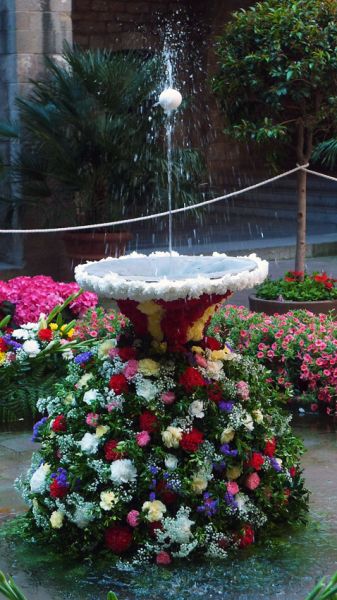
In Catalonia and a few cities in Spain is the tradition of
"the
dancing egg" (l'ou com balla),
which dates to at least the 15th century. An egg is emptied out, the
holes needed to empty it out are sealed with wax, and then the egg is
placed over a vertical jet of water in one of the city's fountains. The
water pushes up against the egg, causing it to turn, but not fall. The
egg dances in the water, and with the fountain having been festooned
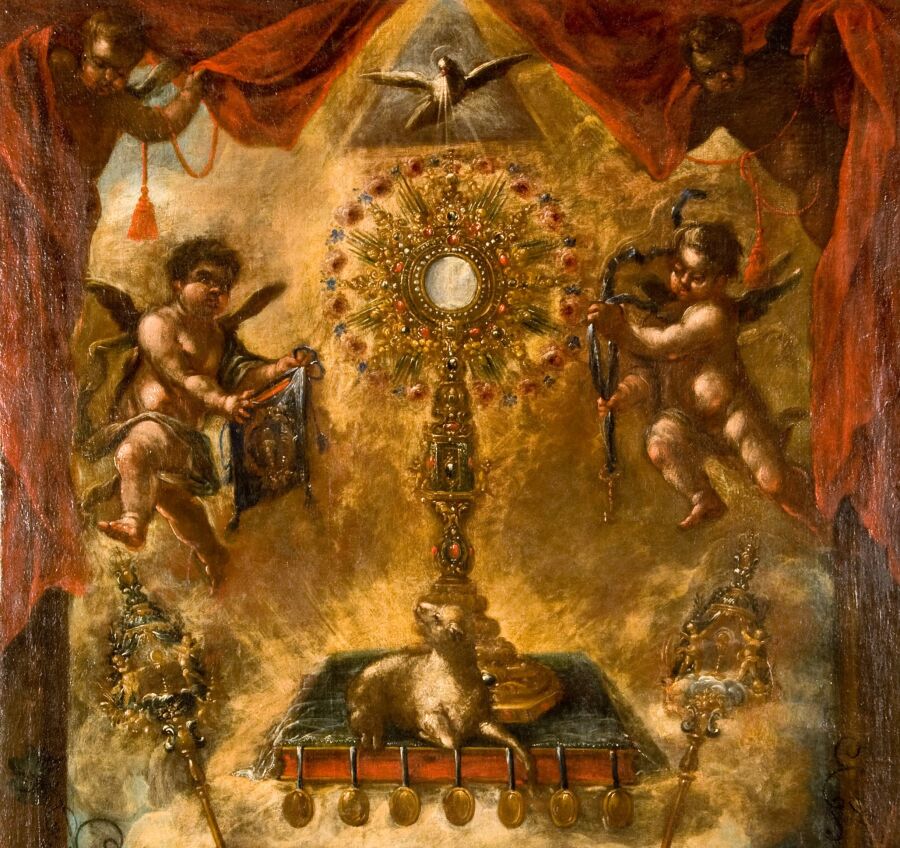
with flowers beforehand, the scene is said to represent the Host in a
bejewelled monstrance.
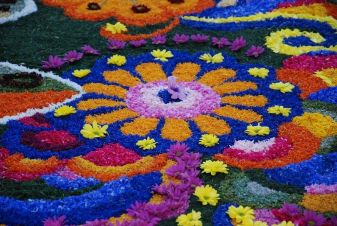
A gorgeous Italian tradition is l'infiorata:
the laying out of flowers and their petals in elaborate mosaic-like
displays on
streets and roadways. This practice is done In Spello, Perugia;
Cannara, Perguia; Diano Marina, Liguria; Genzano, Lazio; San Bartolomeo
in Galdo, Campania; and Chiaravalle, Marche. During the days and nights
before,
hundreds and hundreds of people
work to make the colorful displays. Miles-long stretches of
road might be decorated in this manner in order to form a beautiful
carpet on which the procession can make its way. These sorts of floral
extravaganzas are carried out in places in Spain as well.
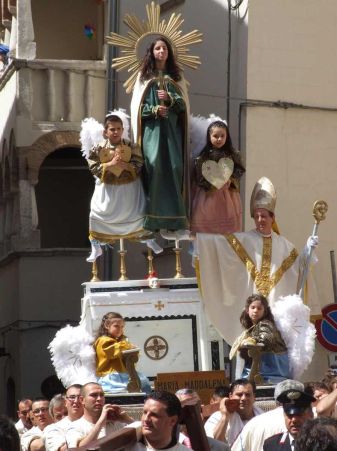
In Campobasso, Molise, Italy, the Sagra
dei Misteri is held now -- a parade consisting of moving
tableaux vivants depicting St. Isidore, San Crispino, San Gennaro, Abraham, St. Mary Magdalene, Saint
Anthony Abbot, the Immaculate Conception,
San Leonardo, San Rocco, St. Michael, the Assumption, St. Nicholas.and the Sacred Heart of Jesus.
Seventy-seven living actors dress as the characters they're depicting,
form their tableaux vivants, and are borne on platforms throughout the
city, each platform being carried by up to twenty-two people. They're
followed by 100 musicians as they make their way along the streets and
through the squares of the town's historic center.
Also today, Catholics may start a public Novena to the Sacred Heart in
anticipation of the Feast of
the Sacred Heart which will be on Friday of next week. Doing so may
earn one a plenary indulgence under the usual conditions. Even if the
Novena is said privately, and if one says the Novena on all 9 days, a
plenary indulgence may be gained.
As to music, there are many ways to celebrate Corpus Christi. Four of
the greatest hymns for the day are Tantum
Ergo, Panis Angelicus, O Salutaris Hostia, and Ave Verum Corpus. I
have to present to you Tomaso Albinoni's version of Ave Verum Corpus;
it's too beautiful to resist. It is sung by a boy's choir called Libera:
To tie together the Feasts of Corpus Christi and the Sacred Heart,
meditating on the reality of Eucharistic miracles is in order. Read
about the Eucharistic Miracle of Lanciano!
Readings
Excerpt on
the Eucharistic center of the rites of the Mass,
from "The Shape of the Liturgy"
By Dom Gregory Dix, A.D. 1945
The outlines of that ritual pattern come down to us unchanged
in Christian practice from before the Crucifixion, the synaxis from
Jesus' preaching in the synagogue of Galilee, the eucharist proper from
the evening meals of Jesus with His disciples. The needs of a Christian
corporate worship gradually brought about their combination. The needs
of a Christian public worship have added to these inheritances from our
Lord's own Jewish piety only an "introduction" of praise and a brief
prayer of thanksgiving. The whole has a new meaning fixed for all time
in the Upper Room. But the form of the rite is still centered upon the
Book on the Lectern and the Bread and Cup on the table as it always
was, though by the new meaning they have become the Liturgy of the
Spirit and the Liturgy of the Body, centering on the Word of God
enounced and the Word of God made flesh.
At the heart of it all is the eucharistic action, a thing of an
absolute simplicity -- the taking, blessing, breaking and giving of
bread and the taking, blessing and giving of a cup of wine and water,
as these were first done with their new meaning by a young Jew before
and after supper with His friends on the night before He died. Soon it
was simplified still further, by leaving out the supper and combining
the double grouping before and after it into a single rite. So the
four-action shape of the liturgy was found by the end of the first
century. He had told His friends to do this henceforward with the new
meaning "for the anamnesis" of Him, and they have done it always since.
Was ever another command so obeyed? For century after century,
spreading slowly to every continent and country and among every race on
earth, this action has been done, in every conceivable human
circumstance, for every conceivable human need from infancy and before
it to extreme old age and after it, from the pinnacle of earthly
greatness to the refuge of fugitives in the caves and dens of the
earth. Men have found no better thing than this to do for kings at
their crowning and for criminals going to the scaffold; for armies in
triumph or for a bride and bridegroom in a little country church; for
the proclamation of a dogma or for a good crop of wheat; for the wisdom
of the Parliament of a mighty nation or for a sick old woman afraid to
die; for a schoolboy sitting an examination or for Columbus setting out
to discover America; for the famine of whole provinces or for the soul
of a dead lover; in thankfulness because my father did not die of
pneumonia; for a village headman much tempted to return to fetish
because the yams had failed; because the Turk was at the gates of
Vienna; for the repentance of Margaret; for the settlement of a strike;
for a son for a barren woman; for Captain so-and-so wounded and
prisoner of war; while the lions roared in the nearby amphitheatre; on
the beach at Dunkirk; while the hiss of scythes in the thick June grass
came faintly through the windows of the church; tremulously, by an old
monk on the fiftieth anniversary of his vows; furtively, by an exiled
bishop who had hewn timber all day in a prison camp near Murmansk;
gorgeously, for the canonisation of S. Joan of Arc-- one could fill
many pages with the reasons why men have done this, and not tell a
hundredth part of them. And best of all, week by week and month by
month, on a hundred thousand successive Sundays, faithfully,
unfailingly, across all the parishes of Christendom, the pastors have
done this just to make the plebs sancta Dei -- the holy common people
of God.
On the
Mysteries (excerpt)
By St. Ambrose, A.D. 240-397
43. The cleansed
people, rich with these adornments [the baptized people in their new
white robes], hastens to the altar of Christ, saying: "I will go to the
altar of God, to God Who maketh glad my youth;" for having laid aside
the slough of ancient error, renewed with an eagle's youth, it hastens
to approach that heavenly feast. It comes, and seeing the holy altar
arranged, cries out: "Thou hast prepared a table in my sight." David
introduces the people as speaking, where he says: "The Lord feedeth me,
and nothing shall be wanting to me, in a place of good pasture hath He
placed me. He hath led me forth by the water of refreshment." And
later: "For though I walk in the midst of the shadow of death, I will
fear no evils, for Thou art with me. Thy rod and Thy staff have
comforted me. Thou hast prepared in my sight a table against them that
trouble me. Thou hast anointed my head with oil, and Thy inebriating
cup, how excellent it is!"
44. We must now pay attention, lest perchance anyone seeing that what
is visible (for things which are invisible cannot be seen nor
comprehended by human eyes), should say, "God rained down manna and
rained down quails upon the Jews," but for the Church beloved of Him
the things which He has prepared are those of which it is said: "That
eye hath not seen, nor ear heard, neither hath it entered into the
heart of man, what things God hath prepared for them that love Him."
So, lest any one should say this, we will take great pains to prove
that the sacraments of the Church are both more ancient than those of
the synagogue, and more excellent than the manna.
45. The lesson of Genesis just read shows that they are more ancient,
for the synagogue took its origin from the law of Moses. But Abraham
was far earlier, who, after conquering the enemy, and recovering his
own nephew, as he was enjoying his victory, was met by Melchisedech,
who brought forth those things which Abraham reverently received. It
was not Abraham who brought them forth, but Melchisedech, who is
introduced without father, without mother, having neither beginning of
days, nor ending, but like the Son of God, of Whom Paul says to the
Hebrews: "that He remaineth a priest for ever," Who in the Latin
version is called King of righteousness and King of peace.
46. Do you recognize Who that is? Can a man be king of righteousness,
when himself he can hardly be righteous? Can he be king of peace, when
he can hardly be peaceable? He it is Who is without mother according to
His Godhead, for He was begotten of God the Father, of one substance
with the Father; without a father according to His Incarnation, for He
was born of a Virgin; having neither beginning nor end, for He is the
beginning and end of all things, the first and the last. The sacrament,
then, which you received is the gift not of man but of God; brought
forth by Him Who blessed Abraham the father of faith, whose grace and
deeds we admire.
47. We have proved the sacraments of the Church to be the more ancient,
now recognize that they are superior. In very truth it is a marvellous
thing that God rained manna on the fathers, and fed them with daily
food from heaven; so that it is said, "So man did eat angels' food."
But yet all those who ate that food died in the wilderness, but that
food which you receive, that living Bread which came down from heaven,
furnishes the substance of eternal life; and whosoever shall eat of
this Bread shall never die, and it is the Body of Christ.
49. Now consider whether the bread of angels be more excellent or the
Flesh of Christ, which is indeed the body of life. That manna came from
heaven, this is above the heavens; that was of heaven, this is of the
Lord of the heavens; that was liable to corruption, if kept a second
day, this is far from all corruption, for whosoever shall taste it
holly shall not be able to feel corruption. For them water flowed from
the rock, for you Blood flowed from Christ; water satisfied them for a
time, the Blood satiates you for eternity. The Jew drinks and thirsts
again, you after drinking will be beyond the power of thirsting; that
was in a shadow, this is in truth.
49. If that which you so wonder at is but shadow, how great must that
be whose very shadow you wonder at. See now what happened in the case
of the fathers was shadow: "They drank, it is said, of that Rock that
followed them, and that Rock was Christ. But with many of them God was
not well pleased, for they were overthrown in the wilderness. Now these
things were done in a figure concerning us." You recognize now which
are the more excellent, for light is better than shadow, truth than a
figure, the Body of its Giver than the manna from heaven.
50. Perhaps you will say, "I see something else, how is it that you
assert that I receive the Body of Christ?" And this is the point which
remains for us to prove. And what evidence shall we make use of? Let us
prove that this is not what nature made, but what the blessing
consecrated, and the power of blessing is greater than that of nature,
because by blessing nature itself is changed.
51. Moses was holding a rod, he cast it down and it became a serpent.
Again, he took hold of the tail of the serpent and it returned to the
nature of a rod. You see that by virtue of the prophetic office there
were two changes, of the nature both of the serpent and of the rod. The
streams of Egypt were running with. a pure flow of water; of a sudden
from the veins of the sources blood began to burst forth, and none
could drink of the river. Again, at the prophet's prayer the blood
ceased, and the nature of water returned. The people of the Hebrews
were shut in on every side, hemmed in on the one hand by the Egyptians,
on the other by the sea; Moses lifted up his rod, the water divided and
hardened like walls, and a way for the feet appeared between the waves.
Jordan being turned back, returned, contrary to nature, to the source
of its stream. Is it not clear that the nature of the waves of the sea
and of the river stream was changed? The people of the fathers
thirsted, Moses touched the rock, and water flowed out of the rock. Did
not grace work a result contrary to nature, so that the rock poured
forth water, which by nature it did not contain? Marsh was a most
bitter stream, so that the thirsting people could not drink. Moses cast
wood into the water, and the water lost its bitterness, which grace of
a sudden tempered. In the time of Elisha the prophet one of the sons of
the prophets lost the head from his axe, which sank. He who had lost
the iron asked Elisha, who cast in a piece of wood and the iron swam.
This, too, we clearly recognize as having happened contrary to nature,
for iron is of heavier nature than water.
52. We observe, then, that grace has more power than nature, and yet so
far we have only spoken of the grace of a prophet's blessing. But if
the blessing of man had such power as to change nature, what are we to
say of that divine consecration where the very words of the Lord and
Saviour operate? For that sacrament which you receive is made what it
is by the word of Christ. But if the word of Elijah had such power as
to bring down fire from heaven, shall not the word of Christ have power
to change the nature of the elements? You read concerning the making of
the whole world: "He spake and they were made, He commanded and they
were created." Shall not the word of Christ, which was able to make out
of nothing that which was not, be able to change things which already
are into what they were not? For it is not less to give a new nature to
things than to change them.
53. But why make use of arguments? Let us use the examples He gives,
and by the example of the Incarnation prove the truth of the mystery.
Did the course of nature proceed as usual when the Lord Jesus was born
of Mary? If we look to the usual course, a woman ordinarily conceives
after connection with a man. And this body which we make is that which
was born of the Virgin. Why do you seek the order of nature in the Body
of Christ, seeing that the Lord Jesus Himself was born of a Virgin, not
according to nature? It is the true Flesh of Christ which crucified and
buried, this is then truly the Sacrament of His Body.
54. The Lord Jesus Himself proclaims: "This is My Body." Before the
blessing of the heavenly words another nature is spoken of, after the
consecration the Body is signified. He Himself speaks of His Blood.
Before the consecration it has another name, after it is called Blood.
And you say, Amen, that is, It is true. Let the heart within confess
what the mouth utters, let the soul feel what the voice speaks.
55. Christ, then, feeds His Church with these sacraments, by means of
which the substance of the soul is strengthened, and seeing the
continual progress of her grace, He rightly says to her: "How comely
are thy breasts, my sister, my spouse, how comely they are made by
wine, and the smell of thy garments is above all spices. A dropping
honeycomb are thy lips, my spouse, honey and milk are under thy tongue,
and the smell of thy garments is as the smell of Lebanon. A garden
enclosed is my sister, my spouse, a garden enclosed, a fountain
sealed." By which He signifies that the mystery ought to remain sealed
up with you, that it be not violated by the deeds of an evil life, and
pollution of chastity, that it be not made known to thou, for whom it
is not fitting, nor by garrulous talkativeness it be spread abroad
amongst unbelievers. Your guardianship of the faith ought therefore to
be good, that integrity of life and silence may endure unblemished.
56. For which reason, too, the Church, guarding the depth of the
heavenly mysteries, repels the furious storms of wind, and calls to her
the sweetness of the grace of spring, and knowing that her garden
cannot displease Christ, invites the Bridegroom, saying: "Arise, O
north wind, and come, thou south; blow upon my garden, and let my
ointments flow down. Let my Brother come down to His garden, and eat
the fruit of His trees." For it has good trees and fruitful, which have
dipped their roots in the water of the sacred spring, and with fresh
growth have shot forth into good fruits, so as now not to be cut with
the axe of the prophet, but to abound with the fruitfulness of the
Gospel.
57. Lastly, the Lord also, delighted with their fertility, answers: "I
have entered into My garden, My sister, My spouse; I have gathered My
myrrh with My spices, I have eaten My meat with My honey, I have drunk
My drink with My milk." Understand, you faithful, why He spoke of meat
and drink. And there is no doubt that He Himself eats and drinks in us,
as you have read that He says that in our persons He is in prison.
58. Wherefore, too, the Church, beholding so great grace, exhorts her
sons and her friends to come together to the sacraments, saying: "Eat,
my friends, and drink and be inebriated, my brother." What we eat and
what we drink the Holy Spirit has elsewhere made plain by the prophet,
saying, "Taste and see that the Lord is good, blessed is the man that
hopeth in Him." In that sacrament is Christ, because it is the Body of
Christ, it is therefore not bodily food but spiritual. Whence the
Apostle says of its type: "Our fathers ate spiritual food and drank
spiritual drink," for the Body of God is a spiritual body; the Body of
Christ is the Body of the Divine Spirit, for the Spirit is Christ, as
we read: "The Spirit before our face is Christ the Lord." And in the
Epistle of Peter we read: "Christ died for us." Lastly, that food
strengthens our heart, and that drink "maketh glad the heart of man,"
as the prophet has recorded.
59. So, then, having obtained everything, let us know that we are born
again, but let us not say, How are we born again? Have we entered a
second time into our mother's womb and been born again? I do not
recognize here the course of nature. But here there is no order of
nature, where is the excellence of grace. And again, it is not always
the course of nature which brings about conception, for we confess that
Christ the Lord was conceived of a Virgin, and reject the order of
nature. For Mary conceived not of man, but was with child of the Holy
Spirit, as Matthew says: "She was found with child of the Holy Spirit."
If, then, the Holy Spirit coming down upon the Virgin wrought the
conception, and effected the work of generation, surely we must not
doubt but that, coming down upon the Font, or upon those who receive
Baptism, He effects the reality of the new birth.