From the Catholic Encyclopedia:
A litany is a
well-known and much appreciated form of responsive petition, used in
public liturgical services, and in private devotions, for common
necessities of the Church, or in calamities — to implore God's aid or
to appease His just wrath. This form of prayer finds its model in Psalm
cxxxv: 'Praise the Lord, for he is good: for his mercy endureth for
ever. Praise ye the God of gods . . . the Lord of lords . . . Who alone
doth great wonders . . . Who made the heavens', etc., with the
concluding words in each verse, "for his mercy endureth for ever."...
...Litanies appeared in honour of God the Father, of God the Son, of
God the Holy Ghost, of the Precious Blood, of the Blessed Virgin, of
the Immaculate Conception, of each of the saints honoured in different
countries, for the souls in Purgatory, etc. In 1601 Baronius wrote that
about eighty forms were in circulation. To prevent abuse, Pope Clement
VIII, by decree of the Inquisition of 6 Sept., 1601, forbade the
publication of any litany, except that of the saints as found in the
liturgical books and that of Loreto. To-day the litanies approved for
public recitation are: of All Saints, of Loreto, of the Holy Name, of
the Sacred Heart, of St. Joseph [Ed. and, approved in 1960, of
the Most Precious Blood of Our Lord Jesus Christ].
Many, many
litanies exist, and all of them may be prayed privately (individuals or
families can
even write their own litanies for their private devotions, calling on
their patron saints and other favorites), but only six are approved for
public prayer. First a little background on each...
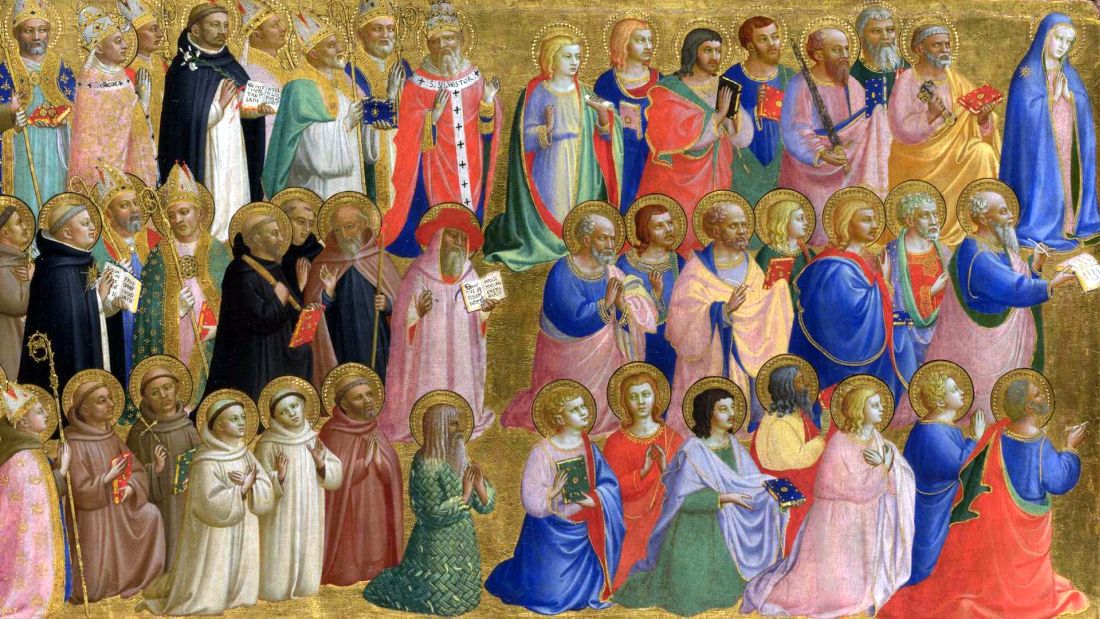
The Litany of the Saints
The Litany of
the Saints -- the oldest of the litanies, dating to A.D. 595 -- is
prayed liturgically at the Easter
Vigil, during ordinations, on Rogation days,
and also during solemn exorcisms,
etc.. Privately, it is
prayed any time one wishes, as with the other litanies, but is
especially prayed after sundown on All Saints' Day in
preparation for
All Souls' Day, and on All
Souls' Day itself.
This litany first invokes God in all Three Persons, then follow, in
this order: Mary; the blessed spirits; St. Joseph and the Patriarchs
and Prophets; the Apostles and Evangelists; all the disciples of the
Lord; the Holy Innocents and the glorious martyrs; the holy Bishops and
Confessors (those who suffer for the faith); the holy priests and
Levites; the virgins and widows; and all holy men and women.
The Litany of Loreto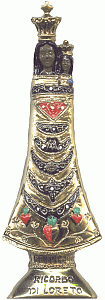
The most beautiful, Marian Litany of Loreto (the "Litany of the Blessed
Virgin Mary"), whose present form dates to the 15th c., is prayed
(usually privately) on Marian feasts and their vigils, on Saturdays,
and is often added to Rosaries. It takes its
name from Loreto, a small town on the Eastern coast of central Italy,
in the region of Le Marche, a place where one can find what is known as
the Holy House of Loreto, a small house that is about 28 X 12 in floor
area, and almost 14 feet high, with a door on the North side, and a
window on the West side.
This house, according to tradition, is the
house where Mary was born and in which the Archangel Gabriel made his
Annunciation to her. It is said to have been translated by angels from
Nazareth to Dalmatia in present-day Yugoslavia after Saracens re-took
the Holy Land, and then to Loreto in A.D. 1291. St. Gabriel's "flight"
from Heaven during the Annunciation, has caused Our Lady of Loreto to
be seen as the Patroness of aviators and of air travellers -- and
Charles Lindbergh, the astronauts of Apollo 9, and Umberto Nobile, who
flew over the North Pole in the 1920s, all took images of Our Lady of
Loreto with them on their historic missions.
The shrine (a basilica is now built around the house) has been
associated with miracles, its veneration is papally approved, and
around 50 Popes themselves have made pilgrimages to it or otherwise
honored it in word, as have many, many Saints. The image at right is a
version of the very unique and stylized statue of Our Lady of Loreto
which is kept at the shrine. The statue -- the original was destroyed
by fire -- depicts Our Lady holding Jesus and as clad in a dalmatic.
Its deep hues are due to the original wood's having been darkened by
the soot from candles and lamps that burned around it in the shrine's
sanctuary.
The Other Public Litanies
The Litany of the Holy Name of Jesus was probably written by SS.
Bernardine of Siena and John Capistran early in the 15th c. and is
prayed most especially during the month of January, which is dedicated
to the Holy Name.
The Litany of the Sacred Heart is a "natural" for the month of June,
dedicated to Christ's Heart.
The Litany of the Precious Blood is commonly recited in the month
devoted to His Precious Blood, July.
March, being dedicated to St. Joseph, is a common time to pray the
Litany to St. Joseph.
The faithful who pray any of these Litanies, under the usual
conditions, receive a partial indulgence.
Below are links to these litanies in English and Latin. When prayed,
one person (or half the people) chants or reads the invocation while
the others chant or read the responses which are in italics in the
pages below.
The Litanies may
be downloaded, too, in .pdf format:
Litany of the
Sacred Heart of Jesus: English
Latin
Litany of the Holy Name of Jesus: English Latin
Litany of the Precious Blood of Jesus: English Latin
Litany of the Saints: English
Latin
Litany of Loreto: English
Latin
Litany of St. Joseph: English
Latin
Litanies for Private
Use
You
will find many other litanies scattered throughout the site, mostly
linked to from pages on the various feast days.
These litanies are for private use, and all are made available in pdf
format for easy downloading. Among them are the:
|