|
Note: It's
recommended that those who are confused or new to Tradition read
through this page, and then go back and re-read, clicking the links as
they go along.
A
typical scenario: You listen to E.W.T.N. or Catholic Answers and have
found through them that the earliest Christians were Catholic, that
Catholic dogma is not unscriptural. You become convinced that Jesus
Christ did set up a Church, that He did so upon the rock of St. Peter,
and that the gates of Hell will never prevail against it. You are
willing to intellectually assent to the eternal teachings of the Church
and truly desire to become a serious, committed Catholic who serves and
worships Our Lord Jesus Christ.
You do what most people do in this case; you call up your local parish
and get enrolled in an R.C.I.A. program. You don't hear much about
Mary, the other Saints, sin, Purgatory, or Hell. You hear very little
about the Mass as a propitiatory Sacrifice, but instead hear it
described only as a "celebratory meal." Depending on the parish you're
in, you may hear and see things that seem totally contradictory to
what you'd always heard the Catholic Church teaches. Your R.C.I.A.
instructor may say things like, "The Catholic Church doesn't teach that
any more since Vatican II" and may come off as religiously indifferent,
not insistent enough that the Church is Christ's Church and that
outside of Her there is no salvation.
The Masses offered seem not too unlike what you'd see at a Lutheran,
"low church" Anglican, or maybe even a Pentecostal faith community.
You've always associated "Catholic" with things like eating fish on
Fridays, nuns in habits, confessionals, and stained glass -- with
things that are ancient, mysterious, and beautiful. You look around
your local parish and are wondering why nothing you see there seems to
match up.
You
were expecting this:

but got this:
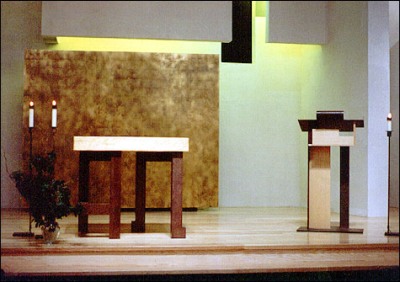
You
thought you'd see this:
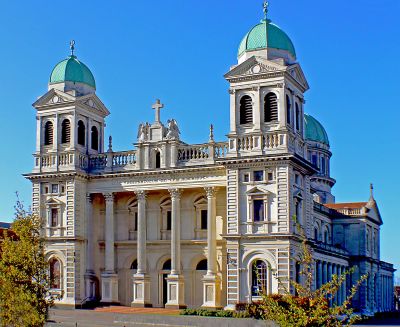 -- but got this instead:
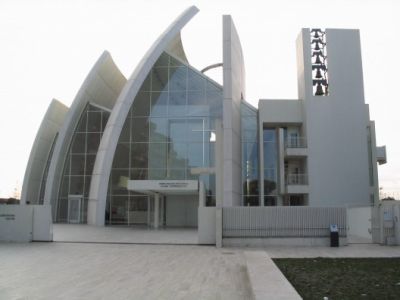
Sincere Catholics speak of the absolute sacredness of Communion,
so you thought that receiving would be more like this:
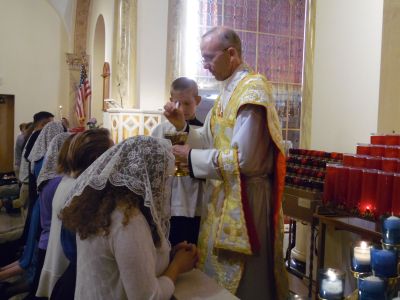
than
like this:
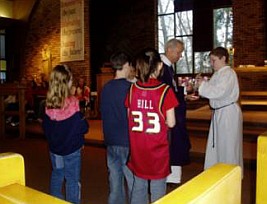
Something
in you is worried. What you are seeing and hearing in your local parish
seems too -- Protestant. Or maybe even pagan or Unitarian. Whatever
it is, it just doesn't add up. All sense of Mystery, of holiness, of
ancientness, of beauty is missing. At the very least, it's just not
"Catholic enough." It isn't reverent. It isn't holy.
What is going on? How can you know if what you're being taught
is truly Catholic if the "spirit" of your parish isn't Catholic? What
has happened to the human element of the Church?
What Happened
Ever
since the time of the so-called "Enlightenment" and up to the
mid-twentieth century, Popes warned us with increasingly greater fervor
about the enemies of the Church. From Pope Gregory XVI's Mirari
Vos (1832), to Leo XIII's Humanum
Genus (1884), to Pope Pius
XI's Divini
Redemptoris (1937), to Pope
Pius XII's Humani
Generis (1950), we have
been warned that the Church has enemies, and that their errors are
spreading. These errors -- whose roots go back to the Mystery of the
"Synagogue of Satan" of the Apocalypse -- began to germinate during the
so-called "Enlightenment" and are summed up by the word "Modernism." 
Called the "synthesis of all heresies" by Pope St. Pius X, Modernism is
summarized in the Catholic Encyclopedia thus:
-
A
spirit of complete emancipation, tending to weaken ecclesiastical
authority; the emancipation of science, which must traverse every field
of investigation without fear of conflict with the Church; the
emancipation of the State, which should never be hampered by religious
authority; the emancipation of the private conscience whose
inspirations must not be overridden by papal definitions or anathemas;
the emancipation of the universal conscience, with which the Church
should be ever in agreement;
-
A
spirit of movement and change, with an inclination to a sweeping form
of evolution such as abhors anything fixed and stationary;
-
A
spirit of reconciliation among all men through the feelings of the
heart. Many and varied also are the modernist dreams of an
understanding between the different Christian religions, nay, even
between religion and a species of atheism, and all on a basis of
agreement that must be superior to mere doctrinal differences.
The
adherents of these ideas gained more and more power over time, fueled
by Masonry and taking on guises as apparently
disparate as Communism and usurious Capitalism (where usurious
--
and not the idea the market determining wages, prices, and production
-- is key). Most importantly, the
Modernist enemies of Christ have even infiltrated into the human
element of the Church itself. Pope St. Pius X warned about this in his
1907 encylical about Modernism, Pascendi
Dominici Gregis:
...the
number of the enemies of the Cross of Christ has in these last days
increased exceedingly, who are striving, by arts, entirely new and full
of subtlety, to destroy the vital energy of the Church, and, if they
can, to overthrow utterly Christ's kingdom itself. Wherefore We may no
longer be silent, lest We should seem to fail in Our most sacred duty,
and lest the kindness that, in the hope of wiser counsels, We have
hitherto shown them, should be attributed to forgetfulness of Our
office.
That We make no delay in this matter is rendered necessary especially
by the fact that the partisans of error are to be sought not only among
the Church's open enemies; they lie hid, a thing to be deeply deplored
and feared, in her very bosom and heart, and are the more mischievous,
the less conspicuously they appear. We allude, Venerable Brethren, to
many who belong to the Catholic laity, nay, and this is far more
lamentable, to the ranks of the priesthood itself, who, feigning a love
for the Church, lacking the firm protection of philosophy and theology,
nay more, thoroughly imbued with the poisonous doctrines taught by the
enemies of the Church, and lost to all sense of modesty, vaunt
themselves as reformers of the Church; and, forming more
boldly into line of attack, assail all that is most sacred in the work
of Christ, not sparing even the person of the Divine Redeemer, whom,
with sacrilegious daring, they reduce to a simple, mere man...
...We have said, they put their designs for her ruin into
operation not from without but from within; hence, the danger is
present almost in the very veins and heart of the Church,
whose injury is the more certain, the more intimate is their knowledge
of her. Moreover they lay the axe not to the branches and shoots, but
to the very root, that is, to the faith and its deepest fires. And
having struck at this root of immortality, they proceed to disseminate
poison through the whole tree, so that there is no part of Catholic
truth from which they hold their hand, none that they do not strive to
corrupt.
There
has been an influx into the Church of those who have, with or without
malice, imbibed the spirit of "the Enlightenment," and there's been a
full-scale, deliberate infiltration by outright
malicious political enemies and religious heretics who share the goals
and tactics of those who hold to "Enlightenment" ideals. Manning
Johnson, a former official of the Communist Party in America, testified
before the House Un-American Activities Committee in 1953:
Once
the tactic of infiltration of religious organizations was set by the
Kremlin... the Communists discovered that the destruction of religion
could proceed much faster through the infiltration of the Church by
Communists operating within the Church itself. The Communist leadership
in the United States realized that the infiltration tactic in this
country would have to adapt itself to American conditions and the
religious makeup peculiar to this country. In the earliest stages it
was determined that with only small forces available to them, it would
be necessary to concentrate Communist agents in the seminaries. The
practical conclusion drawn by the Red leaders was that these
institutions would make it possible for a small Communist minority to
influence the ideology of future clergymen in the paths conducive to
Communist purposes... The policy of infiltrating seminaries was
successful beyond even our communist expectations.
A
Catholic monk who heard ex-Communist Bella Dodd speak at Fordham
University in the 1950s had this to say:
I
listened to that woman for four hours and she had my hair standing on
end. Everything she said has been fulfilled to the letter. You would
think she was the world's greatest prophet, but she was no prophet. She
was merely exposing the step-by-step battle plan of Communist
subversion of the Catholic Church. She explained that of all the
world's religions, the Catholic Church was the only one feared by the
Communists, for it was its only effective opponent.
The whole idea was to destroy, not the institution of the Church, but
rather the Faith of the people, and even use the institution of the
Church, if possible, to destroy the Faith through the promotion of a
pseudo-religion: something that resembled Catholicism but was not the
real thing.
Once the Faith was destroyed, she explained that there would be a guilt
complex introduced into the Church…. to label the ‘Church of the past’
as being oppressive, authoritarian, full of prejudices, arrogant in
claiming to be the sole possessor of truth, and responsible for the
divisions of religious bodies throughout the centuries. This would be
necessary in order to shame Church leaders into an ‘openness to the
world,’ and to a more flexible attitude toward all religions and
philosophies. The Communists would then exploit this openness in order
to undermine the Church.
In
the human element of our Church, we are seeing the results of this
infiltration coupled with the effects of the pressures of secular
materialism and sheer hedonism in the popular culture.
The Revolution: "The Spirit of Vatican II"
In
1870, the First Vatican Council ("Vatican I") was interrupted when
Masonic revolutionaries invaded Rome and forced the unification and
centralization of Italy. There followed in the next decades the Mexican
Revolution, the warnings of Our Lady
of Fatima about Russia spreading
its errors throughout the world, the Russian Revolution, World Wars I
and II, the end of European monarchies, the Spanish Civil War, and
other tumultuous upheavals that shook the social order and proved that
the enemies of Christ were quite busy and very powerful.
Popes Pius XI and Pius XII considered convening a second Vatican
Council in order to address these issues -- especially Communism -- but
both shied away from it, knowing that the enemies Pope Pius X had
warned about could "hijack" their efforts. Cardinal Billot warned Pius
XI that such a Council could be "maneuvered by the Church's worst
enemies, the Modernists" who were already preparing a revolution in the
Church, "a new 1789." 1
In 1959, however, less than three months after his rise to the papacy
as the successor of Pope Pius XII, Pope John XXIII -- "the Good Pope,"
as the media dubbed him -- told the world that he wanted to convene an
Ecumenical Council. Unlike all other such Councils which were convened
to combat heresy or to clarify dogma, this Council was called because
Pope John XXIII wanted "to throw open the windows of the Church so that
we can see out and the people can see in." The Council he convened,
called the Second Vatican Council or "Vatican II," was opened by him on
11 October 1962 and in his opening
address to this Council,
he scoffed at the "prophets of gloom and doom" who were mindful of the
Church's enemies -- but, blessedly, set the tone for the Council with
these words:
The
salient point of this Council is not, therefore, a
discussion of one article or another of the fundamental doctrine of the
Church which has repeatedly been taught by the Fathers and by ancient
and modern theologians, and which is presumed to be well known and
familiar to all.
For this a Council was not necessary. But from the renewed, serene, and
tranquil adherence to all the teaching of the Church in its entirety
and preciseness, as it still shines forth in the Acts of the Council of
Trent and First Vatican Council, the Christian, Catholic, and apostolic
spirit of the whole world expects a step forward toward a doctrinal
penetration and a formation of consciousness in faithful and perfect
conformity to the authentic doctrine, which, however, should be studied
and expounded through the methods of research and through the literary
forms of modern thought. The substance of the ancient doctrine of the
deposit of faith is one thing, and the way in which it is presented is
another. And it is the latter that must be taken into great
consideration with patience if necessary, everything being measured in
the forms and proportions of a magisterium which is predominantly pastoral
in character.
In
other words, this Council wasn't about dogma and doctrine themselves;
it was pastoral in nature -- i.e., it was about how
dogma and doctrine were to be presented and handed down.
For
an entire two years before the Council, preparations were made;
commissions worked diligently to produce seventy-two outlines and
orders of business called "schemata" -- but in the very first general
session of Vatican II, those schemata were thrown out, an act that
served as a clear signal that those who worried about the Council being
"hijacked" were right.
By the time the Council was formally closed by Pope Paul VI on 8
December 1965, the following sixteen documents had been produced (links
go to the documents at the Vatican website and will open in new browser
windows):
These documents -- which all Catholics should read
for themselves -- are very ambiguously written, i.e., one can, albeit
with some difficulty in areas, read them with Catholic
eyes and claim they support the Holy Faith -- or one can read them
with the eyes of a Modernist and claim they support revolution. It is a
matter of debate among traditional Catholics as to whether any teach --
or even can teach -- outright error. Some
traditionalists work very hard to read them as perfectly Catholic,
seeing the ambiguities as simply that: ambiguities which must be read
in the light of Tradition. Others believe that positive error is
contained in them. All agree, though, that no solemn definitions that a
Catholic must accept de fide (as an article of the
Faith) were promulgated. That this is true is supported by papal
statements regarding the Council's intent (such as the opening address
linked to above) and in the fact that none of the documents are marked
by the language used in infallible
definitions.
No matter the case as to the exact nature of the documents in
themselves and how they may have been intended to
have been read, it is a fact that the ambiguities have been exploited
in a revolutionary way. This revolutionary attitude -- often called
"the
spirit of Vatican II" -- has swept
through the human element of the Church, leaving destruction and
confusion in its wake. How often are Catholics told that "since Vatican
II, the Church no longer teaches/practices/believes" various aspects of
Catholic doctrine? How often are we told this even by priests?
The media aid the revolution by constantly reporting on Church affairs
in a self-serving and/or simply ignorant way. If the New York Times reports
that "'the Catholic Church' says X," then in the average layman's mind
"the Church" most definitely now teaches "X," even if there are no
official documents even remotely attempting to exercise any level of
the Ordinary or Extraordinary Magisterium in regard to the proposition
in question. If a Cardinal expresses his personal opinion Y, we are
told that "the Church" or "the Vatican" now teaches Y. And people
believe it. At work here are the same tactics that have, in a mere
forty years, transformed Western culture from one that, for example,
saw extramarital sex as a grave sin to one that looks at it all now
with a wink and a nod. 2
It is simply the power of
the media and of popular culture, allowed to spread their errors with
little resistance from undisciplined Bishops.
The Basics of the Errors
Know
this: true Catholic teaching has not changed -- cannot
change -- in any manner indicative of contradiction. It doesn't matter
if 99 out of 100 priests say X, or if every other theologian who calls
himself "Catholic" teaches X; if X is not truly consistent
with Scripture and Tradition, then X is not an infallible Catholic
teaching. It is as simple as that. Doctrine may be
expounded on and explained more fully, and a doctrine that has always
been believed may be clarified and raised to the level of dogma, but what
was true 50 years ago is still true today, and anything that
is not consistent with that Truth cannot be
true. This is logic 101, the principle of non-contradiction in action.
There is no mystery to it. In order to be a good Catholic, you simply
must come to learn what the Church has always taught. And in order to
fully benefit (in the subjective order) from the Church's liturgy, you
must to do all you can to worship the way the Church has always
worshiped.
So then, how to know what was taught 50 years ago before things got
crazy? Easy: read catechisms 3 and
papal encyclicals
published before the Second Vatican Council along with
those published after that Council. But let me give you a quick rundown
of the ten basic errors you will hear in these times:
- Error 1: Bad
Ecclesiology: A
new ecclesiology that doesn't equate the Catholic
Church with the Church established by Jesus Christ, but states that the
Church established by Jesus Christ is merely partly contained in the
Catholic Church in a vague, undefined way -- a confusion arising over
controversies in understanding the true and intended meaning of the
word "subsistet" in Vatican II's "Lumen Gentium." The meaning of
"subsistet" is debated in traditionalist circles, with some seeing the
word as perfectly acceptable if understood correctly, and with others
seeing contradiction in its use.
The Truth: To do less than
equate the Catholic Church with Christ's Mystical Body contradicts Pope
Pius XII's '"Mystici
Corporis Christi'' among other papal documents, and leads to false
ideas of ecumenism (traditionally, relations between the Catholic
and Orthodox Churches, but generally understood as relations of all
Christian sects) and interreligious dialogue (relations between true
Churches/Christians and other religions). Ecumenism and interreligious
dialogue, in themselves, are fine as long as conversion is the
goal, Truth is not watered-down,
etc.
- Error 2:
False Collegiality: An acceptance -- deriving from modernist
interpretations of "Lumen Gentium" -- of collegiality, the idea that
there exists a "college of Bishops" at all times (rather than just
during Ecumenical Councils) which has authority and jurisdiction over
the Church. This idea has weakened the papacy, attempted to democratize
the Church by destroying the monarchial relationship between the Pope
and his Bishops, and has made bishops' conferences a veritable "second
Vicar of Christ" for the Church. This contradicts, among other
documents, Pope Leo XIII's ''Satis
Cognitum'' and even the "Nota
Praevia'' to ''Lumen Gentium.''
The Truth: Catholic teaching
is that the Keys were given to Peter (Matthew 16), that he and his
successors are the Vicars of Christ who are blessed with the charism of
infallibility which is exercised in very specific ways, and who have
full and supreme authority over the Church apart from any other human
being. Bishops derive their authority from him, who receives it from
Christ. They have no authority apart from him and do not constitute an
alternate or equal authority -- neither individually, nor collectively.
- Error 3:
False View of the Papacy: A deflated view of the papacy and
Magisterium on the
part of "progressives," and an inflated view of the papacy and the
Magisterium on the part of conservative Catholics who misunderstand papal infallibility and the different
levels of the Magisterium.
The Truth: The Pope exercises
his infallibility under very specific conditions. The Magisterium --
the teaching authority of the Church -- has three levels, not two, and
only two of those levels are infallible. That which falls outside the
Extraordinary Magisterium or the Ordinary and Universal Magisterium is
fallible. It is most certainly owed religious assent, but not if it
leads to sin, to error, harm of souls, etc.
- Error 4:
Eradication of the Supernatural: an overly strong focus on the
dignity of man coupled
with an over-emphasis on the natural virtues (as
opposed to the supernatural virtues of Faith, Hope, and Charity which
come from God alone rather than nature). This ignores original sin and
the need for supernatural grace, leading to a sort of Utopianism that
sees peace as possible without recognizing the Kingship of Christ, and
seemingly gives the Church a new mission: peace on earth rather than
the salvation of souls.
There is a softness on sin, especially sexual sins and offenses against
the dignity of marriage. This attitude, and teachings rooted in it,
contradict Pope Pius X's "Quas Primas'',
Pope Leo
XIII's "Testem
Benevolentiae Nostrae,'' ''Rerum
Novarum,'' Pope Pius X's ''Notre
charge apostolique,'' and other papal and conciliar documents
that deal with social teaching.
The Truth: There is no peace
without the Prince of Peace. Man has lost his likeness to God
through original sin, and this likeness can only be restored through
supernatural grace. Without this likeness, there will be strife among
peoples and nations, and no amount of "Can't we all just get along?"
thinking can overcome it. The purpose of the Church and all Her laws is
the salvation of souls. Peace on earth is a fruit
of man's regaining his likeness to God through the Sacraments and
faith, but not the Church's primary goal.
- Error 5:
False Idea of Religious Liberty: An embracing of false
ideas of
religious liberty and the radical separation of
Church and State (as opposed to recognizing them as two distinct
spheres, the secular being informed by -- but not controlled by -- the
religious). This contradicts the oldest teaching of the Church, Leo
XIII's "Testem
Benevolentiae Nostra," etc.
The
Truth: While it is often (perhaps more often than not)
prudent and beneficial to the common good to tolerate error, while no
one may ever be forced to believe against his
conscience, and while those in error must be treated with charity and
simple kindness, error has no positive "rights" in
itself. A State whose laws are not based on natural law,
whose laws don't have the Christian understanding of the True, Good,
and Beautiful at their center to define the "good" in "common
good,"
and whose laws don't have the good of
the family at their heart is bound to lead to
trouble with great eternal and temporal consequences.
Someone's
ideas of morality -- of the True, Good, and Beautiful, of what should
be allowed and disallowed -- will prevail. If one stops to think
about it, it is quite obvious
that there are only a few options in this regard:
- We
can have no rule of law at all.
- We can have a
rule of law based on Catholic morality -- rooted in natural law and the
Catholic view of the Common Good, and marked by common sense tolerance
-- and have our civic holidays and symbolism based on that belief
system.
- We
can have a rule of law based on Jewish, Muslim, Hindu, Buddhist,
Wiccan, or other non-Catholic views of morality, and have our civic
holidays and symbolism based on that belief system.
- We
can have a rule of law based on secular precepts of radical
individualism and tolerance for the sake of tolerance,
the effects of which:
 deny
any role of religion or of the religious in the
public sphere unless they deny their own precepts. This forces the
religious into "schizophrenic"
lives split in half between their "religious, private selves" and their
"public, political selves"; deny
any role of religion or of the religious in the
public sphere unless they deny their own precepts. This forces the
religious into "schizophrenic"
lives split in half between their "religious, private selves" and their
"public, political selves";
end
in abortion, "homosexual marriage," euthanasia, divorce, rampant
pornography, un-Catholic economic systems, the genital mutilation of
children, attacks on the family via
social programs (or, in a libertarian system of this sort, result in no
support via acknowledgment of the rights of fathers), etc. One need not
be religious to see the social effects of such policies;
secularize
historically Christian holidays and symbolism in order to
appease all religions, either denying those things any civic status at
all, or forcing recognition of these aspects of all religious systems
equally, giving equal weight in law, for ex., to Satanism, Scientology,
and Wicca;
sacrifice:
man's needs for culture (rooted in the word "cult"); a society's need
of a shared vision of the Good, True, and Beautiful; and a sense of
historical continuity and rootedness, all in favor of ideologies which
have shown themselves to be divisive and socially and psychologically
unsatisfying.
result in "the
paradox of tolerance" which Karl Popper wrote about, whereby unlimited
tolerance results in the intolerant seizing power. Tolerance itself cannot be the highest value.
That's
it. Those are the options. Which builds community, a sense of place, of
belonging and rootedness? Which system is more likely to be coherent
and lead to happiness? Which supports strong families and a sane social
order? Which is consistent with Catholic teaching? Which is most likely
to lead to the salvation of
souls? And why do so many think that the secular-minded have more of a
"right" than Christians do to determine the moral thinking that
undergirds law?
- Error 6:
False Ecumenism: The spread of a false ecumenism
(movement toward unity between Christians) and incessant, fruitless
interreligious dialogue (dialogue between Christians and
non-Christians) that have as their goal a religious unity that doesn't
require conversion to the Catholic faith; that have served to water
down
the Catholic Faith in order to appease non-Catholics; and that have led
to scandalous "interfaith" prayer and worship services that are based
on sentiment and feelings
rather than true charity which is rooted in Truth. This contradicts
Sacred Scripture, Pope Pius X's "Our
Apostolic Mandate" ("Notre Charge Apostolique"), Pope Pius
XI's ''Mortalium Animos,''
Pope Pius XII's ''Humani
Generis'' and other documents.
In this regard, among the most striking of the errors is the
presentation of Catholic teaching about the
post-Temple Jewish religion, which, being based on the Talmud and
Pharisaic rabbinism rather than the Old Testament and the priesthood,
is a radically different
religion than the Old Testament religion practiced by most of the
Apostles before their meeting Christ and embracing the New Covenant,
which is the fulfilling of
the Old Covenant. The ideas that the Jewish people are in a saving
covenant all their own and that they don't need Jesus, ignoring that
post-Temple
Judaism is antagonistic to Jesus and His Church,
and the kowtowing to Jewish leaders' demands that we change our
liturgy
and prayers, not canonize this person or that, etc., are all new ideas and behaviors not based
in Truth.
Post-conciliar papal kowtowing to false religions has even led to at
least apparent idolatry, with Pope Francis placing actual idols of the
goddess
"Pachamama" inside Catholic churches, blessing them, and bowing down to
them. This seeming apostasy doesn't make Catholic teaching less true,
or the Church less Christ's Church; this sort
of abomination was foretold.
The Truth: While understanding
between the practitioners of various religions is quite good,
while
it is a wonderful thing -- a Christ-commanded thing! -- to have warm,
charitable relations with non-Catholics, and while we are commanded to
love our neighbor, even if that neighbor is an enemy, it is a dogma
of the Faith that "outside the Church there is no salvation" ("extra
ecclesiam nulla salus"). To gain a proper understanding of this very
subtle and very often misunderstood (even by
traditionalists) teaching, see the relevant
paragraphs on the page "Catholicism 101: A Brief Primer."
- Error 7:
False View of Tradition: A new view of ecclesiastical tradition
that sees it
as extremely changeable and has led to dangerous modifications in
Catholic practices, liturgy, and disciplines, and to an embracing of
novelty which had been unheard of it the Church before the Second
Vatican Council. This contradicts, among other papal and conciliar
documents, Pope Pius X's Motu Proprio ''Sacrorum
antistitum'' (an oath taken by all priests prior to the
Council), Pope Gregory XVI's ''Mirari
Vos'', the Fourth Anathema of the Second Ecumenical Council
of Nicaea, the teaching of the First Vatican Council, especially the
document ''Pastor Aeternus"
and the ''Fourth Anathema of the Second Ecumenical Council of Nicaea''
which reads, "If anyone rejects any written or unwritten Tradition of
the Church, let him be anathema."
The Truth: Ecclesiastical
traditions can change over time, but they must do so only organically
-- and never if the changes harm souls, lead to
sin, damage the understanding of the Faith, etc. One of the three
Pillars of the Church is Tradition; it must be guarded, whether those
traditions are written or unwritten.
- Error 8:
Critical View of Sacred Scripture: a new and critical attitude
towards Sacred Scripture
that contradicts Leo XIII's ''Providentissimus
Deus'' and Benedict XV's ''Spiritus
Paraclitus''
among other documents.
The Truth: Sacred Scripture is
inerrant, divinely inspired, and historically and scientifically
accurate even though some parts of it are to be read poetically or
metaphorically. Proper interpretation of Sacred Scripture can be known
by reading the Fathers and Doctors of the Church, and by reading
infallible definitions from Popes, and Councils convened by Popes.
- Error 9:
Appeasing the World: An ignoring of the fact that the Church and
the world
are at variance with one another to some degree, and that the Church has enemies.
This ignores Sacred Scripture, Pope Pius X's warnings in ''Pascendi Dominici Gregis,''
Leo XIII's ''Humanum Genus'',
and many other papal warnings against secret societies and enemies of
Christendom. The most obvious and dangerous way in which our hierarchs
are betraying the Catholic Faith is in a new attitude toward
post-Temple Judaism, a
religion that is not the religion of the Old Testament, but is
Pharisaic rabbinism based on the
explicitly anti-Christ Talmud rather than on Torah. Post-Temple
Judaism is almost a complete inversion of the religion of the Old
Testament. Post-conciliar hierarchs have been giving in to false
religions and the secular world in an attempt to appease them.
The Truth: The Church has
always had enemies and will always have enemies until the end of time.
Toward the end of time,
Antichrist will come and lead these enemies to persecute the Church as
She follows Christ in His Passion and Resurrection. We will not be
spared by some "Rapture," and the State of Israel isn't to be veritably
worshipped as the heresy of
dispensationalism would have it.
- Error 10:
Paschal Theology: A new "Paschal theology" which de-emphasizes the
Sacrificial aspects of our salvation and which leads the faithful to
believe that it is Christ's Resurrection alone, and not the Blood shed
by His Sacrifice on the Cross, that saves. The revision of the Mass
liturgy under Pope Paul VI is a fruit of this "paschal theology," a
theology that contradicts Scripture and Encyclicals such as Pope Pius
XII's "Mediator Dei''.
This paschal theology also de-emphasizes the
meaning of suffering, ignoring Christ's admonition to
Christians to "take up their crosses" (Matthew 10:38), and forgetting
St. Paul's admonitions to mortify the flesh (Galatians 5:18-25,
Colossians 1:23-24).
The Truth: 1 Corinthians 1:23
"We preach Christ crucified, unto the Jews indeed a stumblingblock, and
unto the Gentiles foolishness." We get to the Resurrection through the
Cross; we have to pick up our own crosses and follow Him.
In
addition to these errors, post-conciliar changes in liturgical rites
and religious disciplines have gravely damaged
the faithful's understanding of the holy
religion. Foremost among these changes is the new Order of the Mass
(the Novus Ordo Missae) that is rooted in the
aforementioned Paschal Theology and which, therefore, de-emphasizes
traditional Catholic teaching that the Mass is a Sacrifice (the
offering up of Jesus to to assuage the Father's wrath at our evil ways,
in a re-presentation of Calvary and for the remission of sins).
The Novus Ordo Missae (the Mass published after Vatican II) has been
stripped of important Catholic prayers; is open to abuse because of the
various options allowed; de-emphasizes the ordained priesthood; is
divisive because of the eradiction of Latin
which brought people of
various nations together; is objectively and subjectively more
man-centered; includes
an order of readings that is less theologically profund, beautiful,
poetic, and able to act as
a
sign of the Mystery taking place at Mass, etc. The new order of Mass
readings even omits
controversial things, such as Hell, Pharisaism,
miracles, etc. (see this pdf: "Gutting
the Gospels"). Some of these
problems are summarized in the ''Ottaviani
Intervention''
and on the "Introduction to
the Traditional Mass" page in the "Being
Catholic" section
of this site. Consider what goes on liturgically in a typical parish,
and then contrast it with the traditional
Order of the Mass. Also in the "Being Catholic" section of
this site, you can contrast the sacramental rites you see in your
parish with the traditional rites of Baptism,
Penance (Confession or
"Reconciliation"), Eucharist, Confirmation, Holy
Orders, Matrimony,
and Unction ("Annointing
of the Sick").
In the area of discipline come changes that have served to lead people
to believe that Catholicism is a religion that doesn't reflect the deep
meaning of the Incarnation. The signs, symbols, and external rites that
had always served to discipline the body, inspire holy thoughts, and
feed the imagination have been stripped away. Church buildings have
been emptied of their statues and
other icons. Religious habits and cassocks which once
inspired respect and holy thoughts are rare. Fasting and Friday abstinence from eating meat,
though still the universal law of the Church, are ignored as Bishops'
conferences have their way with them, R.C.I.A. classes don't teach
them,
and lay Catholics simply ignore them. The customs
of the liturgical year and the ways and rhythms of the Catholic home are
disappearing -- rather, they were disappearing, but are being restored
now by traditionalists. All of these things once had the effect of
binding
Catholics together as a single people -- a catholic
(universal) people -- by giving them, as Latin did (and still does for
traditionalists), a common cultural "language."
Priestly formation radically changed after Vatican II, with the result
that homosexual activists have situated themselves in the seats of
Cardinals and Bishops. Entire seminaries have become what Catholics
refer to as "lavender mafias" -- fonts of heresy and clerical sexual abuse, an abuse that is
too often presented as "pedophilia" when, in fact, 81% of the victims
are male, and 90% are between the ages of 13 and 19. The victims aren't
children; they're physically sexually mature teenaged boys and young
men. The Church doesn't have a pedophile problem; She has a homosexual hebephelia and ephebophilia
problem.
And then there's Pope Francis. See these off-site articles-- and know
that I could have listed many, many, many
more:
The Traditional Catholic "Movement"
A
"traditional Catholic" (or "traditionalist Catholic") is a Catholic who
recognizes the above errors in the presentation of Catholic teaching,
who sees unwise pastoral decisions for what they are, who does all
in his power to preserve the Holy Faith in a manner
consistent with how it has always been understood, and who strives
to
preserve all of the liturgical rites and customs of
the Church as they were before the "spirit of Vatican II" revolution.
Traditionalists are not some "branch of the Church," or (necessarily)
some "splinter group"; they are usually and quite simply Catholics to
whom the adjective "traditional" applies.
Traditional Catholics fall into three main categories:
- The
first and by far the largest group consists of those Catholics who
accept the acclaimed Pope and his recent predecessors as true Popes,
believe that the Second Vatican Council was a valid, albeit
problematic, Council, and accept the new rite of the Mass as valid but
inferior. In this group are included:
- those
who attend parishes where Masses are offered in accordance with Pope
Benedict XVI's Motu Proprio "Summorum
Pontificum", often celebrated by priests of the
Fraternal Society of St Peter (F.S.S.P.) or the Institute of Christ the
King (I.C.K), and
- those
who attend chapels or oratories where Masses are offered by priests of
the Priestly Society of St. Pius X (S.S.P.X.) 4 outside
of ordinary diocesan structures. While the S.S.P.X. operates
outside of ordinary diocesan structures, they are not in schism.
Vatican officials consider dealings with the S.S.P.X. to be an
"internal matter." Further, it's been ruled that it is licit to attend
their Masses and offer financial support for their chapels.
- The
second group consists of those who are unsure about the status of the
acclaimed Pope. Many such Catholics worship at Masses offered by the
Society of Saint Pius V (S.S.P.V.).
- The
third group consists of "sedevacantist" Catholics, that is Catholics
who believe that the Catholic Church has not had a true Pope for some
time (most consider Pope Pius XII as the last true Pope) and who,
depending on the time they see as the moment the "Chair of Peter" (sede)
became empty (vacante), may or may not see Vatican
II as a valid Council. Many sedevacantists attend Masses offered by the
Congregation of Mary Immaculate Queen (C.M.R.I.). 5
Though
there is certain level of dispute among these various groups at the priestly
level, traditional Catholic laypeople amongst them generally tend to
have good relations with each other, though often with some very strong
tension between sedevacantists and those who accept the acclaimed Pope
(you will find that much of the online rancor you see from
traditionalists comes from sedevacantists, who are a minority -- a very
loud
minority -- in the traditionalist world, and who generally have nothing
at all to do with "trads" you'll find at Masses offered by your
diocese. They are most of the reason why I have a page about "Toxic Traddism" on this site).
Depending on how he understands the nature of Christian obedience and
schism, a given traditional
Catholic layman might have firm opinions for or against the
advisability of worshiping outside of diocesan structures, or,
conversely, he might worship at more than one of the above Mass
settings without qualm.
A given traditional Catholic might equally like both the F.S.S.P. and
the S.S.P.X., thinking it good that there are those fighting for
Tradition both inside and outside of ordinary
diocesan structures, while another may think one group superior to the
other or that one group is unacceptable for some reason.
Some traditionalists attend Novus Ordo Masses if no traditional Mass is
available to them, and some
traditionalists refuse, believing it
"morally impossible" to do so because they see the new Mass -- not
necessarily
because of
what it is, inherently, but because of what it
isn't, what it lacks -- as too dangerous to the Faith to support, even
if they may see it as valid. If they have no access to the traditional
Mass, some of these
sorts of traditional Catholics become "home-aloners" making do like
Catholics did
during various persecutions.
What Makes a
Person a "Traditional Catholic"
Despite these varying opinions on the requirements of obedience with
regard to attending the New Mass if that's all that's available, what all
traditional Catholics who fit the label have in common -- whether they
are sedevacantist, whether they worship inside or outside of diocesan
structures -- are:
- the dogmas of
the Faith understood in a manner consistent
with the way Catholics had always understood them -- i.e.,
they reject the errors outlined above -- and an upholding of
traditional Catholic moral theology
- a
desire to preserve and restore all of the ancient sacramental
rites, and to do so not because these are "preferred," but
because they are objectively superior to the new rites and should once
again become normative
- a
deep understanding of or intuition about the importance of preserving
not only instrinsic tradition (the unwritten Deposit of the Faith
handed down by Christ and His Apostles), but also the ecclesiastical
tradition (extrinsic tradition) which has served to preserve intrinsic
tradition and allows parents and priests to pass it down in an
effective way 6
- a
strong sensus Catholicus
(Catholic "sense" or "instinct"), including a
cautious, Catholic approach to novelty
Because of
wretched catechesis 7 and/or liberal
attitudes shaped by the secular world, traditional
Catholics are a minority in the Church, and their demographics are hard
to pin down, but their numbers are growing quickly with Catholics
moving away from modernism, and with conversions from Protestantism and
Orthodoxy. Their parishes, chapels, and seminaries tend to be full.
Traditional Catholics also tend to have large families, with many of
them homeschooling their children.
Where the FishEaters
Website Fits Into All of This
The FishEaters website is owned by me, and I do not speak
Latin, have not read the Vatican II
documents in their original language, and am not a theologian.
Therefore, until I'm shown otherwise by sound arguments, I operate
under the
assumption that the documents -- which are pastoral in nature -- were
merely
badly and ambiguously written, exploited by revolutionaries, and must
be interpreted in light of
Tradition. I am also not knowledgedable enough to have a truly informed
opinion as to whether the documents of Vatican II even could contain positive error. Ergo,
I "accept Vatican II": I believe the Council took place and was
convened by a real Pope. What else could "accepting Vatican II" mean
when the Council documents are interpreted a hundred different ways and
when dubia (questions
formally asked of the Pope or of the Congregation for the Doctrine of
the Faith to get clarification about matters) go unanswered? I also
know the Council was pastoral and that its "spirit" has resulted in
disaster. Going forward, I think the Council documents need to be
clarified, once and for all, in a manner that it consistent with
Tradition, and then forgotten.
I attend Masses
offered by traditionalist priests
inside normal diocesan structures (F.S.S.P.), but think the S.S.P.X. is
a totally viable and 100% Catholic option for those seeking to practice
Catholicism in the traditional -- that is, the right -- way. It is
perfectly licit to receive the sacraments from SSPX priests, to attend
their Masses, and to support their chapels and work in general; the
Vatican considers dealings with them to be "an
internal matter." 8
Footnotes:
1 https://sspx.org/en/collegiality-error-of-vatican-ii
Link
is offsite and will open in a new browser
window.
2 This
is precisely how it came about that Catholic women stopped wearing veils, believe it or
not. During the Second Vatican Council, Archbishop Bugnini -- the
Modernist who fabricated the Novus Ordo Mass -- was asked by
journalists whether women will still have to wear headcoverings. He
told them that the Council wouldn't be addressing that issue. And how
did it come out in the newspapers the next day? The reporters wrote
that Catholic women no longer have to wear veils. And so Catholic women
stopped doing it -- even though it had been the immemorial practice of
the Church and a matter of Canon Law. When the new Code of Canon Law
was written after so many years of women not veiling (and, of course,
after feminism won the day), the discipline simply wasn't mentioned.
These sorts of obfuscations, simple errors, or out and out lies happen all
the time! Of this much I will assure you, Catholic: if you
get your Catholic education from newspapers, you are doomed. You must
learn to be able to recognize what is and is not an infallible
statement, learn to recognize the different levels of the Magisterium,
and then seek out official documents and attribute to them proper
authoritativeness. If you don't, you will be forever confused and
forever wrong about what the Church teaches.
3 See this site's Catholic Library to read the Baltimore Catechisms
4
For information about the
Society of St. Pius X, see their website
(link is offsite and will open in new browser window). To clear up a
few misconceptions about the S.S.P.X.: they see Vatican II as a valid,
pastoral Council; they see the Novus Ordo Mass as valid (but also
Protestantized and to be avoided when possible). The Vatican sees
dealings with the S.S.P.X. as an internal
matter.
5
There are a very, very small number of people who
believe we do have a Pope, but that it is not the man accepted as Pope
by the world. These people are often mistakenly referred to as
"sedevacantists," but should be referred to as "conclavists." There are
also "Sedeprivationists" -- those who adhere to the "Cassiciacum
Thesis" which states that the Popes since John XXIII are Popes
materially but not formally due to heresy.
6
See "Conservative vs. Traditional Catholicism" by Fr. Chad Ripperger,
F.S.S.P. from Latin Mass Magazine: http://www.latinmassmagazine.com/articles/articles_2001_SP_Ripperger.html
Link is offsite and will open in a new browser window.
7
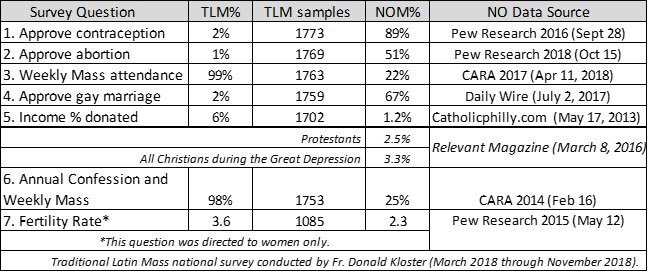
Compare the beliefs and discipline of those who attend the Traditional
Latin Mass (TLM) and those who attend the Novus Ordo Mass (NOM):
|